Twilight is creeping over the jungle, hot and steamy as a sauna. Cicadas screech. Frogs beep-beep. Overhead, macaques cackle in the canopy. Ahead, a lake dissolves into the darkness, its shores fringed by towering trees. Fireflies float in the gloom.
It’s the kind of jungle scene anyone who’s spent time in south-east Asia will recognise, but tonight, for once, I’m not sleeping in a sweaty hammock or camping out in a bug-ridden tent. I’m sitting beside a rooftop infinity pool, dangling my toes into the water, sipping a Singapore sling.
“Would you care for something else, sir?” asks the waiter, as he sets down a dish of spiced nuts and curry puffs. He pads off to serve another customer while I decide, distracted from the cocktail menu by a bat flitting past and the lights of Singapore’s financial district twinkling over the treetops.
Nature is a word few people would probably associate with Singapore. This is, after all, one of the world’s most densely populated countries (trumped only by Macau and Monaco). Yet squeezed in among its skyscrapers, expressways and flyovers are botanical gardens, palm-lined avenues, public parks and waterfront walks, as well as four nature reserves and 20 nature areas. In total, they cover 3,300 hectares — 5 per cent of the island’s landmass, or roughly 23 Hyde Parks.
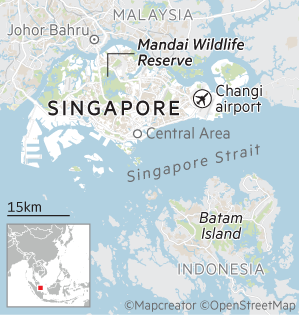
I’ve travelled to Singapore to stay at the new Mandai Rainforest Resort. On the edge of the 126-hectare Mandai Wildlife Reserve, and beside the city’s zoo, it’s a landmark opening for the luxury hotel group Banyan Tree: not just its 100th property, but a home-coming for owners Ho Kwon Ping and Claire Chiang, both native Singaporeans, three decades after they founded the brand in 1994.
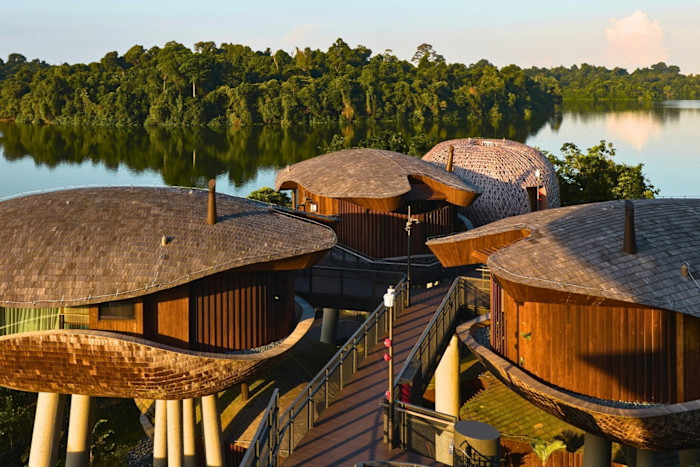
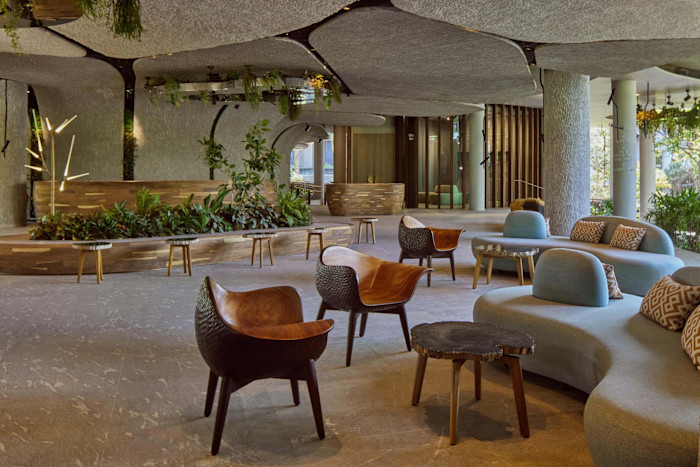
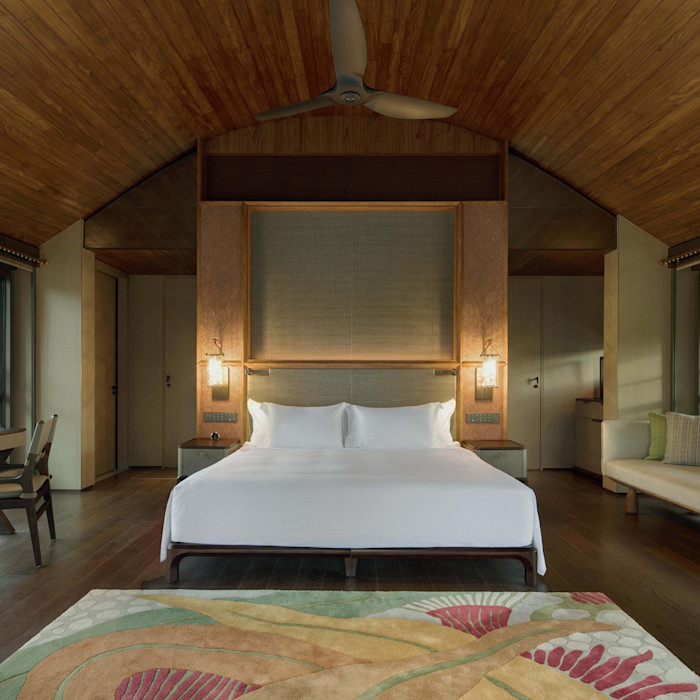
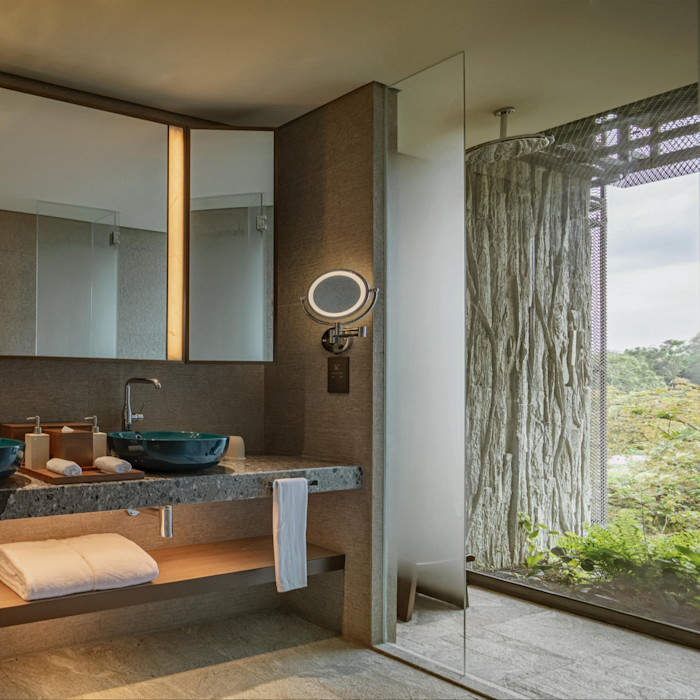
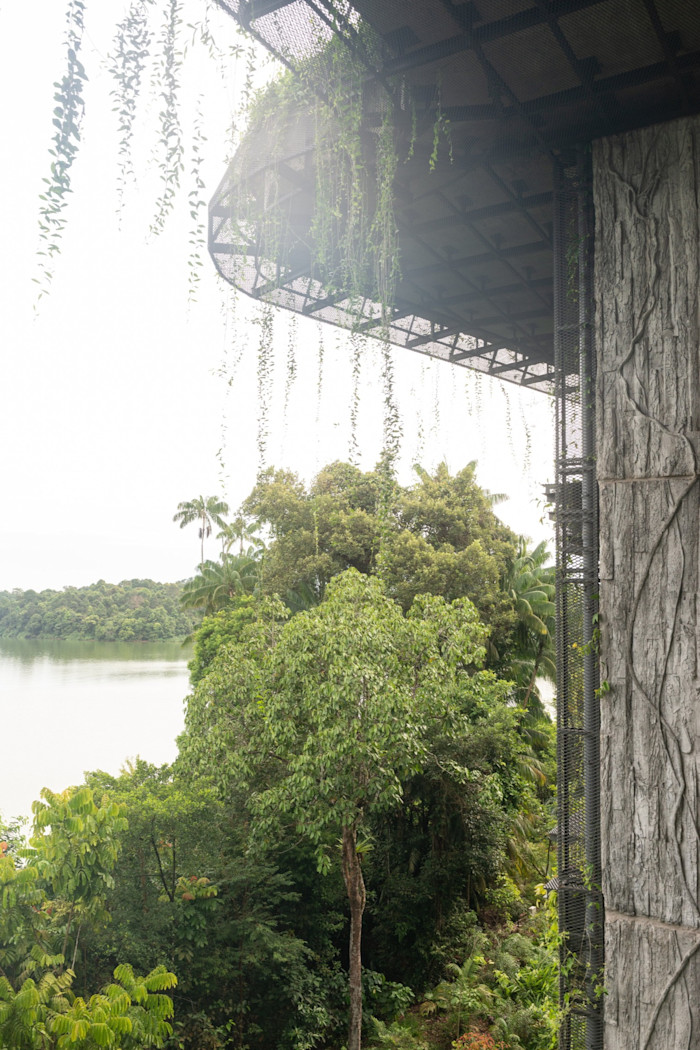
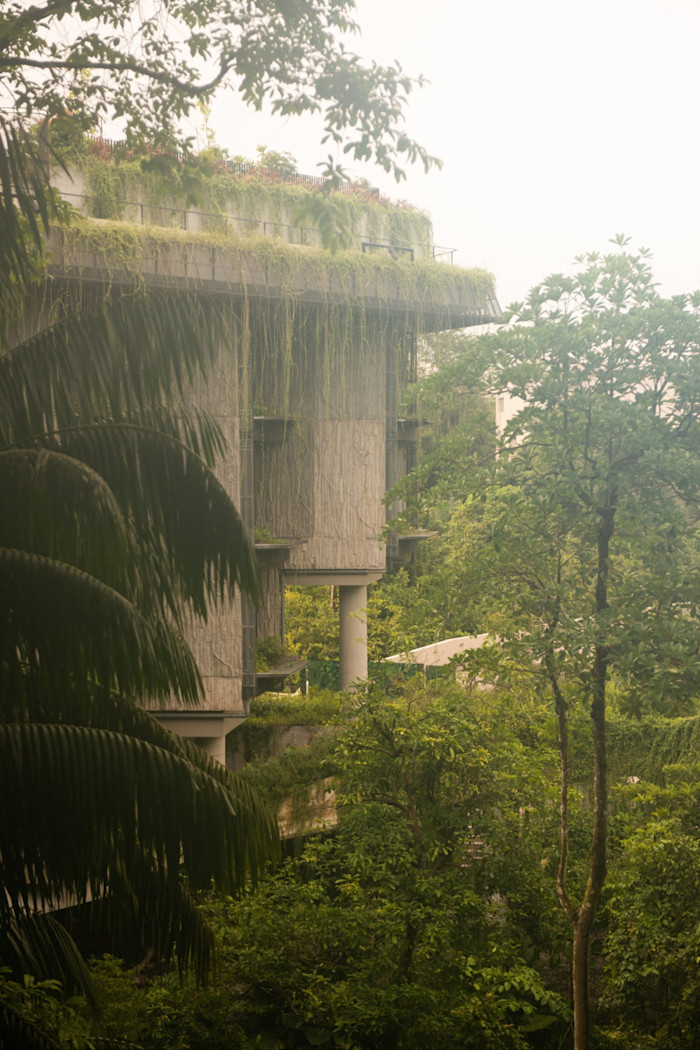
On the surface, the hotel’s concrete-and-glass aesthetic seems an incongruous fit inside a nature reserve. But like Singapore, its stark design conceals a green heart. Bark patterns and leaf motifs are pressed into the concrete. Windows are imprinted with a dot matrix to prevent bird strikes. All 338 rooms have temperature control panels that monitor energy usage, minute by minute. Most striking of all are the curtains of liana vines covering the facade, festooning balconies, screening windows, draping the rooftop.
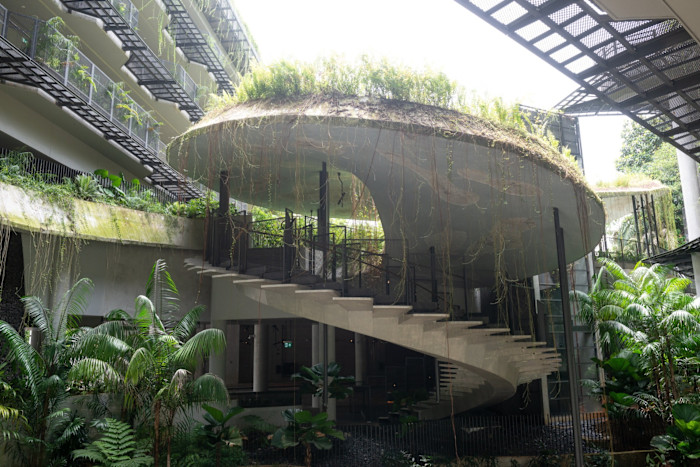
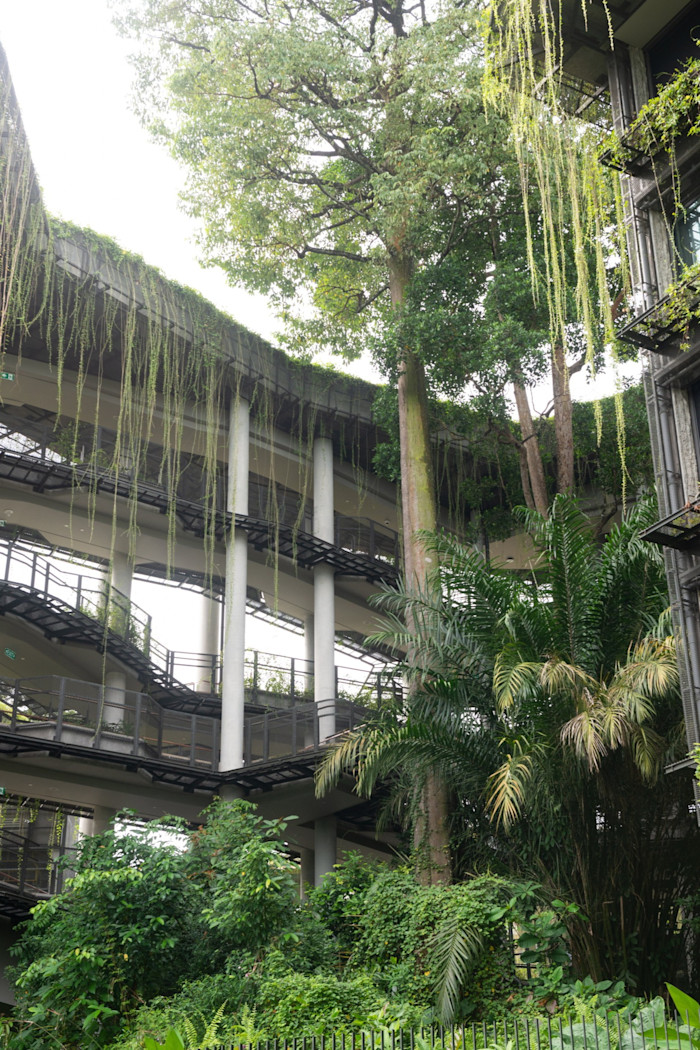
“The architects designed it to fit around the trees that were already here,” explains Yenny Jenny, who runs the resort’s education programmes. “Within a few years, the idea is that the growing lianas will make it become invisible, disappearing back into the forest.”
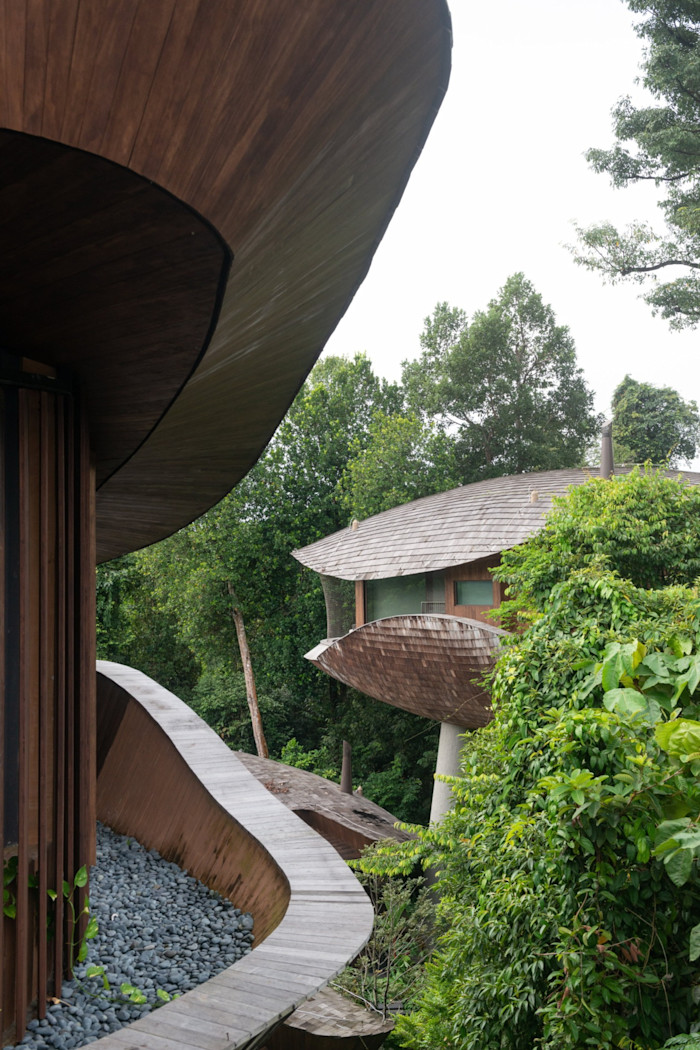
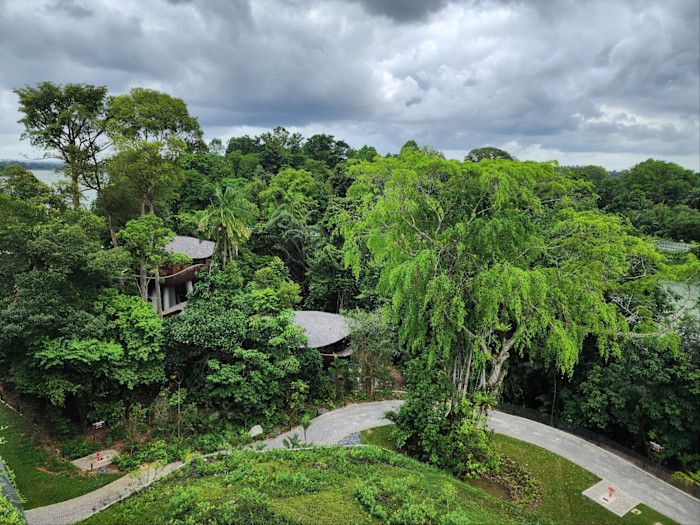
The resort’s most striking features are its capsule-shaped treehouses, which hover on stilts above the canopy, like the Martian invaders in HG Wells’ The War of the Worlds. We step out on to the deck of one of them, looking over the treetops towards the Upper Seletar Reservoir, whose waters surround the resort. Mist plumes from the forest, and a drongo chatters noisily nearby. “It’s inspiring to see how nature returns if you give it a chance,” Jenny says.
To the Dutch settlers who arrived here in the early 17th century Singapore must have seemed like a pocket of paradise. Thickets of mangroves tangled the coastline; inland, the island was cloaked by virgin rainforest. But by the end of the 19th century — particularly after the island became a British trading post in 1819 under Stamford Raffles — its trees had been decimated. Ecologists estimate 99 per cent of Singapore’s forest has vanished over the past 200 years, along with 40 per cent of its biodiversity.
Fragments of this lost forest still survive, however. The largest is Bukit Timah Nature Reserve, established in 1883 by Nathaniel Cantley, a botanist trained at London’s Kew Gardens and later superintendent of Singapore’s Botanic Gardens. Horrified at the destruction of the native trees, Cantley spearheaded the establishment of forest reserves across the island.
Exploring the reserve today inspires mixed emotions: gratitude for its preservation, and sorrow for what’s been lost. From the Banyan Tree, I catch a taxi for the 15-minute drive down the Bukit Timah Expressway, one of Singapore’s busiest highways, then start out on a morning hike into the forest, swapping blaring car horns for birdsong. Trees rise along the path like temple pillars, their crowns obscured by haze, buttress roots snaking on to the path.
These are the giants of the dipterocarp forest: terap, keranji, meranti, seraya. Individually, they are centuries old but their lineage stretches back far further; the dipterocarps’ ancestors once girdled the supercontinent of Gondwana, explaining why members of the family exist in landmasses now divided by oceans.
I hike up to the top of the reserve. At 164 metres above sea level, this is Singapore’s highest point, now topped by a blinking radio tower. At the summit, I get a glimpse of how tiny Bukit Timah is — a green postage stamp of 1.7 sq km dwarfed by the sprawling cityscape — and try to imagine how the island must have looked when these mighty trees covered it as far as the eye could see.
While most of the island’s primary forest has been lost, areas of secondary forest have survived and, in some cases, expanded over the past few decades. The Central Water Catchment is a green swath at the heart of the city and encompasses several forest reserves, including Mandai Wildlife Reserve, the Windsor, Thomson and Chestnut Nature Parks, and four of Singapore’s reservoirs.
In recent years, the city has made a concerted effort to link these areas with “park connectors” — corridors for wildlife. From Bukit Timah, I hike one of these green highways eastward for 8km. For most of it, I rarely step out of the forest. Occasionally, the trail pops out alongside a busy freeway, thronged with midday traffic, then dips back into jungle, where the only sounds are running streams and screeching crickets.
Along the way, I clamber to the top of the Jelutong Tower, a steel-framed observation point, to take in another incongruous city panorama: a carpet of forest, framed by hazy skyscrapers along the horizon. Further east, I cross the TreeTop Walk, a 250m-long steel suspension bridge spanning the canopy. Halfway across, I meet a family of long-tailed macaques, chilling out on the cables as they snack on their foraged fruit lunch.
“As a city, especially since Covid, I think we’ve realised how important our wild spaces are to us,” says Jack Yam, a wildlife enthusiast and climbing instructor who runs guided nature walks around the city. “Singapore has changed so much over the last couple of centuries, but we’re doing our best to restore what’s been lost.”
He tells me about his most recent encounters: dodging king cobras and wild pigs on the island of Pulau Ubin (just north of Changi airport), and a sighting of an elusive mouse deer in broad daylight in Thomson Nature Park. “I’m not sure those are experiences people expect when they come to Singapore,” he says with a laugh.
As with all cities, Singapore has a tough balance to strike in the years ahead. Demand for land is insatiable and environmental challenges — water usage, pollution, climate change — loom on the horizon. But there are reasons to be hopeful, not least the success of the city’s species recovery programmes, which focus on restoring endemic animals, including the straw-headed bulbul, the freshwater crab, the cinnamon bush frog and the critically endangered Raffles’ banded langur. After years of precipitous decline, one by one, they seem to be returning.
Before I leave Singapore, I follow a tip from Jack and head out to Sungei Buloh Wetland Reserve, one of the city’s last areas of native mangrove forest. For millennia, mangroves were one of the island’s keystone ecosystems, supporting myriad plants, insects, animals and birdlife, but they have all but vanished over the past 200 years.
Sungei Buloh covers 202 hectares along the Johor Strait, the channel that divides Singapore from Malaysia. A boardwalk runs along its banks, past bird hides and observation towers, and I follow it as a fuzzy pink sun is rising over the Johor Strait. Monitor lizards laze along the shoreline. A purple heron struts through the mudflats. An Asian kingfisher flashes past in a blur of blue. And as I sit down with my breakfast box, I realise I’m not alone. Two reptilian eyes are spying me from the shallows: an estuarine crocodile, no doubt pondering his own morning meal.
As I munch on my roti prata, watching Pacific swallows and ashy tailbirds flit through the mangroves, I find it hard to believe that on the other side of the island, the rest of Singapore is gearing up for another day’s business.
Details
Oliver Berry was a guest of Mandai Rainforest Resort by Banyan Tree (banyantree.com), where double rooms start from about £310 per night including breakfast. Jack Yam’s tours can be booked by emailing natureguide.sg@gmail.com, or through National Parks Singapore (nparks.gov.sg)
Find out about our latest stories first — follow FT Weekend on Instagram, Bluesky and X, and sign up to receive the FT Weekend newsletter every Saturday morning