France’s President Emmanuel Macron has held talks with Indian Prime Minister Narendra Modi as the two countries close in on a blockbuster fighter jet deal.
In remarks to journalists after their meeting in Mumbai, neither Modi nor Macron, who arrived in India for a three-day visit on Tuesday, referred to the negotiations on the deal, but both stressed the importance of their nations’ defence sector co-operation.
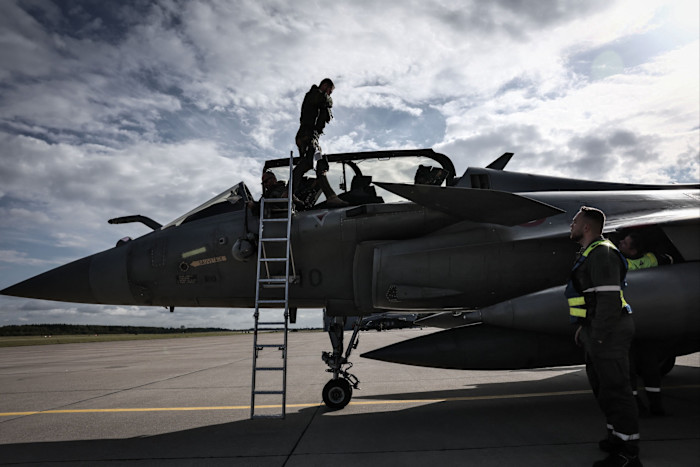
The $35bn purchase of 114 Rafale fighter jets would be India’s largest-ever defence deal. But officials in New Delhi said last-minute negotiations over details including the price were continuing.
The two leaders remotely inaugurated India’s first private helicopter assembly line, a joint venture in Karnataka between Europe’s Airbus and the defence arm of India’s Tata Sons.
The venture would export the helicopter “to the entire world”, Modi said, adding that the “India-France partnership is a force for global stability”.
Macron said French companies were ready to offer “unprecedented forms of co-operation” by manufacturing locally.
“That’s the sense of the co-operation we have in defence in particular — I’ve got to mention the Rafales here, and submarines — and many projects we’re working on together like the final assembly line Tata is developing for Airbus helicopters,” the French president said.
India has previously purchased dozens of Rafale fighters, but the proposed deal would be the largest single export order for French jet maker Dassault Aviation.
Élysée and Indian officials have already made clear a key component of the deal would be the assembly of a large portion of the jets and their components in India, boosting New Delhi’s ambitions to develop its own weapons manufacturing industries.
India’s defence ministry last week cleared the Rafale purchase. Approval was also needed by India’s cabinet, which met on Friday but did not make a statement on the deal. Élysée officials said the talks were not fully finalised.
The negotiations come at a crucial moment for both sides. Europe is trying to revitalise its arms industries as US President Donald Trump sows doubts about the strength of the transatlantic security alliance.
India, the world’s largest arms importer, is desperate to upgrade and expand its fighter jet fleet. Its air force currently operates fewer than 30 fighter squadrons, far below a long-standing target of 42. Pakistan has claimed to have successfully used Chinese-made aircraft to shoot down five Indian fighters, including at least one Rafale, during a five-day conflict last year.
French aerospace and defence group Safran has opened the door to manufacturing Rafale engines in India for the first time as part of the talks.
Macron, who will also attend a global AI summit in New Delhi, is being accompanied on the trip, his fourth to India since taking office, by dozens of business executives including Arthur Mensch, co-founder of AI start-up Mistral, and the head of nuclear power group EDF. Bilateral trade is worth about €15bn annually, the Élysée said.
France and India have sought to deepen ties in recent years, aligned in their pursuit of “strategic autonomy”, Élysée officials said. Analysts also pointed to Trump’s shaking up of the global diplomatic order as providing impetus for countries to seek alternative allies.
“In today’s world, we have to diversify our strategic partners,” said a senior Indian official.
In his remarks in Mumbai, Macron hailed France’s ties with India as “stable and predictable”, saying both countries “believe in international trade and reject coercive methods”.
The Rafales will “form the core of India’s combat potential in the 2030s and 2040s until fifth generation fighters are available in enough numbers”, said Dinakar Peri, a security expert at Carnegie India.
He added that the deal would “consolidate France’s position as the bulwark of India’s aerospace ecosystem . . . with fighter jets, transport aircraft, helicopters and engines”.
India previously bought 36 Rafales for its air force in 2016 and 26 for its navy in 2024. It has also built its own smaller fighter jet, known as the Tejas, and is working on a heavier aircraft, but progress has been stymied by the difficulty of producing advanced engines.
For Dassault, making the jets in India will be a departure from its “Made in France” model. But moving some production will help ease capacity constraints at home. It has also worked on joint production lines in India for its Falcon business jets.
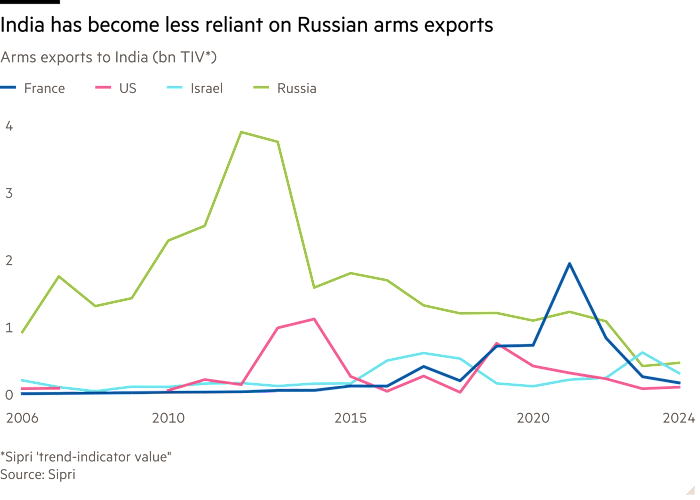
The size of the deal will lend momentum to western efforts to deepen security co-operation with India and wean New Delhi off its decades-long dependence on Russia, its traditional weapons supplier. India has pledged to buy more arms from the US, and the defence ministry last week approved the purchase of six Boeing P-8 Poseidon reconnaissance aircraft.
But New Delhi remains tied to Moscow to maintain its fleet of Sukhoi fighters, as well as tanks, an aircraft carrier and S-400 air defence systems, among other platforms.
Praveen Donthi, a senior analyst at Crisis Group, said India was looking to “leverage” its position as a large arms importer to “strengthen its multi-alignment strategy”.
But Russia is “the cornerstone of India’s strategic autonomy”, he added. “It will be challenging for New Delhi to further reduce its reliance on Russian equipment.”
India Business Briefing
The Indian professional’s must-read on business and policy in the world’s fastest-growing big economy. Sign up for the newsletter here