Good morning. It’s a veritable political circus in New Delhi these days with questions about the trade deal, a cabinet minister’s communications with Jeffrey Epstein and a book by a former army chief jostling for headlines. I am not complaining.
In today’s newsletter, the government further tightens regulations about AI-generated content. But first, an important election in Bangladesh.
Results in Dhaka
That a ringing slogan in Bangladesh’s general election has been “Dhaka, not Delhi” clearly signals how crucial today’s results will be for both countries. The nation went to the polls on Thursday, 18 months after former prime minister Sheikh Hasina was forced to resign and flee. In the months since, local fury against the long-ruling and autocratic leader has morphed into anger towards New Delhi for supporting her. Anti-India sentiment, which was further heightened in December after the killing of a popular activist, has resulted in several attacks on minority groups in the country and forced India to temporarily close visa services and some diplomatic missions in the country. Bangladesh subsequently suspended similar services in New Delhi.
The Bangladesh Nationalist Party (BNP) and the Jamaat-e-Islami are the two key parties fighting this election, after the Hasina-led Awami League was barred from the polls. Voters will also participate in a referendum on constitutional, judicial and electoral reforms proposed by the interim government led by Nobel Peace Prize laureate Muhammad Yunus.
India has started trying to reset ties, with foreign minister S Jaishankar travelling to Dhaka last month to attend the funeral of former prime minister and BNP leader Khaleda Zia. (Her son Tarique Rahman, who has returned after a 17-year exile, is leading the party in this election.) New Delhi is wary of the inroads Beijing will make into Dhaka if its freeze continues.
US foreign policy is another concern. While Bangladesh is on the fringe of Washington’s interest, its proximity to China and access to the Bay of Bengal increases its strategic value. This week’s flurry of trade announcements highlights this point. A day after the Trump administration published a factsheet on its reduced 18 per cent tariffs for India, it unveiled a trade deal with Bangladesh that proposes tariff-free garment imports in return for purchases of US cotton and textiles. Bangladesh’s apparel industry is already a behemoth, constituting more than 80 per cent of the country’s exports, and this makes it even more difficult for Indian garment manufacturers to compete. Indian authorities are now scrambling to get a similar concession from Washington.
The geopolitical situation with Pakistan dominated the strategic landscape last year, but developments in Bangladesh add a significant new dimension in 2026. Today’s results will shape the trajectory of bilateral relations. Delhi is as invested in this election as Dhaka is.
How do you think Bangladesh election results will affect India? Hit reply or email me at indiabrief@ft.com
Recommended stories
China wants to create a “Polar Silk Road” through the Arctic.
Four partners leave EY after independence rule breach on Shell audit.
Why are fertility rates collapsing? Gender roles — female graduates’ decision to have children depends on how they expect their husbands to behave.
Switzerland is set to vote on a plan to cap the population at 10mn.
Apple faces new tensions with the Trump administration.
Four stylish books to add to your coffee-table pile.
More AI rules
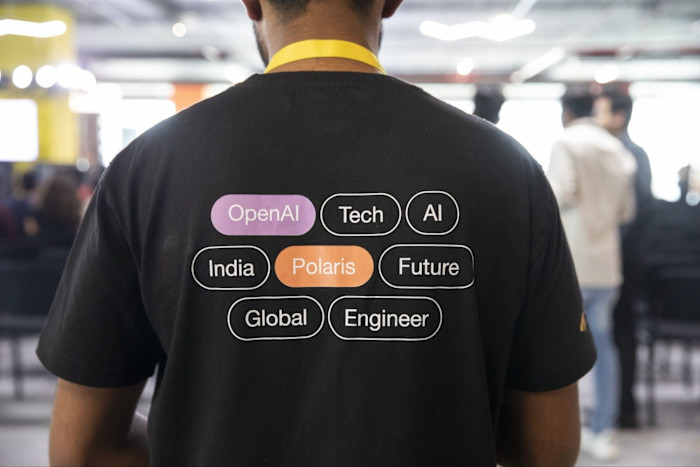
This week, the Indian government released an exhaustive set of regulations to control images and videos generated by artificial intelligence. In doing so, it has taken a sledgehammer to a knife fight. The intent behind the rules is straightforward: prevent people from being misled into believing synthetic content is real. Any such material must be clearly labelled as AI-generated. These rules go beyond obvious harms such as sexually explicit content, especially those featuring children, to include images and videos that have political ramifications. Fake videos of election candidates making inflammatory remarks are barred, for example, as are fake celebrity endorsements and false instructions given by government or corporate leaders. Only harmless uses of the technology, which fall under what the regulations call “good-faith edits”, are allowed but all content is supposed to be prominently labelled.
So far, so reasonable.
The problem lies in how the rules are designed to be enforced. Compliance will be extraordinarily difficult — for both social media platforms and AI companies.
Consider social media platforms first. They now have just three hours to respond to government takedown notices, a sharp reduction from the earlier 36-hour window. In a previous shake-up in the regulations, the government introduced the Sahyog Portal, which allows multiple agencies and law enforcement bodies to issue such notices. The combination of high volume and compressed timelines will leave platforms with little meaningful opportunity to assess or challenge orders. In effect, authorities can restrict content swiftly and with minimal scrutiny. Elon Musk-owned social media site X has already taken the government to court over the portal’s operation, arguing it undermines free speech. The new rules also threaten the safe harbour status of large platforms. If unlabelled synthetic content is promoted, platforms could be deemed to have failed their due diligence obligations.
AI companies are now tasked with ensuring no illegal content is generated. This holds true for all companies in the sector, irrespective of size. Companies will have to build models that can continuously monitor what users are generating and then have to interpret whether this is legal or not. This task, formidable as it is, is made even more challenging by the fact that there is no clear definition of a good-faith edit.
Industry stakeholders were consulted on some but not all of these provisions before they were implemented. While the government’s intent is to prevent misuse of AI, this is a heavy-handed approach. Both AI companies and large social media platforms will have to figure out a way to navigate around it. It is unlikely this will be the final iteration of India’s AI regulations. More revisions seem inevitable.
What do you think about these regulations? Hit reply or email me at indiabrief@ft.com
Go figure
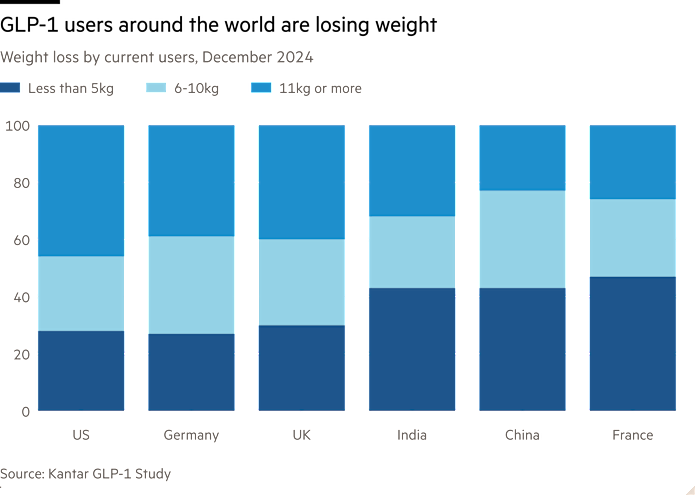
There’s no question that GLP-1 drugs can help users shed weight. While Americans, who started off as heaviest and adopted the drugs earliest, were among the biggest losers, Indians are not far behind.
Read, hear, watch
This week my after-hours recommendation list is as empty as my Valentine’s Day plans. Send me yours. Hit reply or email me at indiabrief@ft.com
Buzzer round
Speaking of Valentine’s Day, name the musical comedy whose iconic scene involves two dogs eating a bowl of spaghetti?
Send your answer to indiabrief@ft.com and check Tuesday’s newsletter to see if you were the first one to get it right.
Quick answer
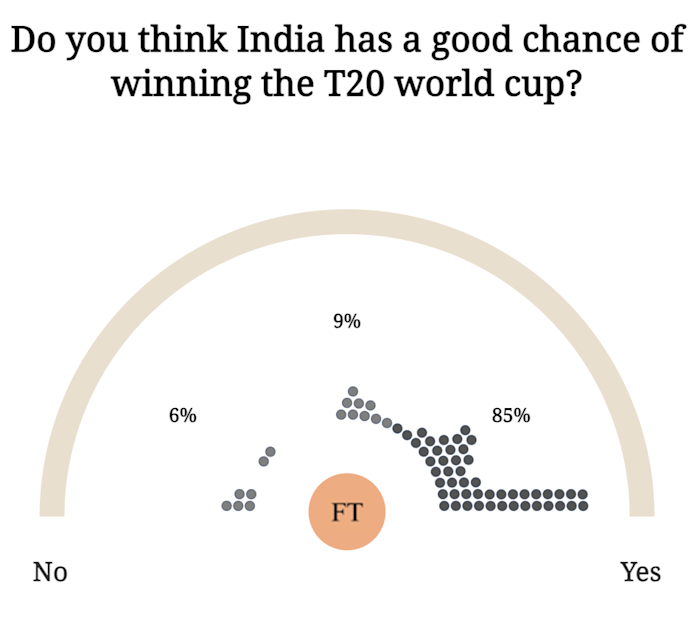
On Tuesday we asked if India has a good chance of winning the T20 World Cup. The results are overwhelmingly in favour of our men in blue. Fingers crossed.
Thank you for reading. This India Business Briefing is edited by Mure Dickie. Please send feedback, suggestions (and gossip) to indiabrief@ft.com.