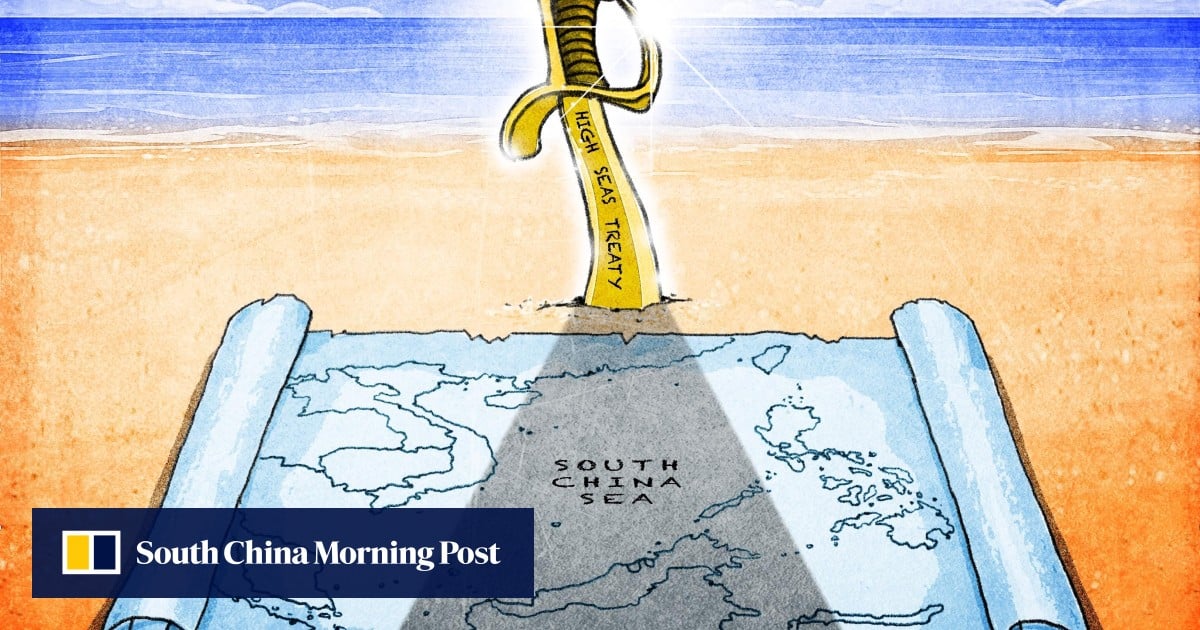
The South China Sea continues to act as a lightning rod for competing claims among regional powers. In the first of a three-part series, Laura Zhou examines how a new conservation framework is being leveraged to advance territorial ambitions within these highly contested waters.
Two decades in the making, the High Seas Treaty, also known as the Biodiversity Beyond National Jurisdiction (BBNJ) agreement, took effect on January 17. That followed a key milestone reached last September, when 60 nations ratified the treaty – meeting the threshold for activation.
Advertisement
The agreement also aims to create protected areas, stipulating that the global community should benefit equitably from the open oceans and their resources – including genetic material found in the high seas, a domain covering almost half of the world’s surface and more than 60 per cent of the global ocean.
Advertisement
But the focus of the High Seas Treaty is already shifting from biodiversity to boundaries. By setting new global norms, the agreement could provide a rhetorical template for South China Sea claimants to mask territorial ambitions with the language of stewardship, turning conservation tools into a novel legal arsenal, analysts note.