Unlock the Editor’s Digest for free
Roula Khalaf, Editor of the FT, selects her favourite stories in this weekly newsletter.
Thailand’s stocks and currency rose on Monday on hopes that the first electoral victory this century by the country’s conservatives represented a breakthrough after decades of political instability.
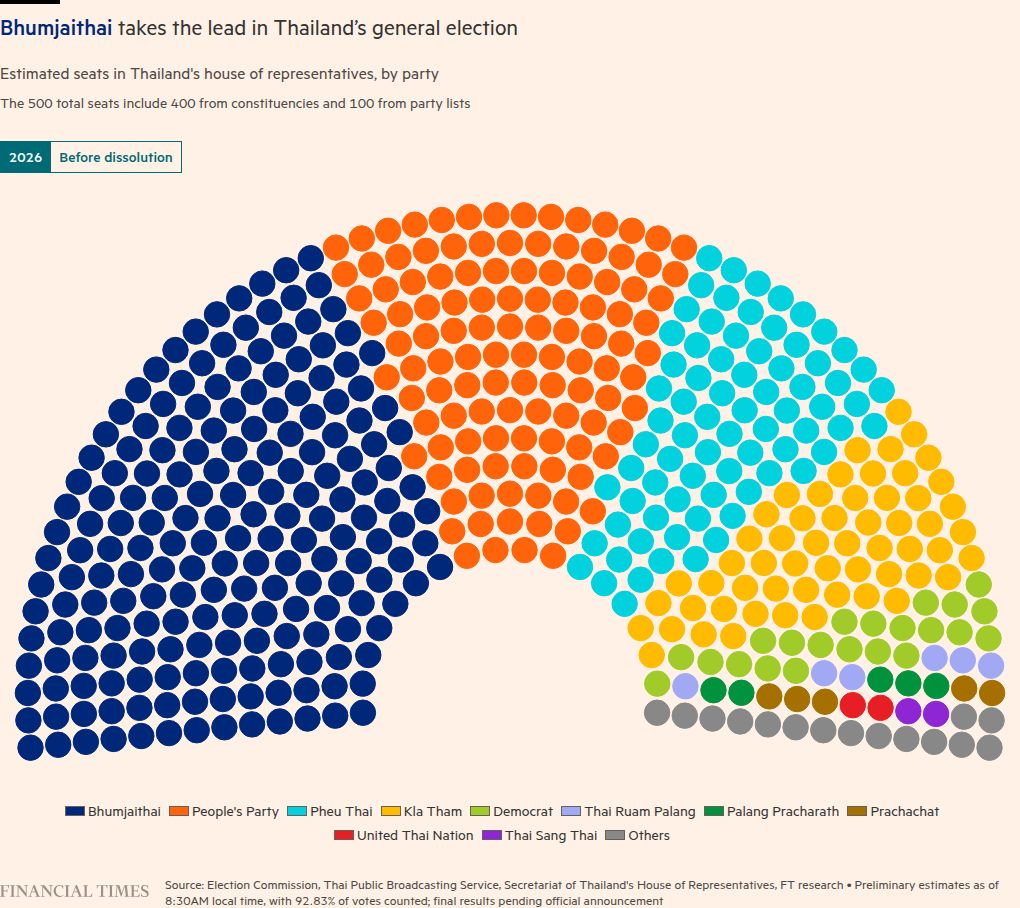
Prime Minister Anutin Charnvirakul’s Bhumjaithai Party, which has become the flag-bearer of the conservative royalist-military establishment, is on track to form the government after preliminary results from Sunday’s election showed it was leading in more than 190 of the 500 seats in the lower house of parliament.
The reformist People’s Party, the pre-election favourite, was leading in about 100 seats, according to the election commission. That puts them in second place.
Thailand’s SETI equities benchmark rose more than 3 per cent on Monday while the baht strengthened almost 1 per cent at Bt31.22 against the dollar.
While Bhumjaithai was still short of a majority, its margin of victory put Anutin — who is seen by political analysts as having the backing of Thailand’s powerful monarchy — in pole position to form a governing coalition in the coming days.
No party has won a Thai election by such a big margin in about 15 years, a factor that analysts said would bring much-needed stability to a country that has been mired in political gridlock for decades due to a stand-off between the conservative establishment and popular progressive forces.
That could also bring much-needed relief to the economy, which is lagging peers in south-east Asia, partly due to the frequent change in Thai leadership.
“With a large pro-establishment party leading the coalition, the next government will have a stronger anchor than has been the case with other administrations in recent years,” said Peter Mumford, south-east Asia head at the consultancy Eurasia Group.
“That said, the new government will be under huge pressure to turn around the struggling economy,” he added. “Opponents will seek to capitalise if they fail.”
Populist groups have been blocked from power in recent years despite winning elections, or have had their leaders ousted through military coups and constitutional courts. Thailand has had three prime ministers since the 2023 election.
The People’s Party in its previous incarnation won that poll, but was dissolved after the constitutional court ruled that its pledge to amend the hard lèse majesté law that protects the monarchy amounted to “treason”. The party dropped that promise ahead of this year’s election.
Bhumjaithai, which won 70 seats in the 2023 election, tapped into strong nationalist sentiment following a sporadic border conflict with Cambodia last year. The party made substantial gains throughout the country, particularly in north-eastern Thailand, close to the border.
It failed to make headway, however, in the capital Bangkok, where the People’s Party won all 33 seats.
“They used this nationalism approach during the campaigns all over the country. It [attracted] a lot of people who live in the borders and the middle class,” said Punchada Sirivunnabood, dean of social sciences and humanities at Mahidol University.
Anutin took office in September after his predecessor Paetongtarn Shinawatra was ousted by the constitutional court for ethical violations over a phone call with former Cambodian leader Hun Sen, in which she sought to defuse the border tensions and criticised the Thai military.
Despite Bhumjaithai’s win, Thais’ appetite for reform remained, analysts said.
In a referendum held alongside the general election, about 60 per cent voted in favour of amending the 2017 military-drafted constitution — a process that could take years and requires two more referendums.
“People realise that this constitution prevents checks and balances and has not controlled the corruption cases,” said Punchada.
Tita Sanglee, an associate fellow with Singapore’s Iseas-Yusof Ishak Institute, said reforms under Bhumjaithai will be gradual and not as drastic as those promised by the People’s Party.
“The results suggest that the voters are prioritising security and economic stability,” she said. “Reform is still important . . . but, in a more messy global environment, voters think immediate stability may feel more urgent.”
Data visualisation by Haohsiang Ko in Hong Kong