Unlock the Editor’s Digest for free
Roula Khalaf, Editor of the FT, selects her favourite stories in this weekly newsletter.
Thai Prime Minister Anutin Charnvirakul’s conservative party is on course to win a snap general election, giving him the upper hand in forming a new coalition government and reviving the fortunes of the country’s royalist-military establishment.
Anutin’s Bhumjaithai Party is leading in 194 of the 500 seats in the lower house of parliament, according to the election commission, with about 90 per cent of votes counted.
Results after Sunday’s vote suggest the party will probably fall short of a 251-seat simple majority and will have to find coalition partners to form a government. The Pheu Thai Party, which is part of Anutin’s incumbent ruling coalition, is leading in 77 seats.
Pre-poll favourite, the progressive People’s Party, is leading in 115 seats, according to the count. Party leader Natthaphong Ruengpanyawut told a news conference that the initial results showed it was unlikely that the party would win the election.
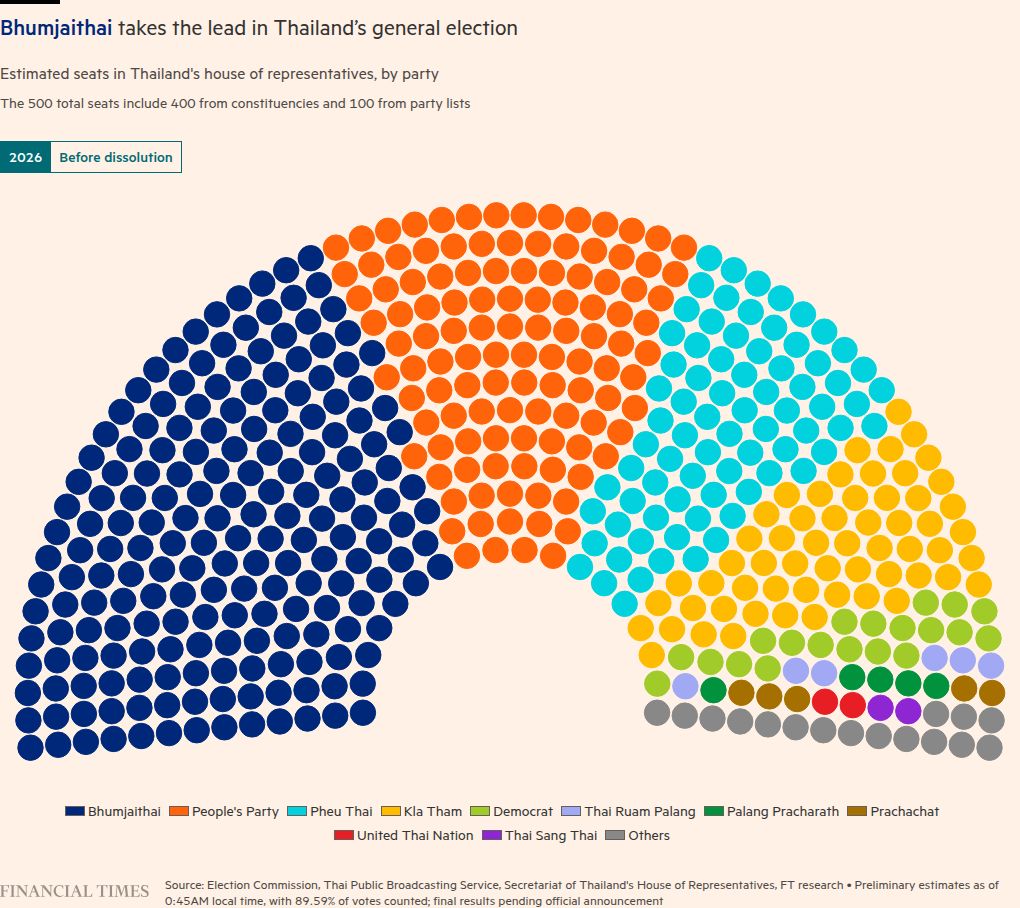
Bhumjaithai’s strong lead is a boost for the conservative establishment, which had been waning in popularity and was losing momentum to the reformist movement led by the People’s Party.
Bhumjaithai has been gaining ground on a wave of nationalistic sentiment following a border conflict with Cambodia that flared repeatedly last year. The pro-military party had projected itself as the protector of the country, while the People’s Party faced criticism for its past comments advocating reforms of the military.
Bhumjaithai has far exceeded pre-election expectations and its performance in the last election in 2023, when it won about 70 seats.
Anutin said on Sunday that he believes his party had won the most seats, but that he will wait for official results before putting together a coalition. The election commission will certify the final results within 60 days.
“Our people have given us more than we expected,” Anutin said. “Nationalism is in the heart of everybody in the Bhumjaithai party.”
Bhumjaithai, however, failed to win a single seat in capital Bangkok, where the People’s Party is leading in all 33 seats.
It is unclear if the election will bring political stability in Thailand, which has been stuck in a years-long political gridlock. Over the past two decades, the conservative establishment has either blocked progressive election winners from forming the government, or ousted populist leaders through military coups or the judicial system.
The political instability has hurt the economy, which is lagging behind its south-east Asian peers with a growth rate of around 2 per cent.
In the last election held in 2023, the predecessor of the People’s Party — the Move Forward party — won but was denied power over its pledge to amend a harsh lese-majeste law that protects the country’s royalty. Move Forward has since been dissolved by the constitutional court and its leaders banned from politics.
An alliance of conservative parties and Pheu Thai came to power in 2023, but the partnership of the old foes proved to be fragile — with Thailand ending up with three prime ministers in as many years.
Along with electing parliamentarians, Thais also voted on a referendum on whether to begin the process of amending the 2017 military-drafted constitution. According to preliminary results from the election commission, about 60 per cent of Thai voters were in favour of the amendment.
Additional reporting by Khemmapat Rojwanichkun in Bangkok
Data visualisation by Haohsiang Ko