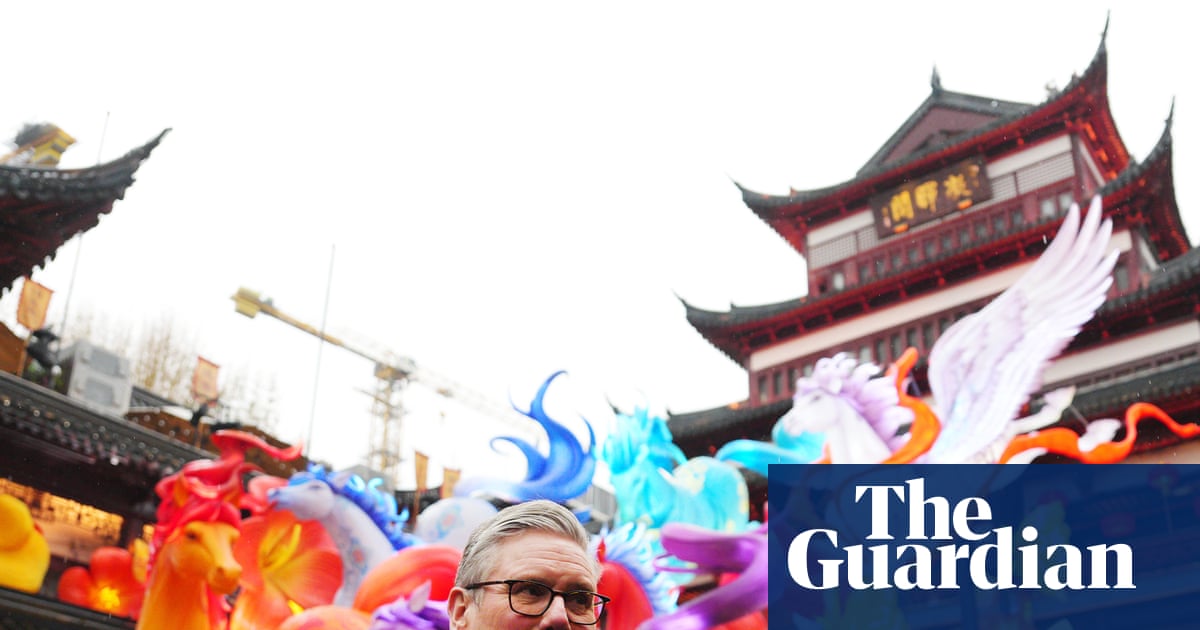
China has lifted the sanctions it imposed on serving British MPs and peers in a significant sign of warming relations after Keir Starmer travelled to Beijing for landmark talks with Xi Jinping.
Nine UK citizens were banned from China in 2021, including five Conservative MPs and two members of the House of Lords, targeted for highlighting human rights violations against the Muslim Uyghur community.
However, it is unclear whether an academic, a barrister, and a former Tory MP who stepped down from parliament at the last election, who were also sanctioned, would be affected.
The Guardian revealed last year that the Chinese government was reviewing the sanctions, which it introduced in response to what it called “lies and disinformation” about human rights abuses in Xinjiang.
In a round of broadcast interviews in China on Friday, Starmer confirmed that the sanctions on serving MPs and peers would be lifted with immediate effect. He said: “I know that the action taken in relation to our parliamentarians has been a real cause of concern, understandably so.
“And therefore I raised that issue whilst I was here, and the Chinese are absolutely clear in response: the restrictions no longer apply. President Xi said to me that that means all parliamentarians are welcome.
“I think that shows that if you engage, you can raise the difficult issues, the issues that my parliamentary colleagues would have expected me to raise, and therefore I can be clear, the restrictions no longer apply.”
Starmer opened the door to a UK visit from Xi after the talks in Beijing on Thursday. However, it would have been politically challenging to do so while the sanctions remained in place. Chinese diplomats are banned from parliament after a spying row.
Starmer suggested on Friday that Xi would be welcome in the UK when it hosted the G20 summit next year. “We are hosting the G20 in 2027. China is a G20 country. So of course I’d like to see President Xi come around the G20.”
China’s sanctions were a retaliation against the UK imposing sanctions on Chinese officials held responsible for atrocities in Xinjiang. It is understood that those will not be lifted in return.
The five MPs put under sanctions in 2021 were the former Tory leader Iain Duncan Smith, Tom Tugendhat, Nusrat Ghani, Neil O’Brien and Tim Loughton, who stood down in 2024.
The two peers were David Alton, a crossbencher, and Helena Kennedy, from Labour. Several are members of the Inter-Parliamentary Alliance on China.
Before the move was confirmed, the seven parliamentarians issued a statement. “We would rather remain under sanction indefinitely than have our status used as a bargaining chip to justify lifting British sanctions on those officials responsible for the genocide in Xinjiang,” they said.
“We would reject any deal that prioritises our personal convenience over the pursuit of justice for the Uyghur people. We stand in total solidarity with our families, former colleagues, and the civil society organisations who remain targeted by the People’s Republic of China.
“We will not accept any reprieve that applies only to sitting lawmakers while others, including civil society organisations, remain sanctioned.”
The Newcastle University academic Dr Jo Smith Finley, whose research focuses on the Uyghurs, and Geoffrey Nice KC, who chaired the Uyghur tribunal that investigated atrocities against the minority group, remain under sanctions.
All nine were banned from entering China, Hong Kong and Macau, any property they had in China was frozen, and Chinese citizens and institutions were prohibited from doing business with them.
The direct impact of the sanctions on the parliamentarians was limited, although there have been suggestions they may have faced intimidation and espionage. The symbolism, however, was significant as relations between China and the UK were at a low ebb.
In April, China lifted its sanctions on five MEPs and on the European parliament’s subcommittee on human rights, which were also imposed in 2021 in response to the EU’s own sanctions.
The move was part of Beijing’s charm offensive to improve ties and revive talks over a trade deal with Brussels, amid the turmoil caused by Donald Trump’s tariffs.