Unlock the Editor’s Digest for free
Roula Khalaf, Editor of the FT, selects her favourite stories in this weekly newsletter.
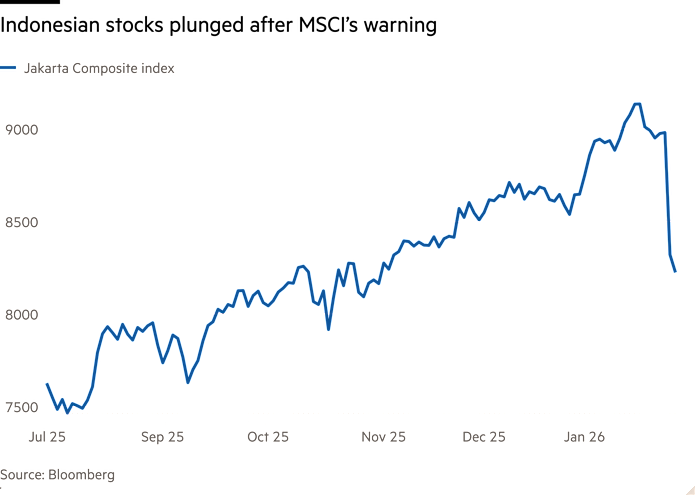
Indonesian stocks tumbled as much as 16 per cent in two days as a sell-off triggered by index provider MSCI’s warning about the market’s investability accelerated.
The Jakarta Composite index fell as much as 10 per cent on Thursday despite a 30-minute trading halt, after a similar interruption a day earlier when the market fell more than 7 per cent.
The slide came after MSCI said it had found “fundamental investability issues” in the Indonesia Stock Exchange’s data feed of publicly traded shares, in a report released on Tuesday.
The index provider said Indonesia could be reclassified from an emerging to a frontier market if no resolution was made by May.
Goldman Sachs also cut its ratings on Indonesian stocks, saying MSCI’s decision and the threat of losing emerging market status was “likely to prompt significant selling”.
In response, the chair of Indonesia’s Financial Services Authority said it would raise the free-float requirement for listed companies to 15 per cent. Shares pared losses after the statement and closed down 1 per cent on Thursday.
The turmoil in Indonesian stocks comes against a backdrop of broader uncertainty over the country’s economic outlook and fiscal situation under President Prabowo Subianto, who has pledged to increase social spending even as government revenues have dropped.
The rupiah, which weakened as much as 0.5 per cent against the dollar on Thursday, has been trading close to all-time lows, fuelled by concerns over central bank independence after Prabowo nominated his nephew as its deputy governor. The nomination was confirmed by parliament this week.
In its announcement, MSCI said many investors “expressed significant concerns” about the way shareholders were categorised by an Indonesian data provider, during a consultation over Indonesian securities’ free float.
MSCI cited opacity in shareholding structures in Indonesia and “concerns about possible co-ordinated trading behaviour”.
Indonesia has long faced questions around concentrated ownership of publicly listed companies, especially for conglomerates controlled by billionaires.
“The slump in Indonesia’s stock market today . . . is the latest in a long list of issues that investors are grappling with. A lot of bad news now appears to be priced in,” said Capital Economics’ Jason Tuvey in a research note.
Wee Khoon Chong, a senior strategist at BNY in Hong Kong, said foreign investors were offloading Indonesian equities and that the “aggressive” fall in share prices “might add further investor outflow pressure”.
“The timing is unfortunate as Indonesia’s currency is at the same time under fiscal and deficit-related depreciation pressure,” Chong added.
Additional reporting by Anantha Lakshmi, Jakarta correspondent, and William Sandlund in Hong Kong