Unlock the Editor’s Digest for free
Roula Khalaf, Editor of the FT, selects her favourite stories in this weekly newsletter.
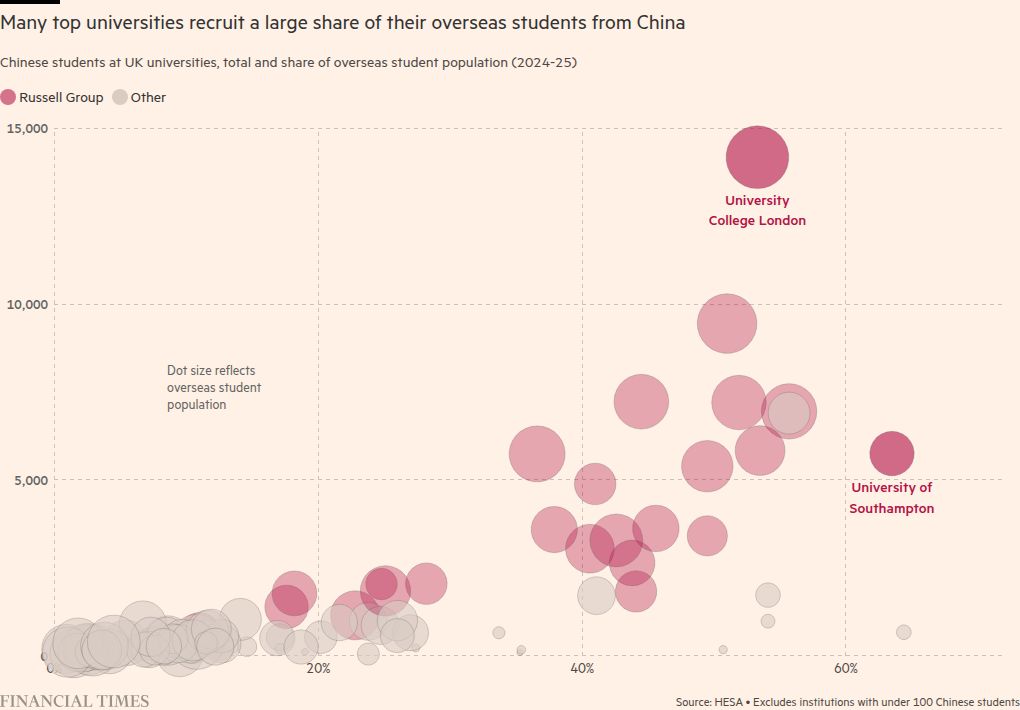
Two in five overseas students at the UK’s top-ranking universities last year came from China, according to new data that underlines concern about the financial risks of relying so heavily on a single recruitment market.
There were almost 105,000 Chinese students at Russell Group universities in 2024-25, representing 42.5 per cent of their international student population, according to FT analysis of official data published on Tuesday.
This is a record-high proportion and almost five times the figure for the rest of the university sector, where Chinese students accounted for just 8.7 per cent of overseas students.
Universities are under pressure to shore up their finances by diversifying recruitment, as intensifying global competition for international students and a softening Chinese graduate jobs market threaten to damp demand for UK degrees.
The data comes as Prime Minister Sir Keir Starmer heads to China to try to repair the UK’s relationship with Beijing, which has come under strain from allegations of political espionage and delays in approving plans to build a “mega” embassy in London.
There is also growing tension over Beijing’s influence on British campuses after evidence emerged in November last year that a campaign of intimidation by Chinese officials prevented publication of research into alleged human rights violations in Xinjiang.
UK academics have warned that universities’ reliance on Chinese fee income is fuelling self-censorship, amplifying existing concerns about the risk of a diplomatic rift destabilising the sector’s finances.
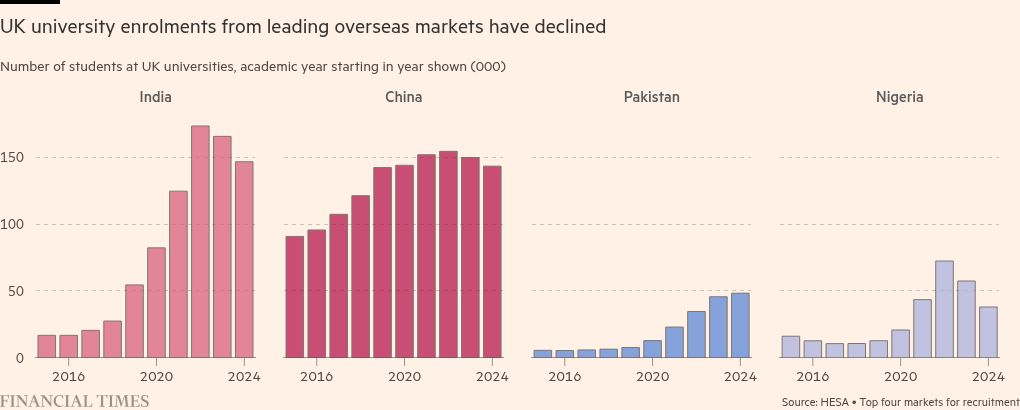
The risks of over-reliance on a single country were underscored by a collapse in recruitment from Nigeria, the UK’s third-largest market, where the number of new students halved between 2022-23 and 2024-25 after it experienced a currency crisis.
Despite pressure to diversify student intakes, universities are restricting recruitment from Pakistan and Bangladesh following the introduction of tighter visa rules and pivoting towards countries such as China with higher compliance rates.
While the Russell Group is increasingly reliant on China, the overall number of Chinese students has declined at these institutions, as its members recorded a larger contraction in overall international student numbers.
This reflects the trend across the sector, with the number of new overseas students falling by 5.4 per cent last year, the second consecutive year of decline from the peak in 2022-23. Recruitment contracted in three of the four largest markets — India, China and Nigeria.
Pakistan was the only top-four country to see growth, increasing the number of entrants by 5 per cent. Nepal recorded one of the fastest rates of growth, almost doubling the number of students at UK universities to 24,435 in 2024-25.
Jamie Arrowsmith, director of Universities UK International, which represents the sector, said visa data suggested the “very challenging” conditions for recruiting international students had continued over the past year. He added that upcoming changes to the UK’s immigration system would make diversifying recruitment to a wider range of countries even more challenging.
“We need a period of policy stability for universities and prospective international students,” he said. “But, fundamentally, this data highlights the need for a properly sustainable funding settlement for our universities.”
Home Office visa data suggests a rebound in international applications for the 2025-26 academic year, but university leaders have warned that a proposed levy on international students, which will take effect from August 2028, will undermine the sector’s future competitiveness.
A long-term funding squeeze has left the sector heavily reliant on fee income from international students but, under pressure to curb immigration, ministers last week dropped the target for overseas student recruitment.
UK universities are instead being encouraged to expand abroad, and nine top-ranking UK institutions, including Bristol and Southampton, were granted permission to open sites in India last year. Tuesday’s data revealed that the number of students studying wholly overseas for UK qualifications rose 7.9 per cent to 669,950 in 2024-25. Of these, 45,790 were enrolled at overseas campuses of UK institutions.
Dr Hollie Chandler, director of policy at the Russell Group, said international recruitment was increasingly competitive.
“That’s why we need government to support diversification efforts in recruitment and put out a strong message about the UK as a positive and welcoming study destination,” she added.