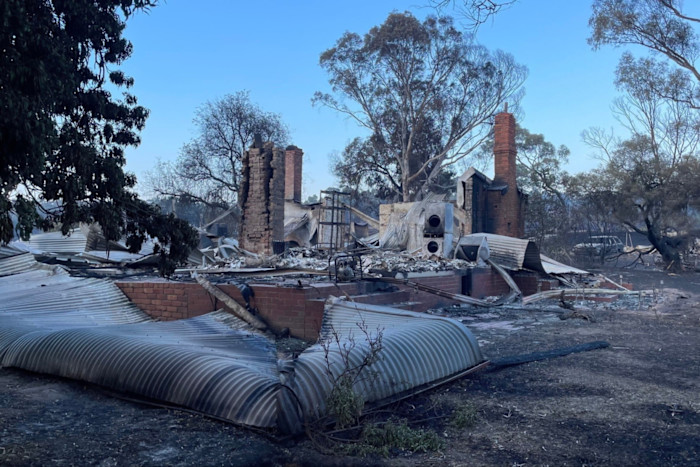
David Jeffries fled his home near Melbourne fearing for his life as some of the worst blazes in years laid waste to rural towns once seen as safe from Australia’s devastating annual fire season.
It was gone midnight by the time he returned, his home in the picturesque town of Harcourt all but destroyed. “It was very surreal,” he said. “The house was still alight. I half expected a ghost to jump out. I thought if I closed my eyes and opened them again then maybe it was a dream.”
The scene at Harcourt, a historic town known for its apples and cider that had been considered to be at lower risk than other areas with denser forestation and a history of bushfires, made clear that for many Australians the battle with fire is now one to be managed, not won. “In retrospect, I don’t think anywhere is safe and secure,” said Jeffries.
Fire officials have warned that temperatures could rise significantly in the coming weeks, with Victoria and New South Wales, the country’s two largest state economies, among the hardest hit by blazes.
Some fear that 2026 could prove to be one of the worst seasons since the “Black Summer” blazes of 2019 that killed 33 people and cost farmers A$5bn ($3.4bn) in lost crops and damage to property and equipment and A$2.4bn of insured losses, according to Moody’s.
The devastation in Harcourt makes clear how hard it has become to prepare for fire season.
“A lot of the public have a sense of how fires move across the landscape in an almost orderly way. But that is changing with erratic winds and massive ember attacks running ahead of the fire. It’s more chaotic. It’s hard to predict and respond,” said Jason Sharples, director of the bushfire research unit at the University of New South Wales.
<div data-o-component="o-expander" class="o-expander o-expander__info-box" data-o-expander-shrink-to="hidden" data-trackable="clip-info-box" data-o-expander-collapsed-toggle-text="Show video info” data-o-expander-expanded-toggle-text=”Hide video info“>
Scientists have warned that climate change is making extreme weather events more intense across the world. That has been evident in Australia where temperatures have soared in recent years with 2025 the fourth-warmest year on record.
Australia has poured more investment into dealing with extreme weather conditions, which has included simultaneous droughts and floods as well as the devastating threat from fires. Floods have also hit parts of the country, including Victoria.
Abnormal weather conditions have made it harder to prepare for the onset of fires as the window for controlled burning — when firefighters set low-intensity fires to reduce the amount of ground fuel in high-risk areas — has narrowed.
This month, the rural fire service in Victoria said that it fought 200 fires with 12 becoming major ones that destroyed more than 220 homes as a combination of extreme heat and dry conditions triggered grass fires that are difficult to combat.
Australians have become accustomed to bushfire season but the threat has intensified, said Iuliia Shustikova, who leads Moody’s bushfire products.
“What makes 2026 stand out is not that fires are burning but how multiple large fires, aligned with extreme conditions, have crossed into areas with property exposure,” Shustikova said. “The result: homes and businesses are directly in the path of fire fronts, amplifying losses and humanitarian impacts.”
Already, there has been one casualty — cattle farmer Maxwell Hobson who tried to defend his property. About 400,000 hectares of agricultural land have been scorched. Local hunting shops have donated tens of thousands of rounds of ammunition to farmers who returned to their properties to euthanise animals injured by the blazes.
<div data-o-component="o-expander" class="o-expander o-expander__info-box" data-o-expander-shrink-to="hidden" data-trackable="clip-info-box" data-o-expander-collapsed-toggle-text="Show video info” data-o-expander-expanded-toggle-text=”Hide video info“>
In Harcourt, telecoms and broadcasting towers went down, meaning residents could not get information from emergency services apps.
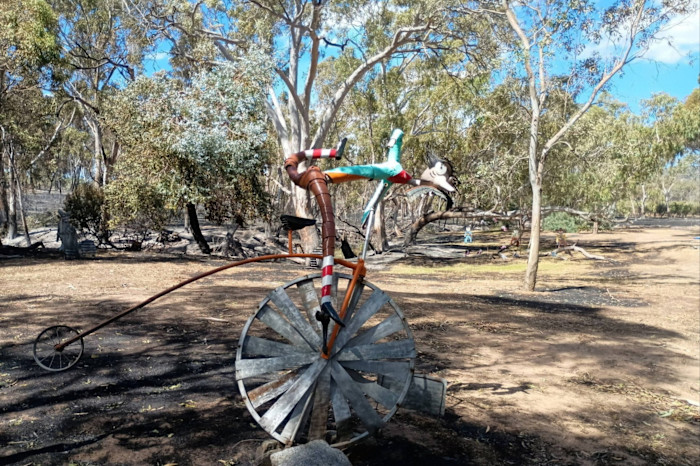
The “firies” — firefighters — have been battling “constant flare-ups” as fires continue to smoulder in the paddocks and trees, said Judy Gleeson, who owns the Woop Woop Sculpture Garden in Harcourt.
“It sounds like a war zone,” she said, speaking to the FT on her phone against the backdrop of helicopters humming overhead to “bomb water” and planes looping over nearby Mount Alexander to drop red fire retardant.
The fire has been a big setback to a business she set up two years ago, she said. The sculptures are singed, the golf’s AstroTurf has melted and the site is being used to entertain the town’s children as parents try to restore their properties.
The state and federal governments have provided financial assistance of about A$100mn to homeowners and farmers who have suffered catastrophic losses. Anger has risen amid accusations that not enough has been spent on upgrading firefighting infrastructure.
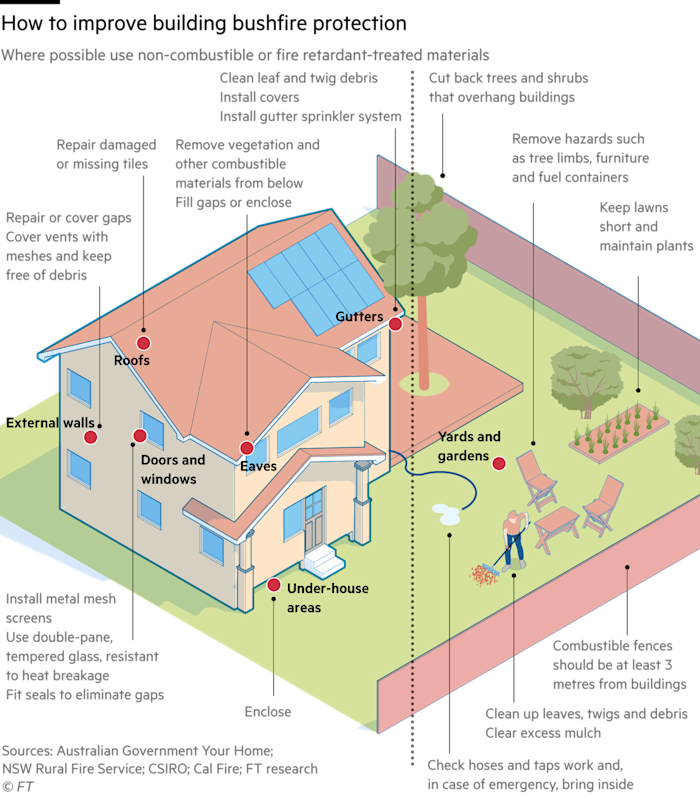
Outside of the cities, fires are usually fought by rural volunteer fire services. Homeowners can do a lot to protect their properties, including cutting grass and firebreak perimeters, clearing gutters and removing “fire fuel” in the form of small bits of bark and wood around a house. They should also check hoses and pack emergency bags.
People living on mountain tops or isolated areas in high fire-risk areas should also evacuate early on days with “catastrophic” threats of bushfires to avoid traffic jams as more people flee. “Regardless of where you are, you need a fire plan,” Sharples said.
Graham Simpson, chair of the Ash Wednesday Bushfire Education Centre, agrees many Australians still do not recognise their responsibilities as they assume that the fire service is there to save them. “That’s a disaster waiting to happen. There are not enough fire trucks in the state to park one in every driveway,” he said.
Jeffries, a retired graphic designer who spent his career designing album sleeves, tour posters and annual reports for companies, lost his life’s possessions including a large vinyl record collection, valuable stamps, his career’s work as well as antique books and furniture that he had inherited from his family. The engines of his cars “were like molten metal”.
He said insurance at roughly A$4,000 a year was out of his budget, so the 69-year-old has to start again. His daughter Molly has raised nearly A$27,000 via a crowdfunding website to help him rebuild his life. “He arrived in 1980 with nothing but a suitcase and an empty bank account. It’s come full circle,” she said.
Jeffries does not hold out much hope of salvaging much from the embers. “I want my coin collection but I need a shovel and that burnt too,” the 69-year-old said.
Cartography by Steven Bernard and illustration by Ian Bott