Good morning. India’s real GDP is set to rise 7.4 per cent in 2026, up from 6.5 per cent last year, according to a government forecast published on Wednesday. Nominal GDP is expected to grow 8 per cent. This first advance estimate forms the basis on which the finance minister will prepare her budget for the year, and I want to call out a couple of interesting points. One, the service sector is expected to see growth of 9 per cent, up from 7.2 per cent last year, and manufacturing, which grew 4.5 per cent in the last fiscal year, is predicted to grow at 7 per cent. Going by these numbers, the overhang of trade difficulties seems to be subdued. Second, since GDP growth for the first two quarters has been recorded at 7.8 and 8.2 per cent, this implies growth slowed down in the last quarter and will continue to be muted in the next three months.
There’s more action on US tariffs this week. Senator Lindsey Graham confirmed on Wednesday that Donald Trump has greenlit his Russia sanctions bill, which aims to impose up to 500 per cent tariffs on countries that buy Russian oil. The Senate could vote on this as early as next week. The US Supreme Court’s ruling on the legality of Trump’s use of emergency powers to impose tariffs is also due soon.
Reliance Industries’ shares derail
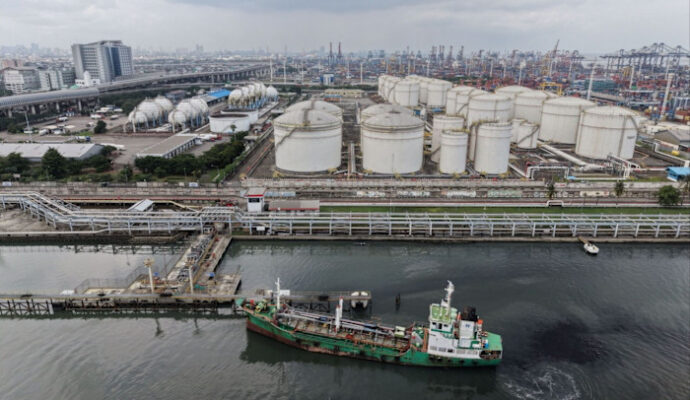
Mukesh Ambani-owned Reliance Industries did not have a good start to the year, with the stock falling more than 8 per cent in the past few days. The big knock came on Tuesday, when Reliance shares lost more than 4 per cent, wiping out at least $10bn in market capitalisation.
What caused this is uncertain, but some fingers point to a Bloomberg report on January 2 which claimed that three tankers carrying nearly 2.2mn barrels of crude from Russia were headed towards Reliance’s Jamnagar refinery. Reliance has called the report “completely false” and said its refinery has not received Russian oil for several weeks. Bloomberg later reported that these tankers “previously linked” to Reliance had been discharged “elsewhere”.
But this did not stop the slide, and the share has continued to trade in the red. Heightened geopolitical tensions and the threat of more tariffs from the US are some of the many problems India’s richest man is facing. The company’s decision to buy less crude from Russia will hit its margins, and this will be visible when it announces its quarterly results later this month.
However, Tuesday’s market action was not just about oil. It is also linked to the prospects of the organised retail sector in India. Tata-owned and publicly listed Trent also had a terrible day in the markets, after analysts highlighted a “worrying deceleration” in growth momentum as consumer spending struggles to take off. Reliance’s privately held retail business is valued at more than $100bn and constitutes about half the market value of the parent company. If Trent has caught a fever, it is not a stretch that Reliance will sneeze too. Trent’s troubles of same-store sales and slowing revenue per square foot are likely to reflect in Reliance Retail’s portfolio as well. Helmed by Isha, Mukesh Ambani’s daughter, Reliance Retail has more than 20,000 stores and is the licence holder for dozens of global brands.
The big fillip for the stock will come later this year, when the company’s telecom service, Jio, debuts in the market. Telecom tariffs are likely to be revised upwards soon, which will improve the revenue prospects of the company. Last year, Jio Telecom said it had 497mn users, making it the largest operator in India.
Overall, though, this will be a challenging year for the group. Global oil markets are in churn, and this will have an impact even if Reliance manages to get the better end of a deal if Venezuelan crude becomes available. Consumer demand, especially in urban India, is visible only in a few segments. And higher telecom fees are unlikely to endear the company to its customers.
Do you think this is a temporary blip for RIL? Hit reply or email me at indiabrief@ft.com
Recommended stories
The latest on Venezuela — US oil groups will need guarantees to invest, China’s oil supplies are threatened, and the country’s streets are overrun by men with guns.
The US will discuss the future of Greenland with Danish officials next week. Here’s how Trump could take control of the Arctic island.
In Italy, it’s a make-or-break year for (Narendra Modi’s friend) Giorgia Meloni.
China hacked the email systems of US congressional committee staff.
Senior finance professionals find it hard to leave their jobs.
Mobility training is this year’s fitness tip.
X rated
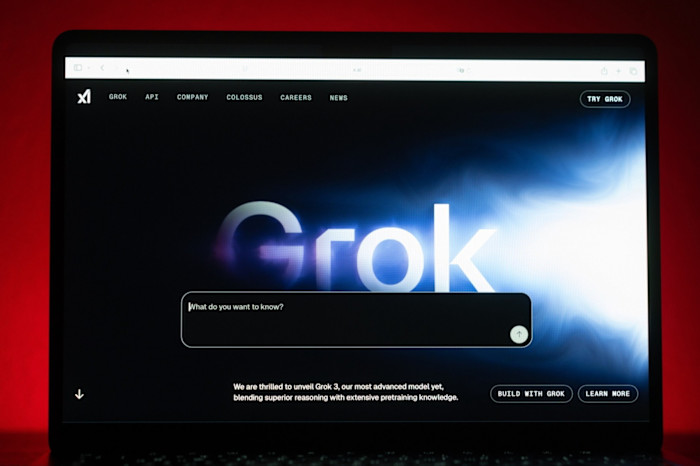
Elon Musk’s X (formerly Twitter) has run afoul of Indian authorities with the latest feature on its AI application, Grok. Indian users have been using the chatbot to create sexualised pictures of women (and sometimes even children) by simply using prompts to modify existing photographs. Last Friday the government gave X 72 hours to submit an “action taken” report spelling out specific technical and organisation measures it has taken to curb this practice. The social media platform eventually submitted its report on Wednesday, but Indian officials are reportedly not satisfied with it and are pressing for more information.
India is not the only country grappling with the aftermath of the introduction of this feature, with women and rights advocates in several other countries raising complaints as well. The UK’s independent communications regulator, Ofcom, has also demanded X explain how it has complied with its legal duties to protect users. Over the weekend, the platform said it would remove illegal content and permanently suspend accounts that participated in the activity.
For X, this run-in with the Indian government is significant for two reasons. Firstly, with 22mn users, India is the fourth largest market for the social media platform. Secondly, this comes at a time when the company is already engaged in a tussle with the government over the new rules governing takedown requests by Indian officials and law enforcement. Privately, government officials are bringing up the bogeyman of whether the latest confrontation will result in the company losing its “safe harbour” status. This refers to a legal provision that offers conditional immunity from liability to social media companies that publish user-generated content.
X and the Indian government have a complicated relationship. It is an important tool for communication for the government, and it is also the only company that is arguing for freedom of speech in pushing back against the new regulations. Worried about losing access to a large market, other social media companies have been more pliable and accepting of the government’s orders. It is unlikely it will come to that for X, but the government will want to send the message that it is the boss.
As for Musk, this is yet another struggle in a line of hurdles he has faced in the Indian market. Tesla, which started its sales operation last year, has barely made a dent. And Starlink is still working its way through permits and permissions, and is yet to launch its services.
Go figure
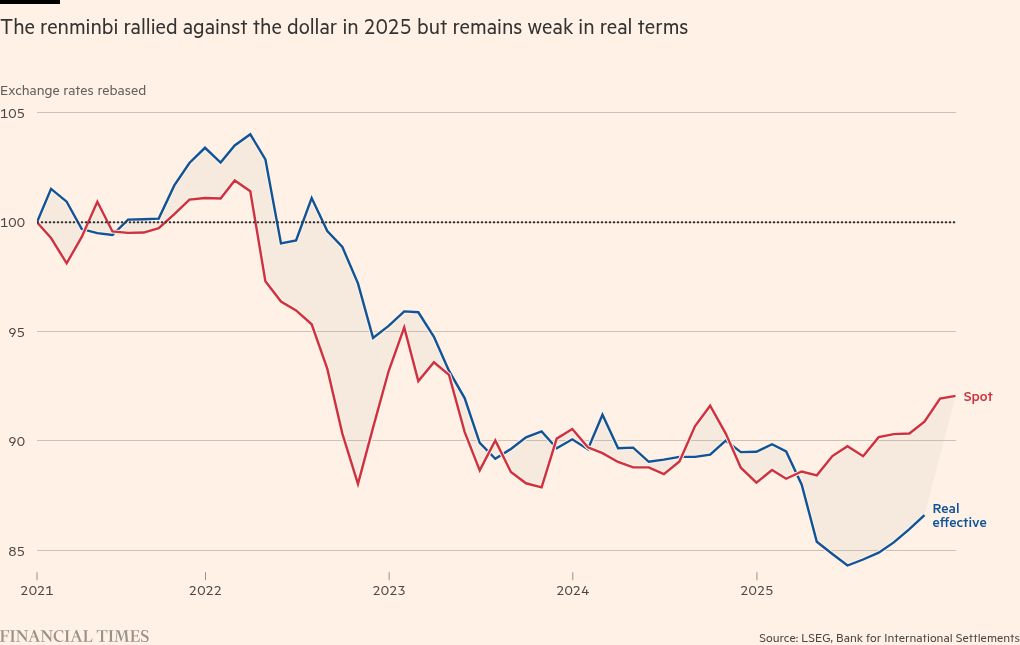
Economists and investors in China are calling on the government to allow a sharper appreciation of the renminbi, since the currency is significantly undervalued and is being used to fuel an unprecedented trade surplus. At the end of 2025 it crossed the level of Rmb7 to the dollar for the first time since 2023 and is now trading at about Rmb6.99.
Read, hear, watch
I used the holidays to make a dent on my reading pile. I really enjoyed the current Booker winner, David Szalay’s Flesh. The story of the rise and rise of István, a Hungarian who moves to the UK, is sparse and sharp. I finished the book in one sitting, something I haven’t managed for many years now.
I watched quite a few interesting shows and movies, including The Great Shamsuddin Family (on Jio Hotstar), a cute little film about Muslim lives in India in the current political climate. I also enjoyed the Netflix documentary Cover Up, on the career of Seymour Hersh, the Pulitzer-winning journalist who, among other things, first reported the story of the US army’s massacre of innocent civilians in My Lai during the Vietnam war. It was inspiring, and also made me introspect about my chosen profession.
Buzzer round
Which popular Danish product has a patented interlocking system that allows users to connect components from 2025 with original pieces made in the 1950s? Hint — it has a dedicated day of celebration later this month.
Send your answer to indiabrief@ft.com and check Tuesday’s newsletter to see if you were the first one to get it right.
Thank you for reading. This India Business Briefing is edited by Tee Zhuo. Please send feedback, suggestions (and gossip) to indiabrief@ft.com.