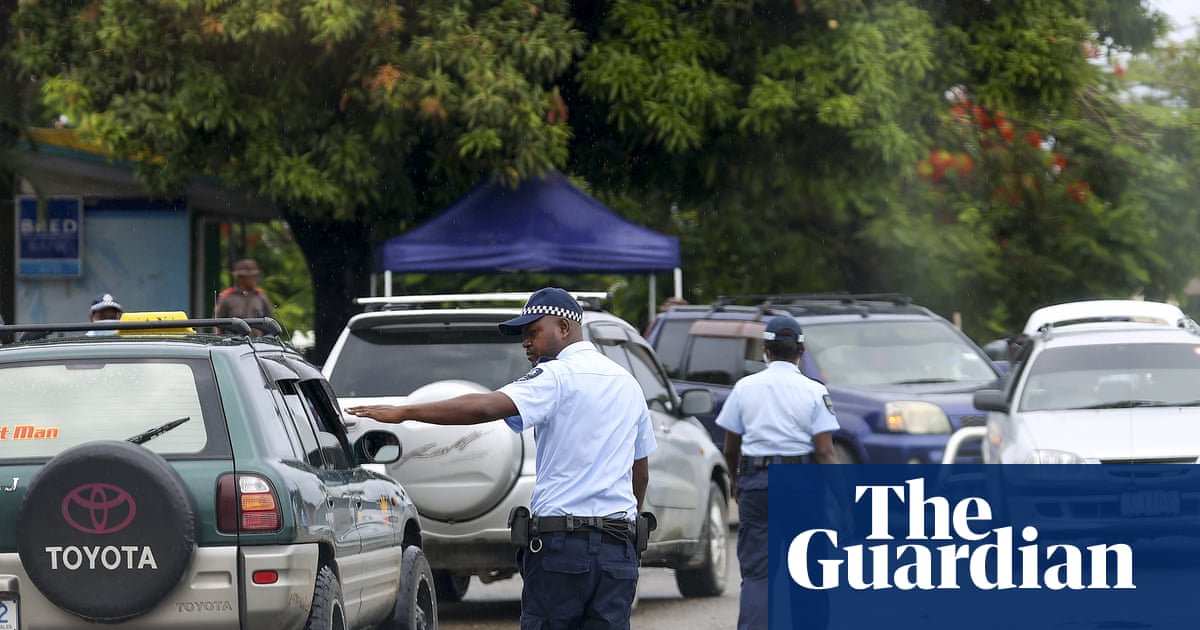
At a church hall on the outskirts of Honiara, dozens of community leaders gathered for a training session organised by the Chinese police, alongside local Solomon Islands officers.
Among them is Ben Angoa, who has enthusiastically embraced the training, as well as other things China has provided: solar lighting, sewing machines, soccer balls, and even noodle-making lessons.
“We really love China,” he says.
The sessions – along with the provision of blue uniforms, flashlights and fleets of police cars – are among the many ways Beijing supports Solomon Islands policing. They’re also a powerful reminder of the battle for influence, taking place across this strategically important nation; what Australian foreign affairs minister Penny Wong has characterised as the “permanent contest” to be the “partner of choice” in the Pacific.
For Angoa, the choice is simple. China has “impact in the community,” he tells the Guardian at the training session in late 2025, “and that’s something we don’t have from our other partners.”
But in the wider country there remain divisions over whose strategies are proving most effective.
“It’s hard to say who is winning,” says Associate prof Graeme Smith, a China and Pacific scholar at Australian National University, but their differing approaches reveal different strategies for the country. In recent years, Australia has concentrated on the police while China focused more on the communities the police are meant to serve.
“Australia’s approach is through formal partnerships and that excludes the involvement of community leaders. This approach obscures the fact that most disputes are managed by community leaders and not the formal police.”
Cars, advisers and community building
Australia has long regarded Solomon Islands as its patch. After a breakdown of law and order in the early 2000s, Canberra spent more than $2.3bn on a regional assistance mission, Lowy Institute analysis shows. The mission ended in 2017 with a reconstituted local police and sense of mission accomplished.
But in 2019, Solomon Islands switched its diplomatic support from Taiwan to China and three years later, signed a controversial security deal with Beijing. The subsequent arrival of Chinese police and advisers created anxiety in Canberra that Honiara was inching away from its sphere. Other countries are involved too – New Zealand supports Solomon Islands police as does, more distantly, the US.
In Solomon Islands, much of what China and Australia offer is the same: both provide advisers who rotate in and out of police stations. Both have also donated so many police cars that the Honiara police headquarters resembles a dusty used car lot. Australia and China have provided weapons, and officers from Solomon Islands travel regularly to both countries for training.
But there are also differences. Australia has focused on building the capability of the 1,100 strong police and ensuring it is fully equipped, with their programme budgeted at more than $170m, according to the Australian Federal Police. Solomon Islands government has recently requested even further support from Canberra, with Anthony Albanese’s government announcing an additional $190m in commitments in 2024. That initiative has reportedly now stalled.
Beijing provides far fewer staff – there are approximately a dozen Chinese police trainers in Honiara, three times fewer than the number of Australians – but their training sessions which have been rolled out across the capital, demonstrate the different approach China is taking in its engagements.
At the session in Honiara local leaders lamented problems within their communities: domestic violence, drunkenness, unruly youths, and dismal economic conditions.
ANU’s Smith described it as “the classic Chinese urban policing model which mixes control with paternalism”.
The training includes Solomon Islands police giving lectures on as the role of police in society and definitions of community policing. Angoa said he has been fingerprinted as part of the program but that didn’t bother him. He said he has provided fingerprints for voter registration and saw no difference. His sole complaint was his uniform didn’t fit.
China’s embassy in Honiara did not reply to the Guardian’s questions about Chinese support to the police.
‘Battle for hearts and minds’
In Solomon Islands, political figures are split on who they determine is the more favoured partner, and mostly value the support in all its forms.
“We can obviously see what’s going on,” says Daniel Waneoroa, the minister for rural development, who characterises international support as a “win-win” but admits coordinating multiple partners is challenging.
Felix Bosokuru, a former politician from Malaita province now in the property sector, believes China’s efforts are working.
“Australia needs to remix the record and stop playing the same song,” Bosokuru says. He was sceptical about Chinese efforts before attending a community leader training session, but his attitude is shifting.
For senior opposition figure Peter Kenilorea Jr, elements of the Australian-Chinese sparring are faintly farcical – “so many cars”- but notes the value of what has been provided. For example, Australia has given Solomon Islands two Guardian class patrol boats and without them “we wouldn’t have these patrol boats, we wouldn’t have the fuel to fuel them or the food to feed the crew when they go out.”
Still, he worries about the ramifications of the geopolitical jostling. It creates rifts within the police, he says, with senior figures perceived as pro-Beijing or pro-Canberra.
“There is a battle for hearts and minds going on” he says, noting how Australia recently erected large billboards around Honiara trumpeting its partnership with the police. And who is succeeding? “China is, definitely’, he replies.