Unlock the Editor’s Digest for free
Roula Khalaf, Editor of the FT, selects her favourite stories in this weekly newsletter.
I like inventing my own new year traditions, much more fun than pious resolutions. Two favourites: close out the old year with a forest holiday (preferably with the sighting of a tiger or two) and start January with rousing travel reading to get the blood moving.
Across Indian cinema and literature, no form of travel has been as romantically celebrated as the great Indian rail journey. Trains stood for the promise of modernity, enabling Indians to discover, and be startled by, themselves.
Two new books — one fiction, one non-fiction — offer striking portraits of the promise and reality of the railways. Rahul Bhattacharya’s second novel, Railsong, tells the story of the wonderfully named Miss Charulata Chitol, who squares up to life’s challenges without fuss, her journey running parallel to an India that changes direction between the 1960s and the 1990s.
At 16, our protagonist runs away from the fictional town of Bhombalpur in Bihar, heading for Bombay, as Mumbai was then called. Her train stutters across the “humongous” country, slowed by stoppages. Miss Chitol’s grungily epic journey takes seven days, in a packed coach where “over time, like melting ice cubes, people lost volume, wriggling their way into improbable openings”. She befriends a protective older woman, endures the dirty conditions, the “sweeps of warm dust” that blow through the wooden shutters. The crowds keep up a running commentary on the state of the nation.
At Bombay, “the thousands of inhabitants emptied out like a plagued village”, “infants, ambitions compulsions” pouring out into a city larger than anything this motherless girl has seen before. Years later, married and established as a railway woman, Chitol reflects on the village boys who run alongside the moving carriages. “Maybe they thought the trains would take them away to somewhere good, somewhere great, to a place they can have all they want.”
The novelist and artist Amitava Kumar folds a sensitive narrative into the 142 pages of The Social Life of Indian Trains: A Journey. “The railway lines that crisscross the country, and are longer even than our majestic rivers, bind the landscape into a whole and give it a sense of a nation,” he writes.
If India’s railways are portrayed by empire enthusiasts as part of a benign civilising mission, Kumar notes instead the “calamities of colonial railway construction”. From hard labour and deaths of workers to the fact that the railways led to the commercialisation of crop production, creating grain shortages and famines, progress extracted a price.
As he points out, most Indians who witnessed the Partition of 1947 have traumatic memories of trains. They offered the “best hope of fleeing the surrounding nightmare of violence”. But a stark image haunted my grandparents’ generation: as massacres escalated on both sides of the newly divided country, ghost trains crossed the border, carrying their grisly freight of slaughtered passengers.
Another side of the country comes into view soon after Kumar boards the Himsagar Express, which runs from the lower slopes of Kashmir to Kanyakumari at the southernmost tip of India. I took the Himsagar Express in 2004: an illuminating but also profoundly disconcerting journey. It is not a luxury train and covers 3,790km and 12 states in three-and-a-half days.
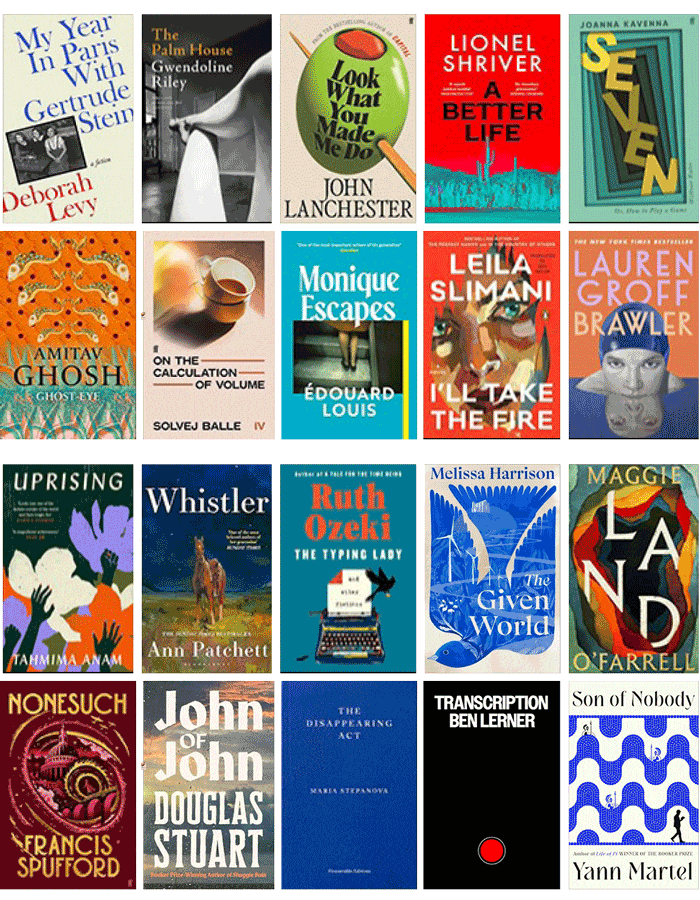
New reading for 2026
Books from Amitav Ghosh, Maggie O’Farrell, Ben Lerner and others — here are some of the top titles of the year ahead
Kumar has a knack for making friends, and feels lucky to have an assigned, air-conditioned berth, “suffering only from filthy toilets and close intimacy with loud passengers”. In the unreserved compartment, others are “packed in like people fleeing some devastating catastrophe”, many sleeping on the floor, trash scattered all over. The distance that separates the haves from the have-nots is on display, perhaps fitting on a train that promises to give travellers a full sense of their homeland.
But at night, the sound of snoring from different berths reminds Kumar “of the croaking of frogs, as if in a relay, in a village pond during the monsoon rains” — a touch of unexpected beauty that made me smile in recognition.
For all the gritty realism of their books, both Bhattacharya and Kumar spur you to get out and travel, across India, Asia, Europe. As Kumar said on a podcast with the Hindustan Times: “If the trains stop, the country will stop. We have to celebrate that, it’s a great thing, it connects our world.”
Join our online book group on Facebook at FT Books Café and follow FT Weekend on Instagram, Bluesky and X