Good morning and happy new year! Welcome back to India Business Briefing. Last week we analysed the big themes of 2025. Today, we look at what the economy, markets and the government will have to deal with in 2026.
India is a dichotomous country. This is both its beauty and its burden. With a population of 1.4bn spread over every possible economic class, most statements about the country can at once be proved to be both true and false. This has always been the case. Even so, in thinking about the three aspects of the country that are relevant for the readers of this newsletter — economy, markets and government — it feels like India is stepping into 2026 at its most dichotomous.
Economy
The economy is growing much faster than expected. GDP rose 8.2 per cent year on year in the July to September quarter. The Reserve Bank of India projects a 6.8 per cent rise for 2026, up from its earlier prediction of 6.5 per cent. The dichotomy here is that this growth is not felt by large sections of the population. Economic benefit is mostly accruing only to India’s affluent. This is well illustrated in property sales, for example, where value is growing but volume is not. Ultra-luxury apartments that cost more than $1mn get sold within days (often within the day) of launch. But middle-income housing projects are left with unsold inventory for several quarters.
There are two fundamental issues stifling the economic wellbeing of the large majority of India’s population. The first is unemployment. According to government statistics, unemployment touched a low of 4.7 per cent in November 2025. Yet every few weeks, local media reports show hundreds of thousands of applicants turning up to interview for less than a thousand job openings in various states. In urban areas, gig work is absorbing a large mass of the unemployed. While this is employment, these temporary jobs have no growth opportunities or safety nets. A large component of the growth in official employment numbers also comes from women’s employment, after the government modified the definition of work to include “unpaid helpers in family enterprises” as employed.
The second component of stress is the credit burden on the Indian middle class. RBI data showed that India’s household debt was over 41 per cent of GDP as of March 2025. Nearly half of this was for consumption, as opposed to mortgages for home buyers or other asset creation. Slower wage growth and higher levels of unemployment are forcing Indians to borrow to stay afloat. The household savings rate is still below pre-pandemic levels.
However, the overall macro outlook is still good. Inflation has been consistently low in the past few quarters, and the central bank will be tempted to cut interest rates further this year. The value of the rupee is the only joker in the pack, and its fate is likely to be determined by events in Washington and not New Delhi. So what will happen in 2026? The headline numbers will continue to impress. But unless real employment and wage growth rise, economic distress will continue in most sections. India will grow in 2026, but most Indians’ wallets will probably not.
Markets
The markets have the same problem as the economy. Technically, Indian stock markets made new highs in 2025, but portfolios do not reflect this. Benchmark indices moved up on a very narrow band of stocks. Small and medium caps had a lackadaisical year, with almost half the stocks posting negative returns and the remaining moving within a small range.
Overall, market predictions for 2026 seem to be cautiously optimistic, but even this is contingent upon corporate results. The other question is around liquidity. If the US Federal Reserve cuts rates, then there is hope that some of that money will find its way into the Indian market. But this is no longer a simple correlation. Last year, even after the Fed cut rates, foreign portfolio investors continued to withdraw from India.
For companies operating in the domestic sector, capital expenditure by the private sector and higher consumption will be the key metrics to watch out for. The beleaguered technology sector will get some relief if a trade deal with the US comes through. Even though services are not subject to Trump’s tariffs yet, a general sense that ties with the US are stable (especially over issues like H1B visas) will be important to the sector.
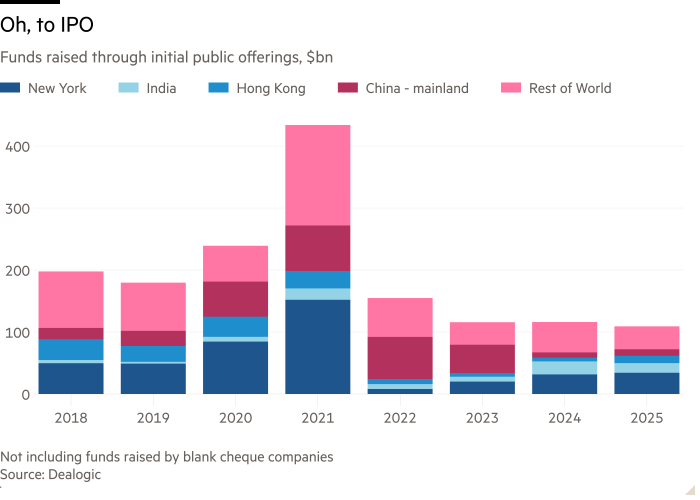
A substantial chunk of the market action in 2025 came from initial public offerings. The enthusiasm in the primary markets will continue, with all eyes on Ambani-owned Reliance Jio. Expected in the first half of the year, this will be one of India’s biggest public debuts.
The next big cue for the markets will be finance minister Nirmala Sitharaman’s budget. An exact date is yet to be announced but her speech usually happens in early February. I am curious to see what she will come up with. There are very few arrows left in her quiver.
Politics
Prime Minister Narendra Modi’s government is in a comfortable position. Four states go to the polls this year: Assam, Kerala, Tamil Nadu and West Bengal (and the union territory of Puducherry). The Bharatiya Janata Party’s prospects of retaining Assam are high. The southern states, which are traditional holdouts against the BJP, are unlikely to yield much. This leaves only West Bengal, where Modi’s party is going to put up a big fight to try to win. None of these are make-or-break elections, which gives the ruling party room to take some unpopular decisions if it has to, without worrying about electoral implications in the short term.
That being said, after 11 years of governing, the BJP-led alliance in New Delhi is losing some of its sheen. There is now room for more criticism about the government in the country’s living rooms and on social media. Even television channels that were extremely pro-government have begun to raise questions about some of its decisions. Most recently, the expansion of permission for mining the Aravalli range, an ancient geological formation, saw significant pushback from even the most favourable TV anchors.
On the other hand, the opposition has failed to put up a united front and has performed poorly in most state elections in the recent past. With his electoral strongholds remaining stable, Modi’s concerns for this year will largely be internal. (A succession challenge ahead of the 2029 elections cannot be ruled out, despite the prime minister’s popularity.) The question is how far the government will take advantage of the relative political stability to push its agenda forward. Will some unpopular decisions prove too unpopular? Even if we don’t find the answers to these questions in 2026, what will certainly be visible are the building blocks on which the BJP is likely to fight the big election in 2029.
Have I missed something? Do you have a prediction for how these will pan out for India in 2026? Hit reply or write to me at indiabrief@ft.com
We will revert to our regular format from Friday. We look forward to another year of keeping you informed about everything India and hearing from you often.
Recommended stories
Nicolás Maduro pleaded not guilty to US charges in a New York court after being captured in Caracas on Saturday. In Venezuela, the government has launched a crackdown on any show of support for the authoritarian leader’s ousting.
Mukesh Ambani takes on Coca-Cola and Pepsi for India fizzy drink supremacy.
India’s billionaires are struggling to woo Trump.
PwC is leaning into crypto as Trump and lawmakers embrace the sector.
The founders of Twitter and Pinterest have launched a new app, Tangle, as an antidote to social media.
Thank you for reading. India Business Briefing is edited by Tee Zhuo. Please send feedback, suggestions (and gossip) to indiabrief@ft.com.