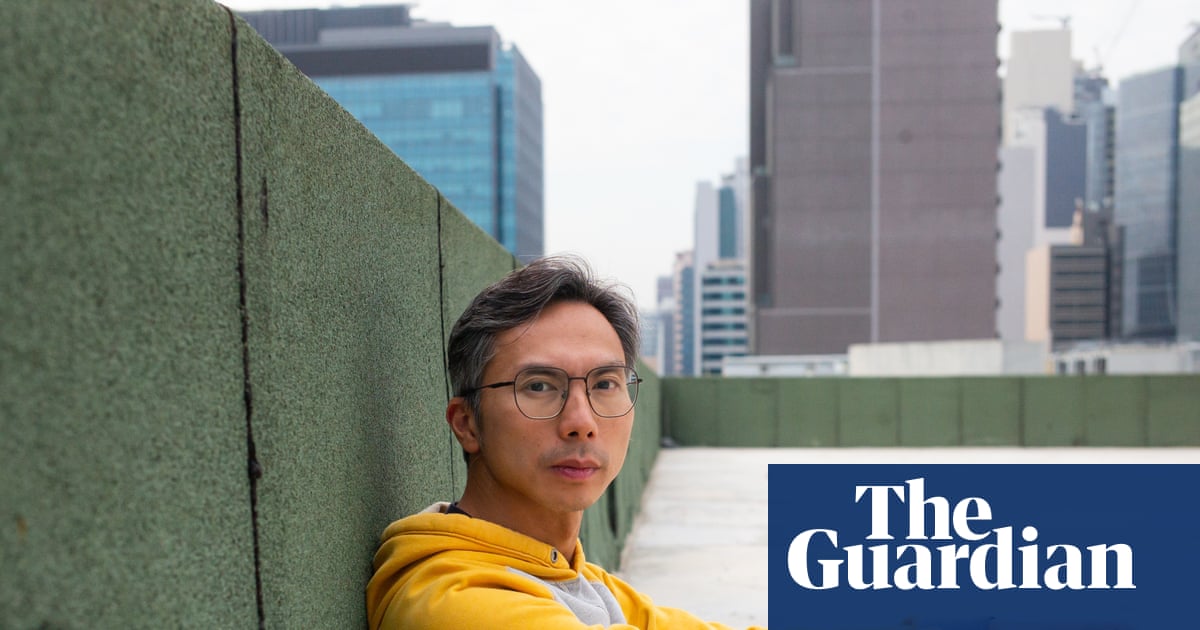
In Hong Kong, where dissent is now characterised by silence, few dare openly criticise the government or the Chinese Communist party (CCP) that controls it. Film-maker Kiwi Chow is one of the few.
“The Chinese Communist party’s practice is to try and destroy history and truth,” the 46-year-old director says from his home in the region. “It’s ridiculous that I can still live in Hong Kong without being in jail.”
In a society where someone can be jailed for wearing a “seditious” T-shirt, his surprise is understandable.
Chow is best known for co-directing the 2015 dystopian anthology film Ten Years, which imagined a future Hong Kong under the increasing influence of the CCP, and for Revolution of Our Times, his award-winning 2021 documentary about Hong Kong’s pro-democracy protests.
His latest film, Deadline, is about high school students haunted by threats of suicide in an environment of intense academic pressure. Chow says this has long been a problem in Hong Kong, but has been made worse by the region’s new national security regime.
Chow can still live in Hong Kong, and many of his films have been successful there, but his outspoken political views and works are making life increasingly difficult for him..
On 12 December, Hong Kong’s film censorship authority refused to grant approval for Deadline to be released, citing national security concerns. In a statement released after the refusal, Chow said that he would not appeal the decision, because doing so would be “futile”.
He added: “This film is the hard work and dedication from so many people – the investors, the actors, and the crew. It is heartbreaking to all of us. When confronted with injustice and absurdity, we feel helpless, and anger seems to be inevitable … In response to this the unfair judgement, my reaction is: I will stick to my filming path.”
Shelly Kraicer, an independent cinema curator specialising in Chinese film, says it is striking that Chow “doesn’t shy away from addressing quite directly the political constraints that he perceives he’s under”.
Much of Chow’s work deals with the upheavals that have shaped his home region. Most recently, the aftermath of the Wang Fuk Court fire, which killed at least 160 people in November, has brought further state pressure on dissent.
Less than a fortnight after the blaze, Hong Kong held “patriots only” legislative council elections, with only candidates vetted by the government allowed to stand. With Hongkongers reeling from the tragedy, and questions swirling about government accountability, the only way to safely voice dissent was by not voting. Turnout was at a near-record low of 31.9%.
Chow was one of the people who did not vote, but he has also been vocally critical of the government’s handling of the disaster.
“With collusion between officials and businesses, shoddy workmanship, lax oversight, rampant corruption and an unbalanced system, Hong Kong could not uphold professional standards,” he has said. “How long must Hong Kong endure this?”
The construction company that was doing renovation work on the compound at the time of the fire has not commented publicly on the tragedy. The consultancy in charge of the renovations reportedly closed down in the weeks after the fire. Directors from both of the firms have been arrested.
A Hong Kong government spokesperson said authorities were “going all out” to investigate the cause of the fire, and that several people had already been arrested on suspicion of manslaughter.
The fire was the biggest test of Beijing’s grip on Hong Kong since the 2019-20 pro-democracy protests, which were ultimately quelled by the imposition of a fierce national security law. The first sign that Chow was not going to be silenced by this came in 2021, when he released Revolution of Our Times, a two-and-a-half-hour documentary filmed from the frontlines of the protests.
The film, which premiered at the Cannes film festival, took its name from the banned protest slogan: “Liberate Hong Kong, revolution of our time”.
Now Chow’s latest film, which stars the legendary Hong Kong actor Anthony Wong, has in effect been banned from public screening.
In theory, Deadline, which was filmed in Taiwan and partly funded by the government there, isn’t as politically sensitive as his earlier works. Set in an unnamed Asian city, it tells the story of an elite private school where students buckle under the heat of intense academic competition. It was released in Taiwan on 7 November.
But Chow believes the authorities are trying to make an example of him personally by refusing to grant approval for the film. “They don’t want to arrest me, but they want to destroy my creative career,” he said.
Hong Kong’s Office for Film, Newspaper and Article Administration said it would not comment on the approval process for individual films.
Kraicer said Hong Kong authorities “seem to be more interested in controlling what kinds of films get shown there rather than controlling the film-makers themselves”.
Deadline deals with themes that are common across east Asia. But Chow believes the pressure on teachers and students is even more intense in Hong Kong, where national security is now part of the curriculum.
“What happens when history, society and truth need to be distorted in school?. Teachers can’t talk about it, students can’t talk about it. They feel that despite what’s happening in society, the truth is distorted.”
He adds that in the course of his research for Deadline, he spoke to a physical education teacher who was struggling with how to incorporate national security elements into his sports lessons.
The official response to the Wang Fuk Court fire reflects Hong Kong’s new national security-focused era. Several people were arrested for alleged national security offences in the days after the blaze, including a student who started an online petition calling for government accountability.
On 15 December, a court in Hong Kong found the pro-democracy activist and publisher Jimmy Lai guilty on national security offences, in the most high profile case the city has seen since the imposition of the law in 2020.
But Chow remains undaunted. He thinks the authorities are unlikely to arrest him, lest they bring more attention to his films. He concedes it could still happen, though. He’s discussed the possibility with his wife and says he would rather use his freedom to speak out while he can.
“Even if we left Hong Kong, the fear would linger,” he says, referring to Beijing’s increasing practices of targeting critics overseas. Instead, he says, “I want to stay in Hong Kong and get used to living with fear.”
Additional research by Ching Wong