Stay informed with free updates
Simply sign up to the Life & Arts myFT Digest — delivered directly to your inbox.
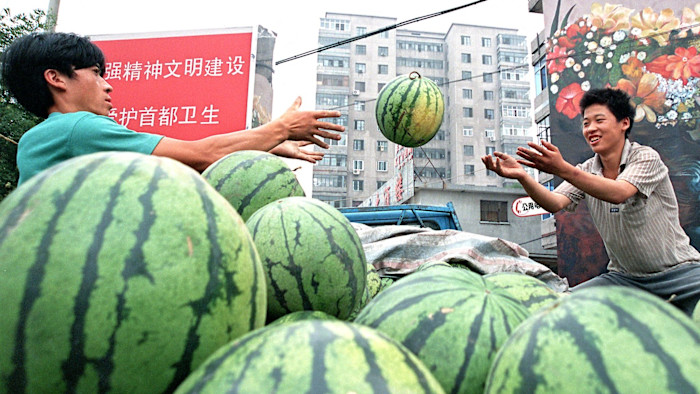
Each night this summer, millions of Chinese are gathering around television sets for a report that serves as basic a function as the weather forecast . . . the watermelon wrap-up.
It is high season for watermelons, and the streets of Peking, the Chinese capital, are lined with watermelon men thumping melons to prove to passers-by, who will consume nearly one watermelon a day and sometimes much more, that they are of the best quality. The Peking municipal government estimates that the city’s 9m population will eat 250m kg of watermelons during the summer. Families watch the television report in the eager way that a stockholder scours the share lists of a financial newspaper in the west.
Train robbed
Chinese work units have begun to enter into the spirit of the season by providing workers with a “watermelon allowance”. If a work unit does not have the connections to obtain good melons on the cheap, it will give staff a cash subsidy.
One Peking newspaper sent trucks deep into the countryside to provide workers with 25 watermelons each, although the melons were sold by the farmers on the condition that the newspaper’s staff collected the seeds and returned them to the farm.
The big news this season has been the “great train robbery”, and the fate of Lao Guixing and Zhang Minghua, the masterminds of the watermelon heist.
Several weeks ago, Lao and Zhang led 160 fruit vendors in an assault on a fully-laden train at Peking’s Yongdingmen station.
The gang members, some of whom rode to the scene on pedicabs, stole 25 tonnes of watermelons. But, a few days later, Lao and Zhang were caught, paraded on television with their heads shaved, and given life sentences for their crimes.
The watermelon season has gradually become more of an event since China launched its economic reforms in late 1978, and allowed farmers to control crops.
Local farmers say bad weather has reduced the crop slightly this year, and prices are certain to rise from the 80 US cents that it takes to buy a quality melon.
One melon man, Xiao Liu, who sells from the back of a bicycle trailer in the east of Peking, claims to earn about $700 a month, which is more than twice the average annual urban wage in China.
He explained the complex art of picking a good melon: when thumped, the ideal thick-skinned model will give off a dull thud and not too many vibrations.
Xiao Liu goes in for the hard sell. Showing the flair that China now encourages, he has painted on his melons the characters for “extra special quality”. He also showed his skills with a knife in what Chinese call “killing a melon”.
Garlic crop
While Xiao Liu has done well out of economic reform, a group of garlic farmers from Cangshan, in Shandong province on the north coast, recently showed their displeasure with the way local officials were managing the reforms by storming the local government building armed with garlic.
The garlic crop in the region has been too successful and, according to the official China Legal News, the problem has been exacerbated by sloppy distribution by local officials, with the result that garlic prices have plunged.
An angry farmer and his wife rode to the government building in a cart full of garlic and told officials that they came bearing gifts. The couple then began throwing garlic around the offices, and were soon joined by other irate farmers in what the Chinese press has dubbed “the Cangshan garlic incident”.