Stay informed with free updates
Simply sign up to the Technology sector myFT Digest — delivered directly to your inbox.
The world’s biggest robot vacuum cleaner maker is betting on artificial intelligence to transform the market for the household device.
Beijing-based Roborock, a major rival to Roomba maker iRobot which fell into bankruptcy this week, hopes to grow in Europe and the US with products containing AI-powered features such as robotic arms and dog excrement recognition, said president Quan Gang.
“Chinese companies are betting on high-value AI innovations and have little to worry about when it comes to hardware supply chains,” he said. “We’re all in. The output will come quickly, and the changes will be significant.”
Quan’s remarks came as iRobot, a pioneer of the category, said this week it would be taken over by its Chinese supplier, Shenzhen-based Picea, after years of falling behind lower-priced and faster-moving rivals.
iRobot helped introduce robotics into the home with its Roomba vacuum cleaner in the early 2000s but was later undercut by companies with more novel products, including a combination mop and vacuum that iRobot long spurned.
Gary Cohen, iRobot’s chief executive, said to the Financial Times this week that the company had failed to take its competition seriously and did not deliver as straightforward a user experience as rivals.
In the first nine months of this year, five Chinese companies made up 66 per cent of the global robot vacuum cleaner market, according to data from research group IDC. Roborock topped the list with more than 21 per cent, while iRobot had fallen off the world’s top five this year.
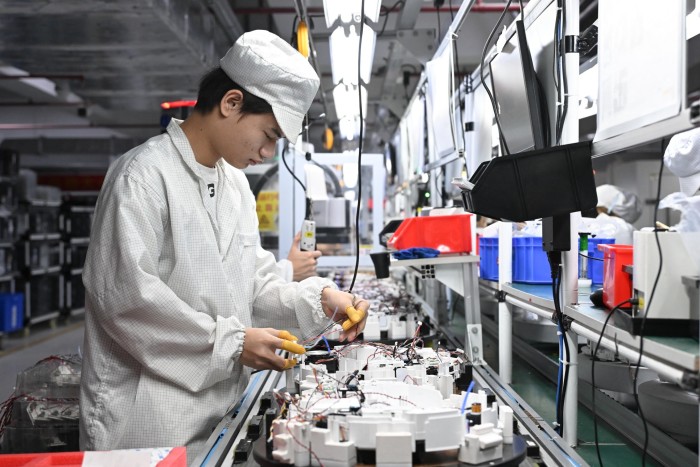
“In terms of physically building things, China already has advantages that no other country can match,” said Quan, citing the country’s vast electronics supply chain. “At the same time, in software and AI, we [benefit] both from government support and from the industry’s agility to adapt to the trend.”
The company is using self-developed and open-source AI models to train its vacuum cleaners to perform tasks such as picking up socks and automatically cleaning up after meals.
Quan said AI integration would help Roborock compete globally and avoid the so-called involution plaguing China’s manufacturing sector, in which excessive competition has driven down prices and squeezed margins.
“Investing in new technology . . . is something we must do,” he said. “Otherwise, we’ll end up caught in the same kind of cut-throat competition as the [domestic] auto industry.”
Taylor Ogan, founder of Shenzhen-based hedge fund Snow Bull Capital, said one advantage of Chinese manufacturers was their focus on integrating AI into hardware, while western technology companies were emphasising chatbots and software.
“AI is not purely software,” he said. “You can’t build AI without tremendous advanced hardware. The actual end products [are] becoming more blended in China . . . but in the west, it’s still just large language models.”
Roborock said iRobot’s takeover by Picea would introduce a “new type of player” that merges Chinese manufacturing technology with global brand recognition.
“At this stage, it’s still too early to fully judge how this integration will reshape the market,” the company said. “However, our approach remains the same regardless of how competition evolves.”
Quan said Roborock had ambitions to be number one in the US — where it currently leads in the premium segment but not in the mass market — by expanding its presence in brick-and-mortar stores.
The company has a dedicated production facility in Vietnam to supply the North American market in response to US President Donald Trump’s tariffs.
“We’re not panicking, as this is what all [Chinese] businesses are dealing with,” Quan said. “We have a strong sense of risk awareness.”