Good morning. Today we explain why — and how — the EU will loan Ukraine €90bn borrowed against the bloc’s budget, and why Germany’s environment agency is downplaying the impact of the EU diluting its combustion engine phaseout.
Have a great weekend, and a wonderful winter break. We will be back on January 5.
Fumble
EU leaders have agreed to fund Ukraine with a €90bn loan backed by the bloc’s shared budget for the coming two years, but only after a painstakingly developed “reparations loan” idea using Russia’s immobilised assets was cast aside, write Paola Tamma and Laura Dubois.
Context: Ukraine needs urgent funding or risks going bankrupt by the second quarter of next year, which is why EU leaders gathered in Brussels yesterday pledged to find a solution.
The one they came up with in the early hours of this morning wasn’t the original plan of using €210bn of Russia’s immobilised assets in the bloc to back a loan to Ukraine.
Belgium, which hosts the majority of those assets, had staunchly opposed the plan. After France and Italy also floated concerns, the mood among the other leaders shifted. An alternative was quickly tabled and swiftly agreed: collectively taking on €90bn in joint debt, plus interest costs. Hungary, Slovakia and the Czech Republic will be exempt.
“To be honest, I don’t like to be here at four in the morning,” EU Council President António Costa told reporters. “But I like that we have delivered on financing Ukraine for the next two years.”
From Kyiv’s perspective, there is little difference in the outcome. Ukraine will only have to pay back the loan once Russia pays war reparations, and the debt would not weigh on its already aggravated finances.
Leaders also pledged that “the assets will remain immobilised and the union reserves its right to make use of them to repay the loan.”
But that would require a peace deal, and another separate decision by EU leaders. Meanwhile, successive EU budgets will absorb the cost.
“Nobody will pay this loan back,” said an EU diplomat.
The winners of the summit include Ukraine, but also Russia-friendly countries, and Belgium.
Germany and the European Commission, which spearheaded the idea of the reparations loan, were left to defend the outcome.
German Chancellor Friedrich Merz, who has staunchly opposed any joint EU borrowing, said “this is in my view a very practical, good solution that in its impact is exactly like the solution that we had long discussed — but was clearly just too complicated.”
Belgium’s Prime Minister Bart De Wever, meanwhile, was jubilant.
“We proved that the voice of small and medium-sized member states also counts,” De Wever told journalists. “You should not complain about the colour of the cat; if it can catch a mouse it is fine.”
Chart du jour: Polarisation
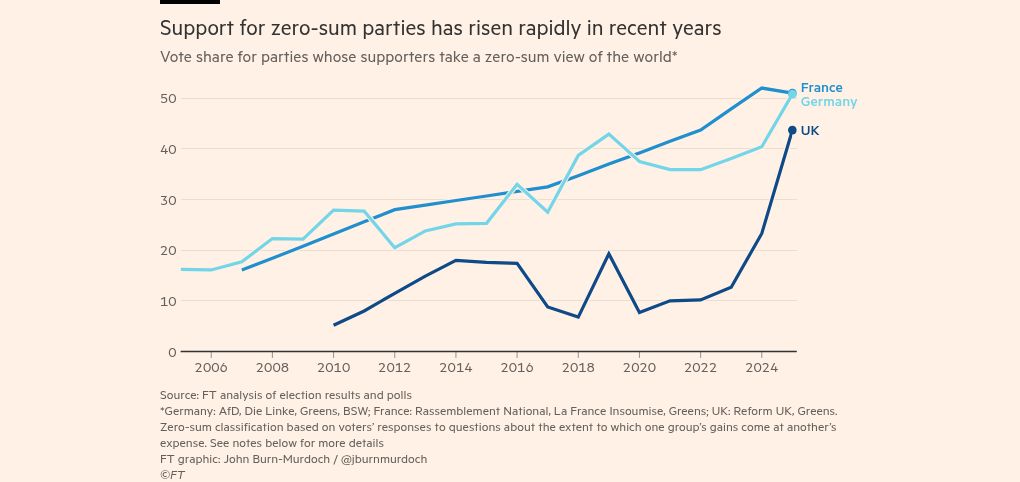
For the past decade, a dominant political narrative across much of the developed world has been the rise of the populist right. But that story has since become more complicated, writes John Burn-Murdoch.
Driving forward
The head of the German Environment Agency (UBA) has played down the importance of the EU scrapping its 2035 combustion engine ban, arguing that China has already set the pace for vehicle electrification, write Alice Hancock and Laura Pitel.
Context: The European Commission on Tuesday watered down rules that required carmakers to hit zero tailpipe emissions by 2035, a flagship part of the bloc’s ambitious Green Deal climate law.
Instead, manufacturers will be allowed 10 per cent of their 2021 emission levels as long as they make cars using green steel or vehicles that run on renewable fuels.
Dirk Messner, president of UBA, said that he was “not very happy” with the decision but that it was “not so important because the real standards for the global automobile market is now coming from China, and China has a very clear strategy, and the strategy is electrification”.
Messner, who is also a member of several environmental forums with China, said that Europe had become too backward-looking and focused on traditional industries.
“China is moving very dynamically into a green economy perspective with huge investments in innovation and infrastructure around these kinds of issues,” Messner said. “We in Europe are managing these kinds of elements down currently . . . the European Green Deal is under stress.”
He noted that German Chancellor Friedrich Merz, in a bid to boost the bloc’s energy-intensive industries, had hosted summits for the steel sector and combustion engine carmakers in recent months but not for innovative clean technologies.
“We don’t have summits about the digital-driven autonomous driving systems which might come up . . . Looking into the future and building the competitive advantages of the future, I think this is what would make the difference.”
What to watch today
Ukrainian President Volodymyr Zelenskyy travels to Poland, meeting Polish President Karol Nawrocki in Warsaw.
Now read these
Bypassing export bans: China’s semiconductor manufacturers are upgrading their advanced chipmaking equipment with the help of the Netherlands’ ASML.
Silver screen: From Ukraine’s trenches to covert moviemaking in Iran, click here for the FT’s 10 best films of 2025.
Christmas flights: Airlines are on track for the biggest holiday season getaway in history as industry braces for a record 300mn flights.
Are you enjoying Europe Express? Sign up here to have it delivered straight to your inbox every workday at 7am CET and on Saturdays at noon CET. Do tell us what you think, we love to hear from you: europe.express@ft.com. Keep up with the latest European stories @FT Europe