Unlock the White House Watch newsletter for free
Your guide to what Trump’s second term means for Washington, business and the world
Tractor maker Deere has warned that US President Donald Trump’s tariffs are backfiring on American farmers, prompting cash-strapped producers to delay replacing ageing equipment.
Cory Reed, president of the company’s agriculture and turf division, told the Financial Times that demand for expensive farm equipment in the US is faltering as growers contend with weak crop prices, higher input costs and persistent trade uncertainty.
“The large ag business has seen the most pressure, and that’s largely in the North American market,” he said in an interview in New York, referring to its unit that sells high-horsepower tractors, combines and sprayers, along with its precision agriculture technology.
“Most of that downturn was our home market, here in the US. It wasn’t the European market and it wasn’t the South American market.”
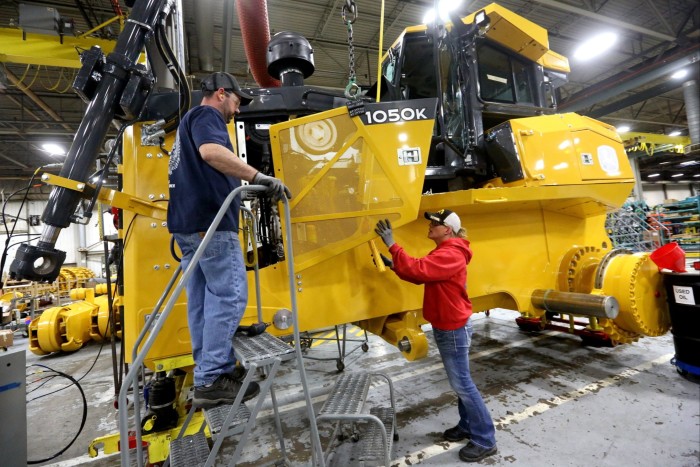
The strains have pushed Deere to slash production at its flagship tractor plant in Waterloo, Iowa, with the group “building half as many tractors this year as we did two years ago”, Reed said.
Reed added that the world’s biggest farming equipment maker is planning further job cuts in 2026 after several rounds of lay-offs in recent years.
He said: “Our US market has been the one under the most pressure . . . based on what’s happened with trade flows, what’s happened with tariffs and what’s happened with the escalating cost structure internally, as we’ve seen that market cycle down.”
The pressure stems from the disruption to agricultural trade. China, traditionally the largest buyer of US soyabeans, only resumed purchases of American beans last month after retaliating against new tariffs on Chinese goods.
The pause created a supply glut that has weighed on farmer sentiment and pushed prices lower: US soyabeans are down about 40 per cent from their mid-2022 highs and corn almost 50 per cent.
The Trump administration on Monday announced a $12bn aid package for farmers — including $11bn in one-off payments to crop growers — after soyabean producers reported heavy losses and farm bankruptcies rose nearly 50 per cent over the first nine months of 2025.
While the White House said the assistance would provide “much-needed certainty”, growers warned it would not fully offset months of depressed prices and disrupted trade.
Reed reiterated guidance that sales in Deere’s large agricultural machinery business are expected to fall 15 to 20 per cent in its 2026 fiscal year.
Deere’s overall net income fell 29 per cent to $5bn in the year to November 2, and it expects profits to weaken further to between $4bn and $4.75bn in 2026.
Stress across the farm belt is deepening. The Federal Reserve Bank of Chicago said loan-repayment rates in the Midwest fell for the eighth consecutive quarter in the three months to September, while nearly half of surveyed agricultural lenders expect more forced sales or liquidations of farm assets this winter.

With crop prices down, many growers are unwilling to commit to six-figure machinery purchases, opting instead to extend the life of existing equipment. Reed said used inventories, which had swelled over the past two years, had only recently begun to clear.
“Customer uncertainty” had led to muted demand, said Reed. “If you’re a farmer and you’re trying to make a capital equipment decision, and you’re not sure what exactly your export market is, [you’re less likely to buy].”
Tariffs have also pushed up manufacturing costs. Duties on steel and aluminium have lifted US steel prices, even for manufacturers sourcing materials domestically. Deere expects tariffs to impose a $1.2bn pre-tax hit in 2026, double the $600mn absorbed this year, with the burden running at roughly $300mn a quarter, according to its latest guidance.
Trump singled out Deere’s Mexico business during his presidential campaign in 2024, threatening a 200 per cent tariff on equipment brought into the US if production moved south.
Reed said the episode highlighted how closely Deere’s US and Mexican plants were tied and forced a rethink of its manufacturing footprint. The company is still investing on both sides of the border, including more than $20bn in the US.
Tariffs have also undermined the competitiveness of US-built equipment overseas. “One in four of our large tractors we build in the US get exported to places like Europe or Canada,” Reed said. “That’s put pressure on the competitiveness of our cost structure going into those parts of the world. So we’ve had to aggressively go after cost.”
Reed said he expected the downturn to bottom out in early 2026 “as some of that certainty returns”.
Trump’s bailout package, lower interest rates, a new bioethanol policy and signs of improving agricultural trade flows — including more grain exports and firmer domestic consumption — were “positive indicators”, he said.
But restoring predictable market access through trade deals would be decisive: “Getting the free flow of commodities back out of the US into the global market.”


