Unlock the Editor’s Digest for free
Roula Khalaf, Editor of the FT, selects her favourite stories in this weekly newsletter.
Residents of a riverside housing estate on the outskirts of Singapore’s bougie Tiong Bahru neighbourhood were alarmed to discover two five-foot high metal fences had been erected across their shady communal badminton court last month.
The imposing structures were put up by the local council following months of complaints over Singapore’s latest antisocial scourge: pickleball.
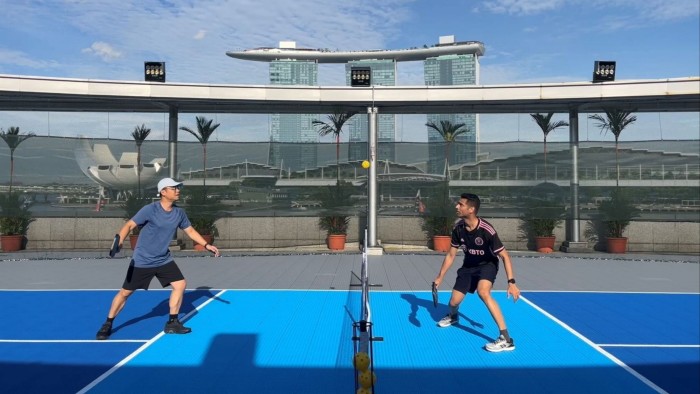
The paddle sport — which combines elements of tennis, badminton and table tennis — has taken off in the affluent city-state in recent years, part of a global wave of popularity for a game that is easy to learn and lends itself to socialising.
Yet in congested Singapore — a country of 6mn people living on an island less than half the size of Greater London — it has become a lightning rod issue, pitching enthusiastic picklers against neighbours driven mad by the sport’s relentless “pock, pock, pock” soundtrack.
The metal fences in Tiong Bahru are designed to prevent pickleball games from being played on the badminton courts. “It’s a ridiculous decision,” says Roger Ho, a retired army physical training instructor, who now coaches pickleball and competes in international competitions. “There were signs already in place [limiting play time] and Singaporeans are obedient citizens. All these iron fences have done is create more hazards.”
There has been an active pickleball-playing community in Singapore for at least three decades but for years it was known as an old man’s game. Only as worldwide enthusiasm has grown has the game been more widely taken up by younger players.
As recently as 2014, there were fewer than 20 pickleball court bookings a month in sports centres across Singapore. This rose to nearly 8,000 a month in the first half of this year. The number of participants in the Singapore Pickleball Association’s annual competition has jumped from just over 400 to more than 2,100 in the past three years.
Singapore’s year-long heat and humidity means games naturally take place in either the early morning or late evening. And many of these outside matches are played in communal sports spaces in the country’s government-subsidised housing estates, where about 80 per cent of the population lives.
This is the cause of the arguments. Pickleball’s perforated plastic ball makes a high-frequency noise when struck by the hollow paddle. But when played in repurposed badminton courts within the high-rise housing projects, the sound has a tendency to ricochet and travel far.
Complaints over pickleball noise have hit records, with more than 700 raised over games played in housing estates in the 18 months to August. The issue has become a key concern for municipal councils and has led to questions in parliament. Disputes between neighbours are becoming a growing problem.
Facing complaints from residents, some local authorities are weighing up more restrictions on when pickleball matches can take place. Many councils already have already limited playing time from 8.30am to 9.30pm, though this window could shrink.
Another possibility councils are considering is setting up new courts specifically designed for pickleball next to roads and away from homes. But in a heavily populated island where land is already scarce, finding different locations is tricky.
Unsurprisingly in entrepreneurial Singapore, the dilemma has prompted some to spot a business opportunity. Other cities enduring the same public backlash against the sport’s growing popularity could take note.
Instructors like Ho have set up training centres, renting space in parks away from residential buildings and putting up canvas-covered courts to limit sound pollution. Elsewhere, several of Singapore’s high-end hotels have built rooftop courts and offer coaching to guests.
Another suggestion is for players to use specially adapted quieter equipment, such as paddles with a thicker polymer core and so-called “silent” foam balls. But these tend to be unpopular with players, who crave the satisfying pop as they hit the ball.
“The bounce is the same, but the feeling when you hit it is different,” says Ho. “The sound just makes us feel better sometimes.”