This is an on-site version of the White House Watch newsletter. You can read the previous edition here. Sign up for free here to get it on Tuesdays and Thursdays. Email us at whitehousewatch@ft.com
Good morning and welcome to White House Watch. In this edition, we’ll be looking at:
Donald Trump’s relaxation of export controls on chip sales to China
Increasing tensions between the US and EU
The battle for Warner Bros gets political
Donald Trump has decided to let Nvidia export its powerful H200 chips to China, a significant step that solidifies what appears to be a dovish turn from Washington towards Beijing at the contested intersection of economics, technology and national security.
The move has already sparked concern among some US security officials and lawmakers over access to advanced technology for artificial intelligence, Demetri Sevastopulo and Michael Acton report.
“Selling large numbers of H200s to China will give rocket fuel to the Chinese AI industry,” said Chris McGuire, a tech expert at the Council on Foreign Relations who held senior roles in the White House and the state department during Joe Biden’s administration.
McGuire added that Chinese tech group Huawei “admits it cannot build a chip better than the H200 for at least two years. This will give Chinese AI firms the computing power they need to close the gap with the US”.
The US president announced the move in a Truth Social post, saying Chinese President Xi Jinping had already responded “positively” to the move and that the conditions for the sales would “allow for continued strong national security”.
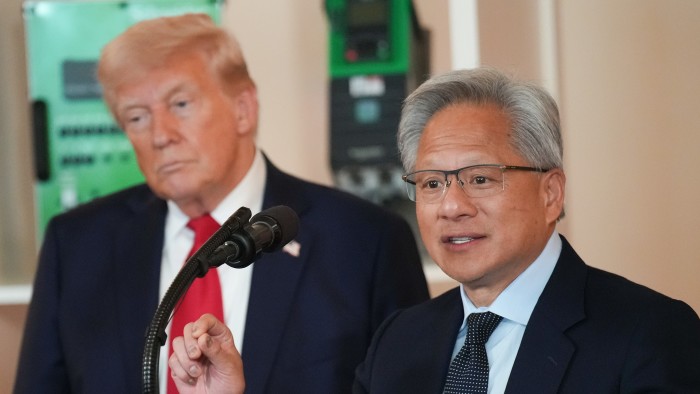
There are few additional details of the arrangement so far, but Nvidia shares jumped on the back of the administration’s decision, which caps a major effort by chief executive Jensen Huang to court Trump and senior US officials.
The decision also highlights the influence of David Sacks, the White House AI tsar, who believes, along with Huang, that restricting exports of US chips handicaps American companies and hurts efforts to make the world reliant on the country’s AI chips and technology.
There could still be opposition on Capitol Hill and in China that could stymie the move. But it signals a big shift from the Biden administration’s approach, which imposed sweeping export controls on chip-related technology in an effort to slow the modernisation of China’s military.
In addition, it shows how Trump has decided to take a more conciliatory stance towards Xi during his second term, including during an October summit in South Korea where they patched up a spat over China’s rare earths export restrictions and extended a lower tariff regime in place since May.
The latest headlines
Trump is heading to Pennsylvania today to try to improve his approval ratings on affordability and the cost of living. But he is presiding over a “K-shaped” economy that could be hard to defend and many voters are unhappy with.
How did Paramount launch a hostile takeover bid for Warner Bros Discovery with the support of Jared Kushner, the president’s son-in-law, to scupper an agreed deal with Netflix that is rattling Hollywood? Here’s an inside look.
Trump has announced a $12bn bailout for farmers hit by his trade policies, including retaliatory tariffs and higher input costs.
Japan has asked the US to be more vocal in its support after Beijing reacted furiously to Prime Minister Sanae Takaichi’s comments about Taiwan.
The US president has said he will sign an executive order to prevent US states from individually regulating AI, in a move that is likely to inflame tensions within his own Maga coalition.
The Federal Reserve is expected to cut borrowing costs again at the conclusion of its rate-setting meeting tomorrow. However, economists polled for the latest FT-Chicago Booth survey say there are deep divisions within the central bank.
What we’re hearing
Tensions are rising sharply between the US and the EU. Late last week, the White House released its national security strategy, which called for “cultivating resistance” with Europe, cementing the growing rift between Washington and Brussels and triggering shock and outrage in the capitals of some of America’s staunchest allies.
But rather than attempting to address European concerns about the foreign policy manifesto, US officials have been doubling down on their criticism, particularly of the EU, on the back of the move by Brussels to impose a €120mn fine against Elon Musk’s social media platform X.
“Europe has to be very careful. They’re doing a lot of things. We want to keep Europe Europe. Europe is going in some bad directions,” Trump said at the White House on Monday.
“It’s very bad — very bad for the people,” he added. “We don’t want Europe to change so much.”
Trump said the Musk fine was “a nasty one”, but he insisted that the billionaire had not “called me to ask for help on that one”.
The rhetoric coming out of Washington about Europe has certainly taken a turn for the worse — and could damage the relatively solid relationship Trump has built up with EU Commission president Ursula von der Leyen this year, which led to a deal being hatched over the summer to limit US tariffs on EU goods.