Unlock the White House Watch newsletter for free
Your guide to what Trump’s second term means for Washington, business and the world
Thailand has launched air strikes on Cambodia after border clashes that killed one Thai soldier, marking the collapse of a Donald Trump-brokered peace deal between the south-east Asian neighbours.
Each side accused the other of instigating the renewed outbreak of violence, which is the most serious since a five-day conflict in July killed at least 48 people and displaced an estimated 300,000.
The Thai army said on Monday it had retaliated after Cambodian troops opened fire in Ubon Ratchathani province, killing one Thai soldier and injuring eight. Cambodia also used BM21 rocket launchers to strike a civilian community in Buriram province, the army said.
The Royal Thai Air Force said Cambodian actions “posed a direct threat to Thailand’s national security, the safety of border-area residents and Thai personnel operating in the region”. The air force said it targeted only military installations.
Cambodia’s defence ministry accused its neighbour’s forces of initiating what it called “brutal and inhumane” attacks on its troops. Thailand has engaged “in numerous provocative actions for many days . . . with the objective of instigating confrontations”, the ministry said in a statement. Cambodia has not retaliated and continues to monitor the situation, it said.
The renewed hostilities derailed a truce brokered by Trump to end the July fighting, the deadliest confrontation between the neighbours in a decade over a border dispute that has dragged on for over a century.
In a statement, Hun Sen, Cambodia’s influential former leader and the father of current Prime Minister Hun Manet, referred to Thai forces as “aggressors”, and called on Cambodian troops to “be patient”.
“The red line for responding has already been set,” he said.
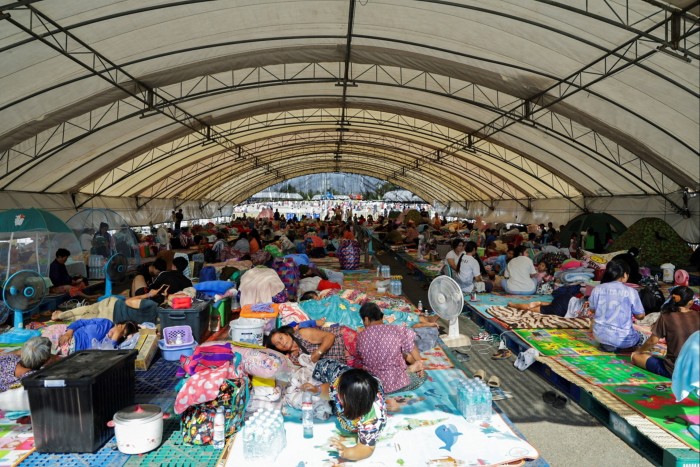
At the heart of the conflict are competing territorial claims over several temples along the countries’ shared 800km border and surrounding areas.
One of the biggest flashpoints is the 11th-century Preah Vihear temple, which Cambodia claims based on a 1907 map created during French colonial rule. The International Court of Justice awarded jurisdiction of the temple to Cambodia in 1962, but Thailand has continued to maintain a military presence in the area.
The two countries agreed to a ceasefire in July after the US president threatened to halt negotiations on US tariffs on their exports, on which both economies rely. In October, they signed a peace accord in Trump’s presence in Kuala Lumpur, at a summit of the Association of Southeast Asian Nations.
However, tensions have continued to simmer. Thailand unilaterally called off the deal in November, as it accused Cambodia of laying new landmines that injured several Thai soldiers along a disputed border. Cambodia rejected Bangkok’s allegations, saying it was committed to the peace deal.
Malaysia’s Prime Minister Anwar Ibrahim, who mediated the ceasefire talks and oversaw the signing of the peace agreement, said he was “deeply concerned” by reports of the renewed fighting and urged both sides to “exercise maximum restraint”.
Tita Sanglee, an associate fellow at the Iseas-Yusof Ishak Institute, said the truce was bound to fail, because it “was effectively pushed through by major external powers and Malaysia as the Asean chair”.
“Beneath all of this lies a territorial dispute that is utterly difficult to resolve, with both countries using vastly different maps and holding fundamentally different approaches to resolution,” she added. Thailand favours bilateral talks, while Cambodia is pushing further for ICJ rulings.
“Both sides are likely to hit harder now, seeking advantage on the ground before the next ceasefire,” she said. “Whether it ends quickly will hinge on how and when external powers choose to intervene.”