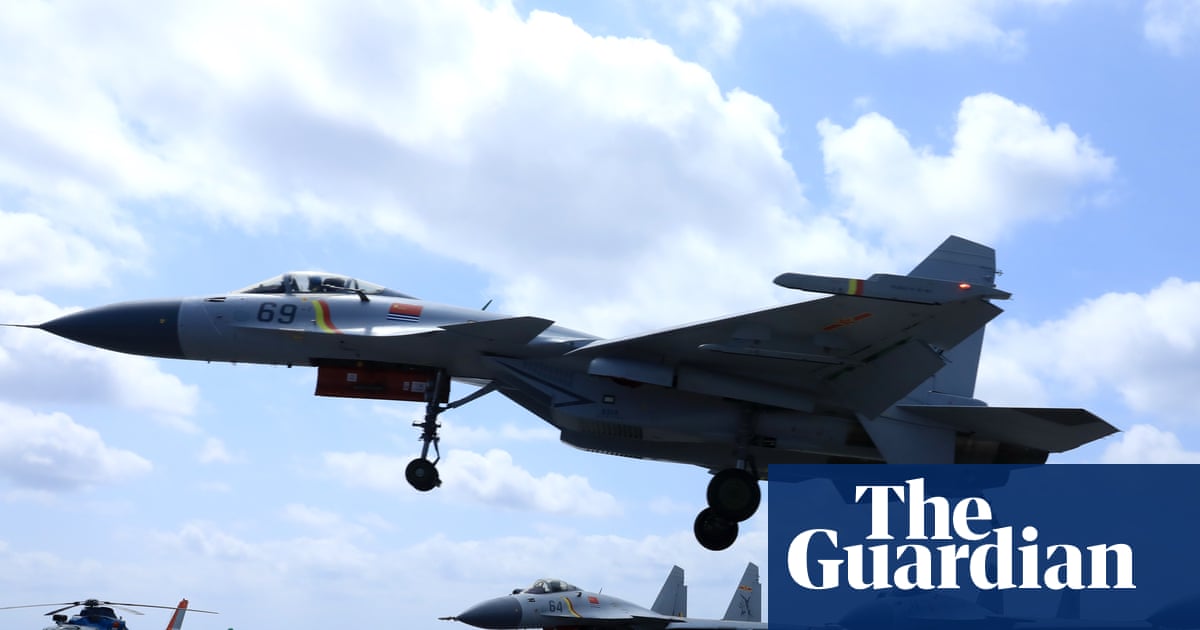
The diplomatic dispute between Japan and China appeared to deepen over the weekend after Chinese military planes were accused of locking their radar on to Japanese fighter jets near the Okinawa islands.
Japan’s prime minister, Sanae Takaichi, vowed to “respond calmly and resolutely” to the alleged incident, saying her country would take all possible measures to strengthen maritime and airspace surveillance and closely monitor Chinese military activities. The country’s foreign ministry also summoned China’s ambassador on Sunday. China’s government has roundly rejected Japan’s accusations, instead lodging its own counterprotests.
The alleged incident occurred south east of Okinawa’s main islands, where China’s People’s Liberation Army (PLA) said it was conducting “far-sea training”. Japan’s defence ministry said it recorded about 100 fighter jet take-offs from China’s Liaoning aircraft carrier.
The ministry said Chinese J-15 fighter aircraft from that carrier directed their fire-control radar on to Japanese F-15s twice – at 4.32pm and again about two hours later on Saturday. Visual confirmation was not possible due to the distances involved, it said, and no damage or injuries were caused.
A fire-control radar lock is one of the most threatening acts a military aircraft can take because it signals a potential attack, forcing the targeted aircraft to take evasive action.
It was the first time Japan’s defence ministry has disclosed a radar lock by Chinese warplanes, Japan’s Kyodo news agency reported.
The Japanese defence minister, Shinjiro Koizumi, said on Sunday the incident was “dangerous and extremely regrettable”.
“These radar illuminations went beyond what is necessary for the safe flight of aircraft,” he said.
On Sunday vice-foreign minister Funakoshi Takehiro summoned China’s ambassador, Wu Jianghao, and “made a strong protest that such dangerous acts are extremely regrettable”, according to the ministry.
China has disputed Japan’s claims as “completely inconsistent with the facts”, instead accusing Japan’s self-defence forces of having “maliciously followed and harassed” its Liaoning aircraft carrier group while it was conducting training drills.
The Japan side was “repeatedly sending aircraft to intrude into the exercise and training zones that China had demarcated and announced in advance,” said senior Col Zhang Xiaogang, spokesperson for China’s defence ministry, on Sunday.
A Chinese foreign ministry spokesperson on Sunday told Japan to “immediately stop its dangerous moves of harassing China’s normal military exercise and training”.
“The Japanese side, by hyping up the so-called issue of ‘radar illumination’, is deliberately making a false accusation against China to build up tension and mislead the international community,” the spokesperson said.
The incident is the latest in weeks of spiralling bilateral disputes, which began after comments by Takaichi – that a PLA attack on Taiwan could trigger Japanese military involvement in the conflict – sparked outrage in China.
Insisting that Japan could exercise its right to collective self-defence – or coming to the aid of an ally – Takaichi said Tokyo had to “anticipate a worst-case scenario” in the Taiwan Strait. The remarks prompted Donald Trump to urge Takaichi to avoid further escalation in a dispute with China.
Takaichi has refused to withdraw her remarks, saying that Japan’s position has not changed. Japan’s postwar constitution forbids it from using force as a means of settling international disputes but a 2015 amendment – passed when Takaichi’s mentor, Shinzo Abe, was prime minister – permits it to exercise collective self-defence in certain situations, even if it is not directly under attack.
In response Beijing has launched a range of diplomatic and economic retaliatory moves, including reimposing a ban on Japanese seafood into China, and sending military and coast guard vessels and planes into the disputed waters of the Senkaku Islands and close to Japan’s outlying Okinawan territories near Taiwan. Chinese state media has also revived a campaign questioning Japan’s territorial claims over the Ryuku Island chain, which includes Okinawa.