Unlock the Editor’s Digest for free
Roula Khalaf, Editor of the FT, selects her favourite stories in this weekly newsletter.
A majority of Hongkongers have sat out legislative elections held after last month’s deadly fire in a residential high-rise as authorities struggle to win a mandate for their new, “patriots only” system of governance.
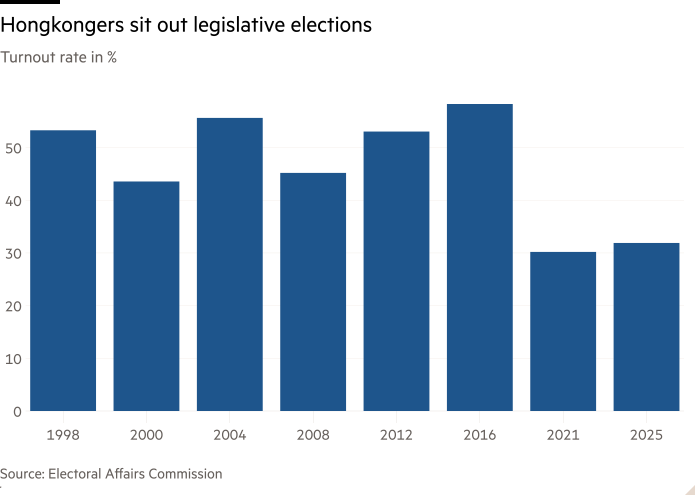
On Sunday 31.9 per cent of the 4.1mn registered voters cast ballots for directly elected seats in the Legislative Council, less than two weeks after a fire in the Tai Po district engulfed seven apartment buildings and killed 159 people.
That is a marginal improvement from a 30 per cent turnout in 2021, the first election held under the “patriots only” system, where only pre-approved candidates are allowed to stand.
“Credibility has become an issue for Hong Kong elections . . . people no longer see them as relevant,” said Steve Tsang, director of the Soas China Institute in London. “This became even more of an issue as people have been prohibited to articulate their views freely over the Tai Po fire.”
The low turnout came despite an extensive government push to bolster participation, including targeted advertising campaigns, extended polling hours and shuttle buses to ferry residents from fire-affected districts to polling stations.
As voting proceeded, Hong Kong’s anti-corruption watchdog said it had arrested four people on suspicion of inciting others not to participate or to cast invalid ballots through comments left on social media.
The four arrested were all men aged between 33 and 41. Abstaining from the election is legal in Hong Kong, but inciting others to do so is not.
The commission “is determined to uphold a clean election and will not tolerate anyone to interfere”, it said in a statement, adding that seven others had been arrested earlier.
On the eve of the election, the Chinese central government’s national security office in Hong Kong summoned foreign media, including the Financial Times, saying that some outlets had spread false information and smeared the government in their recent reporting on the Tai Po fire.
“Do not say that you have not been warned,” said a security officer, who declined to give his name or cite any examples of false reports.
While elections in Hong Kong prior to 2019 were hotly contested between “pro-democracy” and “pro-establishment” camps — the 2016 election had a 58 per cent turnout — many voters now feel little motivation to participate, according to analysts.
Hong Kong authorities have struggled to manage public feelings about the fire, which burned for two days. The use of substandard mesh netting and styrofoam boards during renovation works is thought to have contributed to the rapid spread of the blaze.
Criticism of the government’s response has been tightly constrained. National security police have detained several people, including a university student who launched a petition calling for an independent investigation.
Additional reporting by Robin Harding in Hong Kong