Unlock the Editor’s Digest for free
Roula Khalaf, Editor of the FT, selects her favourite stories in this weekly newsletter.
Prime Minister Narendra Modi and President Vladimir Putin have graced billboards across India in recent weeks. One caption reads: “The dialogue began decades ago. We’re just turning up the volume.” Another hails the “old friendship” between the two nations.
The campaign, for the launch of state-owned Russia Today’s television news channel in India, comes ahead of Putin’s arrival in New Delhi on Thursday for talks that India’s foreign ministry said would cover all aspects of the countries’ “special and privileged strategic partnership”.
The annual India-Russia Summit, which Putin founded 25 years ago, aims to strengthen a relationship that dates back to the cold war and has been solidified by energy and defence co-operation.
But those ties have been strained by tensions with the west over Moscow’s invasion of Ukraine and US tariffs on New Delhi over its purchases of Russian oil.
“There are challenges to the India-Russia relationship, particularly because of India’s increasing engagement with the west and the toxicity of Russia in the west,” said Nandan Unnikrishnan at the Observer Research Foundation think-tank in New Delhi. “But India is never going to give up on Russia totally.”
Putin’s spokesperson Dmitry Peskov told reporters on Tuesday that discussions over sales of fighter jets and surface-to-air missiles — both of interest for New Delhi — would be “high on the agenda” this week.
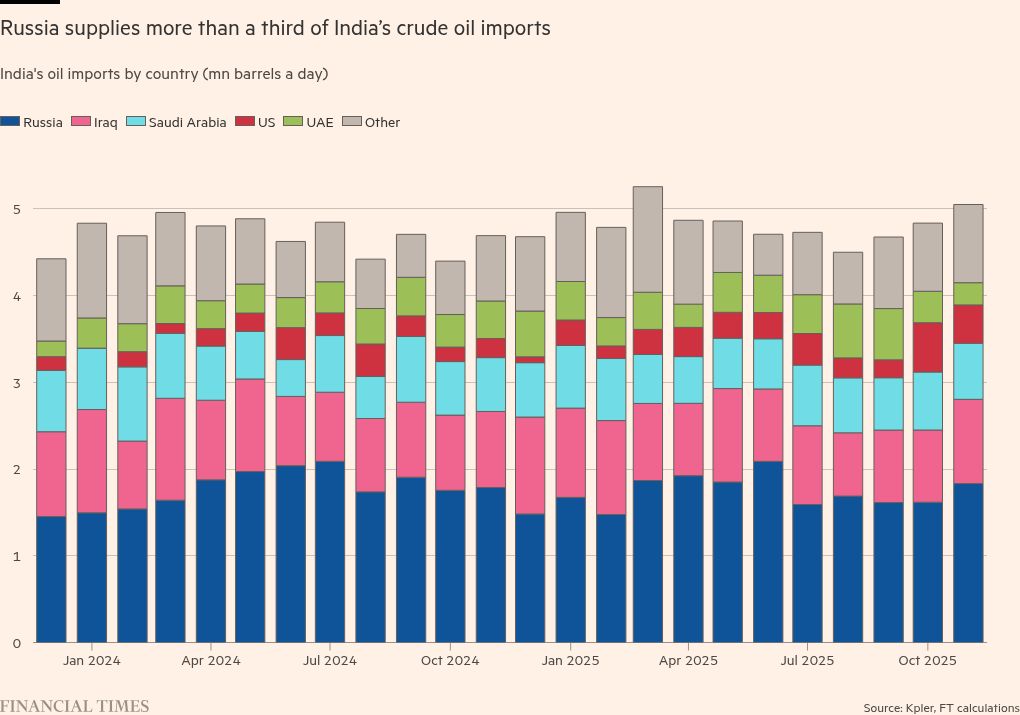
Putin’s last visit to India was in December 2021, just before he launched his full-scale invasion of Ukraine in February 2022. Since then, India has become Moscow’s largest buyer of seaborne crude, importing nearly $140bn worth of Russian oil, government data shows.
Donald Trump has accused Modi of helping fund Putin’s war machine and complained that “India buys most of its oil and military products from Russia, very little from the US”. In August, he imposed a 25 per cent punitive tariff on Indian goods, bringing Washington’s total levies to 50 per cent. Moscow said such measures amounted to illegal trade pressure.
India has curtailed some oil purchases since then. Reliance, the owner of India’s largest private oil refiner, said late last month that it would stop using Russian crude following US sanctions on Russian oil producer Rosneft.
But “a complete halt to Russian imports is unlikely because discounted Russian barrels remain attractive”, said Sumit Ritolia, a lead India analyst with Kpler.
The Nayara Vadinar refinery, which is backed by Rosneft and located in Modi’s home state of Gujarat, is still buying Russian crude. The facility, India’s second-largest, is subject to UK and US sanctions, but has not been targeted directly by the US.
“Even though strategically, the most important partner India has globally today would be the United States, the volatility of Trump’s White House gives an additional boost to the relationship with Russia,” said Ajay Bisaria, a former senior Indian diplomat who specialises in India-Russia relations.
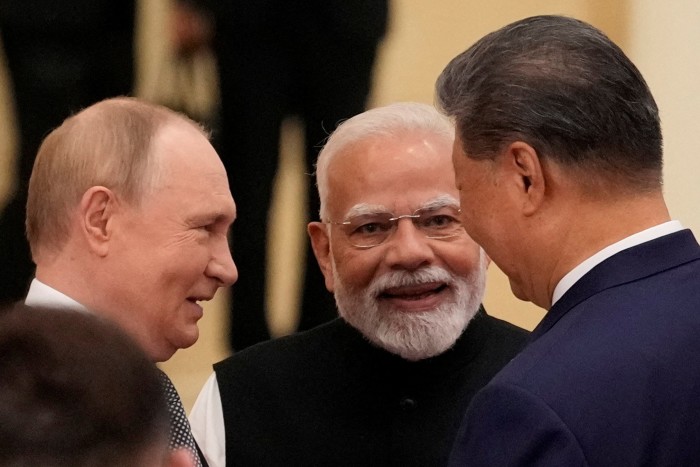
Ties between Moscow and New Delhi date back decades. When India went to war with Pakistan in 1971 to support the creation of independent Bangladesh, the Soviet Union openly backed then-prime minister Indira Gandhi — even sending nuclear submarines to the Bay of Bengal — despite fierce opposition from the US, which sided with Islamabad.
In recent months, top Indian officials have made a flurry of trips to Russia to shore up ties in the face of Washington’s pressure. Modi and Putin held an hour-long conversation in a limousine at a security forum in China in September. Later that month, New Delhi sent dozens of troops to the Zapad military exercises — drawing criticism from Brussels.
India’s trade in goods with Russia was $68bn in the financial year ended in March, up from $13bn in 2022 but about half the figure of the comparable figure for $132bn with the US, New Delhi’s largest trading partner. About $50bn of the trade with Russia was oil imports.
US and EU currency restrictions have made it difficult for Russia to repatriate oil profits, resulting in billions of rupees accumulating in India by early 2023. Moscow even drew up a list of electronics and other sensitive goods to exchange for the funds.
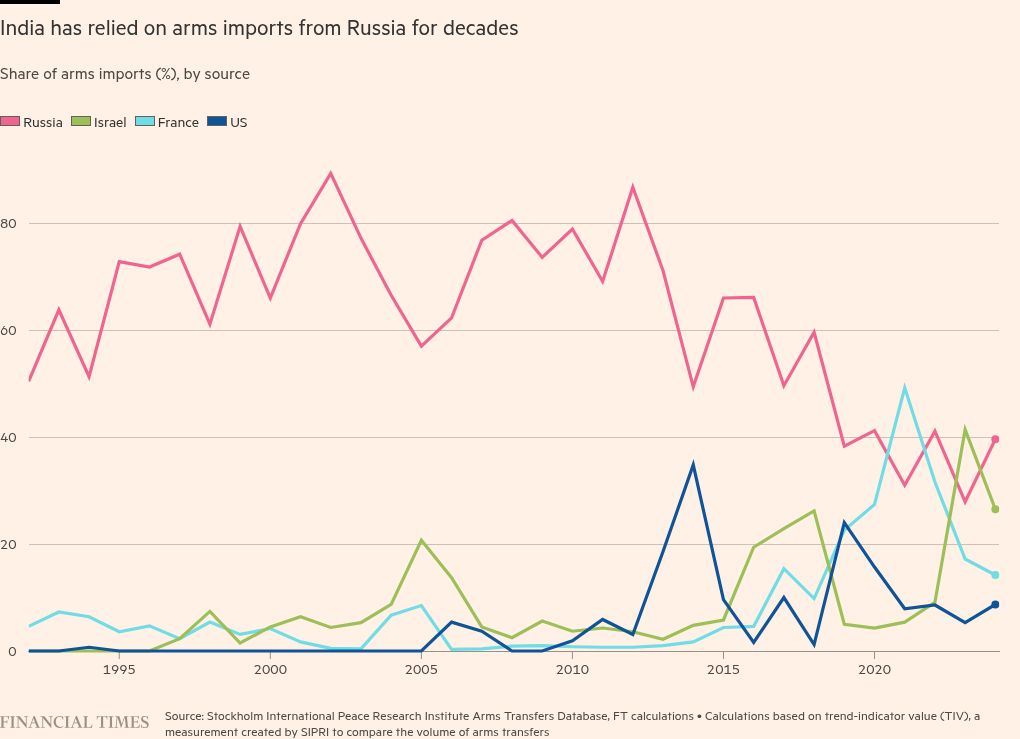
India-Russia co-operation was “not confined to oil”, noted Chietigj Bajpaee, senior research fellow for South Asia at Chatham House.
Russia has helped India build its civil nuclear capability and has a deal to build six nuclear power plants. The chief of Russian state-owned nuclear monopoly Rosatom is due to join Putin on the trip to discuss expanding civilian nuclear co-operation.
India, world’s biggest weapons importer, has also long relied on Russian arms, even as it has been also buying from the US, Israel and France.
Peskov confirmed there would be discussions about India acquiring more Russian S-400 air defence systems, which New Delhi used during a brief conflict with Pakistan this year, and possibly Su-57 fighter jets.
India has explored leasing a nuclear attack submarine, a prospect that has been delayed by the war in Ukraine.
India Business Briefing
The Indian professional’s must-read on business and policy in the world’s fastest-growing big economy. Sign up for the newsletter here
The two countries jointly produce BrahMos missile, which New Delhi fired in this year’s conflict with Islamabad, and which it is selling to the Philippines with Moscow’s approval.
Military ties are set to deepen. Russia’s lower house of parliament on Tuesday ratified an agreement with India that would allow deployment of troops, warships and aircraft to each other’s territory.
The Russians “have been our friends through both fair and foul weather”, India’s defence secretary Rajesh Kumar Singh said last week. “We are not going to stop our defence co-operation with them anytime soon.”
Data visualisation by Haohsiang Ko in Hong Kong