Unlock the Editor’s Digest for free
Roula Khalaf, Editor of the FT, selects her favourite stories in this weekly newsletter.
Hemachandran Kannan is director of the AI Research Centre at Woxsen University and Raul Villamarin Rodriguez is vice-president of the university, in Hyderabad, India
Last year, Farida Group, one of India’s largest shoemakers, became a symbol of the country’s importance to global supply chains when it announced a Rs10.1bn ($114mn) investment in an export facility at a 150-acre site in Tamil Nadu. But in August 2025 the group — which supplies brands such as Cole Haan and Clarks — was hit when Donald Trump announced the imposition of tariffs totalling 50 per cent on Indian exports, citing the continued purchase of Russian oil.
New orders dried up and the Tamil Nadu project froze. By late October, further uncertainty emerged when the US president signalled an imminent trade deal with India that could reduce tariffs from 50 to 15 per cent. Should companies invest in capacity now or wait for potential relief?
Last year, $87bn in exports to the US, India’s largest trading partner helped generate a $45.8bn trade surplus while the country’s footwear, textiles, jewellery, leather goods and chemicals industries had built substantial market presence across US retail chains. Yet suddenly, India’s export growth looked vulnerable.
“With 25 per cent tariffs, you can still work, negotiate with buyers and make adjustments in profits,” Rafeeque Ahmed, chair of Farida told India’s Business Standard. “At 50 per cent you don’t have anything.” Farida, with 23,000 employees, relies on US exports for 60 per cent of its business.
Test yourself
This is part of a series of regular business school-style teaching case studies devoted to business dilemmas. Read the text and the articles from the FT and elsewhere suggested at the end (and linked to within the piece) before considering the questions raised. The series forms part of a wide-ranging collection of FT ‘instant teaching case studies’ that explore business challenges.
The choices for Farida were, first, to continue exporting to the US while pursuing aggressive cost reductions, raising prices and renegotiating contracts with brands such as Cole Haan and Clarks. A second option was pivoting towards European, Asian and Middle Eastern markets where tariffs are lower. A third alternative was to scale down production of goods destined for the US and redirect capacity towards domestic markets or niche global segments. This would limit its exposure but undermine its Rs200,000 annual export volume and risk reduced margins.
For policymakers, options included diplomatic negotiations with Washington and leveraging India’s strategic importance in the region and its role in the “China Plus One” manufacturing strategy, designed to diversify supply chains. They could deploy emergency relief measures such as easier bank financing, wage subsidies and tax breaks for affected exporters. They could also explore long-term structural reforms to accelerate market diversification and strengthen domestic demand.
Other policy options — maintaining Russian oil purchases, engaging in diplomatic negotiations with Washington, or accelerating domestic stimulus for affected exporters — carried implications far beyond trade economics, touching on geopolitical alignment, energy security and industrial policy priorities.
India’s textiles and apparel exports, valued at $11.37bn annually to the US, now face competition from Bangladesh and Vietnam, where tariffs remain at 20 per cent. A third of India’s exports of gems and jewellery are to the US, contributing 7 per cent to GDP and employing 5mn people. Marine products, chemicals and automotive components confront similar competitive disadvantages.
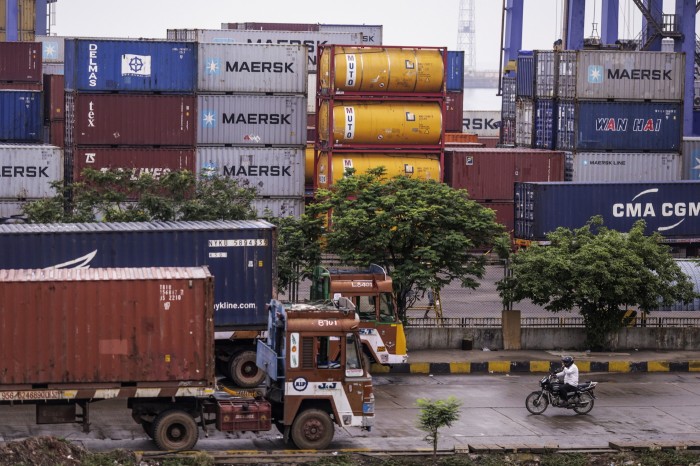
As the situation evolved, the Modi administration indicated in October that India and the US were “very close” to finalising a trade deal, with negotiations linking tariff cuts to reduced purchases of Russian oil. The government provided targeted relief: subsidised bank financing (via lower interest rates) for labour-intensive exporters such as footwear makers; accelerated market diversification to Vietnam, Indonesia and Africa, where tariffs are lower; and stimulated domestic demand through increased government procurement for military boots, police footwear and school uniforms. A nationwide “self-reliance” campaign was also launched, emphasising domestic consumption and positioning India as a credible alternative to China in the global “China Plus One” manufacturing strategy.
Farida had already begun to diversify. In September, it partnered with Taiwan-based CJ Enterprise to produce New Balance footwear. Simultaneously, it accelerated expansion plans, based on a calculated bet that tariffs would be negotiated down or new customer relationships would offset US market losses.
In the coming years, successful diversification could reduce Farida’s reliance on US buyers and build resilience against future trade shocks. However, establishing new supply chains and customer relationships can take 18-24 months, during which time the company will face cash flow pressures and workforce reductions.
For India, the crisis could accelerate manufacturing competitiveness improvements. The textile and apparel industry employs 45mn people directly, making policy support crucial to avoid mass unemployment. Emergency relief measures would provide immediate support for labour-intensive exporters but prove costly.
Questions for discussion
Further reading:
Indian rupee tumbles to new low on Trump tariff concerns
Donald Trump tariffs threaten Narendra Modi’s ‘Make in India’ drive
In charts: What Donald Trump’s tariffs mean for India’s economy
How India can trump US tariffs
Effects of tariff and non‐tariff barriers on India‐US agricultural trade
Consider these questions:
• Rather than waiting for a trade deal resolution, Farida Group invested a further Rs2bn in a Phase 2 expansion of the initial Rs10.1bn facility in north-west Tamil Nadu (to launch in January 2026) and committed Rs12bn to a nearby Phase 3 production site. Was this expansion wise, or does it expose the company to unacceptable risk if trade negotiations stall? What would you have decided as chief executive, and why?
• Farida’s partnership with Taiwan-based CJ Enterprise to produce New Balance footwear represents diversification into new brands and 16 international markets. How does this differ from its traditional Cole Haan/Clarks model? What are the risks of becoming a contract manufacturer versus building proprietary brands?
• Instead of simultaneously pursuing trade negotiations and deploying emergency relief measures, should the government have prioritised one strategy over the other? What are the fiscal and political costs of maintaining both approaches?
• India was asked to reduce Russian oil purchases as a condition for tariff reduction. How should Modi’s administration weigh energy security and geopolitical alignment against export competitiveness? What would be the domestic political consequences of either choice?
• Government procurement initiatives were designed to absorb “a portion” of production capacity diverted from the US. What percentage of Farida’s current US-bound capacity could realistically be absorbed by domestic Indian government contracts? What are the structural limits?
• Vietnam and Bangladesh faced 20 per cent tariffs while India faced 50 per cent. How did this create an opportunity for competitors? If you were a US retailer, would you shift orders, and under what conditions might you return to Indian suppliers after a trade deal?
• Farida faces three paths simultaneously: absorbing tariffs through cost-cutting; diversifying to new markets via the New Balance partnership; and reducing US exposure and focusing domestically. In what order should the company sequence these investments given cash flow constraints?
• What contingency plans could manufacturing companies such as Farida have developed before the tariff shock? How can companies use this crisis to build resilience against future geopolitical trade disruptions?