Unlock the Editor’s Digest for free
Roula Khalaf, Editor of the FT, selects her favourite stories in this weekly newsletter.
The EU is preparing to reject a demand from India to be exempted from its carbon border tax, a move that will complicate efforts to seal a trade deal between the two by the end of the year.
Delhi has suggested it levy its own export fee on products that would be liable for the carbon charge, such as steel, aluminium and fertilisers, rather than be subject to the EU import duty which is set according to how much carbon is emitted during their manufacture.
The EU carbon border adjustment mechanism — CBAM — aims to level the playing field for European heavy industry, which must buy permits to emit carbon based on market prices, currently around €80 a tonne.
But four EU officials said the Indian idea, under which India would charge exporters based on value not carbon content, would not incentivise manufacturers to cut greenhouse gas emissions. They also fear setting a precedent because the US and other trading partners are also pushing for exemptions.
However, Brussels was prepared to reduce levies on imports covered by CBAM if India introduced a domestic carbon pricing scheme, one of the EU officials said. The Indian government is consulting on whether to do so.
“There can be discussions around how any Indian effective carbon pricing could be deducted from CBAM, but not an exemption,” the official said.
The issue is important to both sides in the negotiations, because the EU is India’s biggest trading partner in goods, ahead of the US. Bilateral trade topped $139bn in the 2023-24 fiscal year, according to the Indian government.
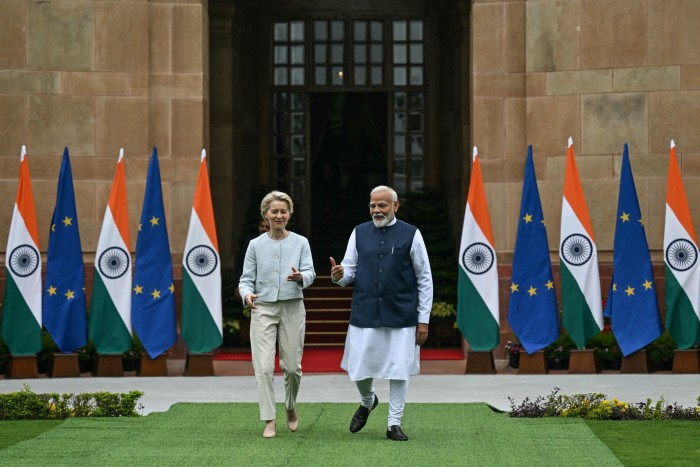
Indian Prime Minister Narendra Modi and European Commission president Ursula von der Leyen agreed in February to push to seal the trade deal this year, spurred by Donald Trump’s return to the White House.
Both India and the EU face heavy tariffs from the US, a key export destination, and are under pressure from industry to find new markets.
India also has high tariffs on imports, some hitting more than 100 per cent on key EU exports such as cars, spirits and dairy products. European luxury goods makers are targeting India’s growing middle class and huge population.
In late October, India’s trade minister Piyush Goyal met EU trade commissioner Maroš Šefčovič in Brussels where they explored “possible landing zones on the outstanding issues”, the Indian government said in a statement.
“There was also a good discussion on India’s concerns on non-tariff measures and the new EU regulations,” it said, adding that both sides “agreed that issues related to steel, auto, CBAM and other EU regulations still require further discussion, as these issues have higher sensitivities”.
Earlier this year Indian officials acknowledged that the CBAM, under which the EU plans to levy tariffs from January, has been a bone of contention and said it would affect trade as it could hit India’s heavy industry.
Before re-engaging in negotiations with the EU, India denounced the CBAM — which also covers cement and chemicals — as a “trade barrier”.
India also objects to other recent EU unilateral green trade measures such as a ban on imports of some products if they contribute to deforestation, although implementation of this has been delayed after international criticism.
Earlier this month, a senior team of negotiators from the EU visited New Delhi for further talks focused on “core areas, including trade in goods, trade in services, rules of origin among others along with technical and institutional matters”, the Indian government said.
“Both sides agreed to further accelerate efforts towards achieving a balanced trade agreement” with the aim of “concluding the India-EU FTA negotiations at the earliest”, the Indian government said.
Talks began in 2007, but the effort foundered in 2013. They restarted in 2022.
Modi is trying to modernise India’s domestically focused manufacturing. His government has signed trade pacts with Australia, the UK and European Free Trade Association of non-EU members, and is negotiating one with the US.
Indian trade officials did not reply to requests for comment. European Commission trade spokesman Olof Gill said: “We remain focused on securing a mutually beneficial deal before the end of the year, as per the stated intentions of President von der Leyen and PM Modi.”