HK Patil stood to address the legislature of the south Indian state of Karnataka. It was early this March and the burly, softly spoken state law minister with a distinctive mop of silver hair was about to table a new and controversial bill.
The proposed law sought to end decades of conflict over the ownership of Bangalore Palace, a late-19th-century Tudor-style mansion set within expansive grounds just a short distance from where Patil stood amid a legislature that was ready to descend into acrimony.
In the heart of India’s tech hub Bangalore, now officially renamed Bengaluru, the state would be allowed to appropriate the Palace’s 472 acres of prime city-centre real estate from its owners, the royal family of Mysore, and its 33-year-old titular maharaja, Yaduveer Krishnadatta Chamaraja Wadiyar. The bill also sought to nullify more than $300mn-worth of compensation that India’s Supreme Court had previously said was owed by the state to the family.
It was a sticky situation, politically speaking: the young maharaja had been elected the year before as an MP for India’s ruling Bharatiya Janata party. But the BJP sits in opposition in Karnataka. As Patil, a member of the rival Congress party, spoke, BJP assembly members began shouting and gesticulating furiously in support of the royal family. At one point Patil struggled to make himself heard. The speaker pleaded for order. “Wait, let him talk!” he bellowed.
Normally composed, Patil banged his fist on his desk. He warned that the court-mandated compensation, due after the state government earmarked a 15-acre portion of the estate to widen adjoining roads, would be ruinous for the state. “If we accept the order, this 2km stretch will become the costliest stretch in the world.”
Amid the tumult, the law was passed, as BJP politicians walked out in protest. One party leader alleged there was a “political vendetta” at play. But the confrontation was only the latest turn in a saga centring on the rights and wealth of India’s once mighty monarchs.
Since India’s freedom from British rule in 1947, the Wadiyar kings have waged a slow battle for control over their historic real estate, including another palace in the neighbouring city of Mysore (now officially named Mysuru). The dynasty, and wider Urs community they belong to, have been dogged by litigation, infighting and family rifts, flitting between political parties in an attempt to stay relevant and protect their legacy and traditions.
“When you become a nobody, it becomes easier for the government to go after you,” said Manu Pillai, a historian who has written about the Wadiyars. “But if you remain a somebody, then your voice still has some authority and power and you’re able to use it to protect what you have.”
Bangalore Palace is a local landmark, open to the public and receiving a few thousand weekly visitors. It has hosted touring performances from Aerosmith, Elton John and Iron Maiden in the heart of the city.
In September, I headed towards the lush tree-lined grounds of the palace, to learn about the building and its royal owners. A late monsoon downpour lashed the bumper-to-bumper traffic. Snack vendors huddled beneath umbrellas, near a stern sign announcing that the property belonged to Her Highness Pramoda Devi Wadiyar, the 73-year-old widow of the previous maharaja. Low turrets and parapets rose up covered in ivy, like a miniature Windsor Castle — an inspiration for the expansion and transformation of the original structure, a European-styled manor, bought and renovated by the then Mysore king in the 1800s.
On arrival, I met Michael Ludgrove, curator of the Wadiyar stock of art and antiques, and my guide through the palace’s rambling interior. A mounted elephant’s head loomed over one doorway and in a small room, beneath portraits of magnificently moustached and turbaned maharajas of old, Ludgrove settled on a wooden bench as the tourists ambled past.
Ludgrove first met the Wadiyars during a more than two-decade career working across the UK, Australia and India at the auction house Christie’s. He valued the then maharaja Srikantadatta Narasimharaja Wadiyar’s library. Ludgrove remembered Srikantadatta as a “charming character” with a deep passion for art and jewellery. He owned thousands of works, including those by the celebrated Indian artist Raja Ravi Varma, whose paintings have sold for millions of dollars. After leaving Christie’s, Ludgrove accepted an invitation in 2008 to help sort the king’s vast collection and restore his multiple properties to their splendour.
The Wadiyar (“lord” in the regional language) dynasty first emerged in the late 14th century. Legend has it that their forefathers emigrated from the north-west, claiming descent from the Hindu deity Lord Krishna. Many historians believe they were more likely local feudal lords on the ascent. “They had their pulse on the politics of the time,” said Vikram Sampath, a historian and author of a book about the Wadiyars.
The Wadiyars emerged as one of India’s most influential royal houses. By the 18th century, however, their authority was usurped by the Muslim military commanders Hyder Ali and his son Tipu Sultan. Tipu became legendary for his defiance of the British East India Company, until his eventual death in battle at the hands of a force commanded in 1799 by Arthur Wellesley, who later became the Duke of Wellington.
With Tipu gone, the British sought a pliant ruler. They installed five-year-old Krishnaraja Wadiyar on the Mysore throne. The restored dynasty adapted to the new order and set about crafting a progressive legacy. The kingdom set up dams, universities and industry, becoming the first of India’s more than 500 royal states to form a representative assembly in 1881. “Some of the other princely states were only involved in lavish spending, extravagance, debauchery,” said Sampath. The Wadiyars, by contrast, set “the very foundations of modern Karnataka”.
The legal battle playing out today also has a long history. After independence, Mysore quickly folded into the new Indian union. The royals retained their palaces and state incomes, known as the privy purse. But that arrangement came under strain during the socialist Congress government’s long rule. Prime Minister Indira Gandhi dismissed the achievements of the maharajas as “a big zero”, and in 1971 she abolished their titles and handouts, reducing them to mere private citizens.
After the death of the last ruling maharaja, Jayachamarajendra Wadiyar, in 1974, some of the royal properties fell into disrepair. The government took custody of a large section of Mysore Palace, leaving a residential portion for the family. But by the mid-1980s Jayachamarajendra’s son and successor, Srikantadatta, demanded its full return and threw himself into politics, switching expediently between parties.
The fight intensified in the 1990s. Srikantadatta’s brother-in-law, Raja Chandra Urs, told me that a “hostile” state had kept “the family in perpetual shackles by their brazen attempt to expropriate their ancestral properties worth a fortune for a farthing”. He believes those moves are politically motivated. While the Urs community is “microscopic”, numbering fewer than 50,000, the clan’s cultural influence remains strong. “People still revere the Mysore royals, their scions still win elections. If they have the wealth, they may be unstoppable,” Chandra said. “So it is easier to vanquish them. That is what successive governments are striving to achieve.”
Srikantadatta’s death in 2013 plunged the family into turmoil. He was only the latest Mysore king to die without a direct heir, a pattern often attributed to a 17th-century curse. But his widow, Pramoda Devi, announced she would adopt as her son Srikantadatta’s 22-year-old grandnephew, Yaduveer Gopal Raj Urs, who was then studying in the US, anointing him maharaja under the Wadiyar name.
The choice angered other relatives, including Srikantadatta’s eldest nephew, who launched an inheritance lawsuit. By email, Pramoda Devi told me that she was “amused” by suggestions her actions were part of a power grab. “I have not tried to wrest control of things which do not belong to me,” she said. “The selection of young maharaja was the choice exercised by me and accepted by him and his parents.” She added that the involvement of her late husband and the current king’s in politics had “no bearing” on the family’s legal disputes and they had not used public office to influence them.
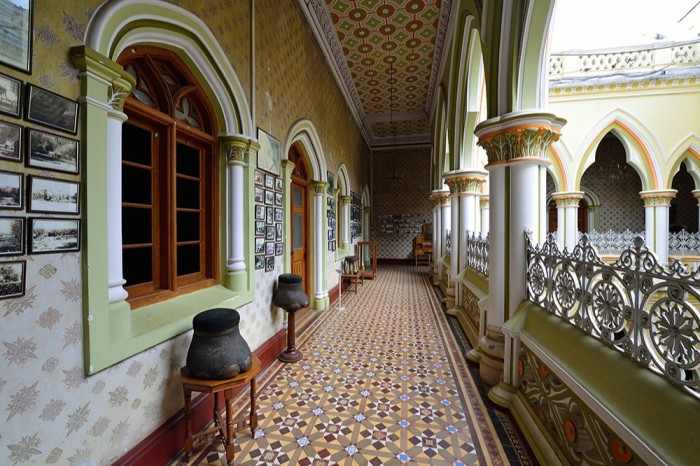
Meanwhile, she continued what Ludgrove called a “very adventurous path of restoring and renovating” the royal properties. Bangalore Palace has steadily opened more rooms to the public and now offers audio tours in multiple languages. “She’s single-handedly done all this with the government trying to grab both the palaces,” Ludgrove said.
Late last year, India’s Supreme Court ruled that Karnataka’s government was in contempt for failing to pay compensation for the road-widening across palace land. Yet, a month later, the state prepared legislation for a renewed takeover. Karnataka’s chief minister, Siddaramaiah, who goes by one name, insisted, “This decision is not based on hostility; it is being taken in the interest of the people.” Karnataka’s law ministry and minister Patil did not respond to requests for comment.
A day before Dasara, I was summoned to Mysore Palace. The city in late September was draped in fairy lights ahead of the 10-day Hindu festival. A private entrance to the residence avoided the crowds of tourists wandering the grounds and gazing at a number of ceremonial elephants.
A palace has stood in Mysore since the 14th century, though the current incarnation was designed and completed in 1912 by British architect Henry Irwin. Despite the grandeur of its pink marble domes and sweeping arches, one person warned me the private quarters were “in very bad shape”. Inside, the carpets were worn and the walls festooned with old weaponry, art and portraits. Piled in one corner was a cricket bat, a pram and scattered toys used by the maharaja’s two children. Upstairs I was greeted by the current maharaja, Yaduveer Wadiyar, dressed in the standard Indian politician’s uniform of a white kurta and trousers, with the addition of a pair of large diamond-stud earrings.
Yaduveer was preparing for the imminent austerity and seclusion of Dasara, barred from consuming stimulants or anything else that could alter his mental state. “Caffeine withdrawal is very real,” he said. His days were to be filled with rituals and worship, culminating in a spectacular parade of pachyderms and pageantry. “Today, we have the goodwill of people,” he explained. “It’s because of the good work and upholding that tradition . . . we understand that our time in terms of rule is over, and now within the framework of democracy we have to move forward.”
A decade into his symbolic reign, Yaduveer has secured the royal line with his marriage to a Rajasthani princess and the birth of two sons, breaking the Wadiyar “curse”. From the day of his crowning, speculation swirled over whether he would enter politics. “I had no interest,” he admitted. “But obviously your opinions change.” Now, as a BJP parliamentarian, he sees his role as helping to deliver the government’s economic development plans in south India. “The sentiments of India have changed and this is my personal venture, my career, my outlook.”
Surveying the booked-lined room with a large circle of spears mounted on one wall, he acknowledges that “it looks rather grand . . . we are in a literal palace . . . there are obviously expenses which have to be taken care of”. His adopted mother manages a portfolio of properties and investments, with Yaduveer sharing directorship. According to the latest accounts for the financial year ending March 2024, they generated about $1.3mn of revenue and roughly $590,000 in profit. The maharaja’s election disclosure last year listed assets worth about $1mn. Pramoda Devi declined to comment on the family’s wealth.
India Business Briefing
The Indian professional’s must-read on business and policy in the world’s fastest-growing big economy. Sign up for the newsletter here
Despite their earnings, Yaduveer said they had to remain “very vigilant” due to their ongoing legal expenses and fight with the state. The family’s right to property remains protected by India’s constitution and Karnataka’s government had, he claimed, “misused, in my opinion, the legislature”. The disputes, he said, were a drain on India’s taxpayers. Chandra said the fractious family remains united against their “common enemy” and expects further rulings within months.
During Dasara, however, the king, who now spends much of his time in New Delhi as a parliamentarian, would remain in Mysore, withdrawing into the theatre of palace ritual recalling centuries of pomp and power. As the historian Sampath put it: “They are allowed to live in a make-believe world for 10 days.”
Chris Kay is the FT’s Mumbai bureau chief
Find out about our latest stories first — follow FT Weekend Magazine on X and FT Weekend on Instagram