Stay informed with free updates
Simply sign up to the Life & Arts myFT Digest — delivered directly to your inbox.
Harasumento Daizen sells itself as a complete compendium of school, home and workplace misery. Jaunty in presentation, but serious in tone, it is an almanac of affliction. A Baedeker of beastliness. It is also missing an entry.
The title translates roughly as The Encyclopedia of Harassment and, with the help of catchy wordplay, real-world examples and manga illustrations of the problem, is forensic in its analysis.
The book is Japanese, but, with some exceptions, its observations could have been made anywhere. It explores 68 distinct ways in which people, sometimes unconsciously, make other people’s lives worse, unhappier and less dignified under the general umbrella of “harassment”.
The bar for infraction, in some instances, seems quite low. Is slurping noodles too noisily (nuhara) really a form of workplace microaggression? How far is too far when insisting that colleagues sing at karaoke (kahara)? Have you commented too intrusively on a colleague’s home in the background of a Zoom call (rimohara)? Few readers will reach the end of Harasumento Daizen without concluding they have committed at least one of its wrongs, probably within the last 24 hours.
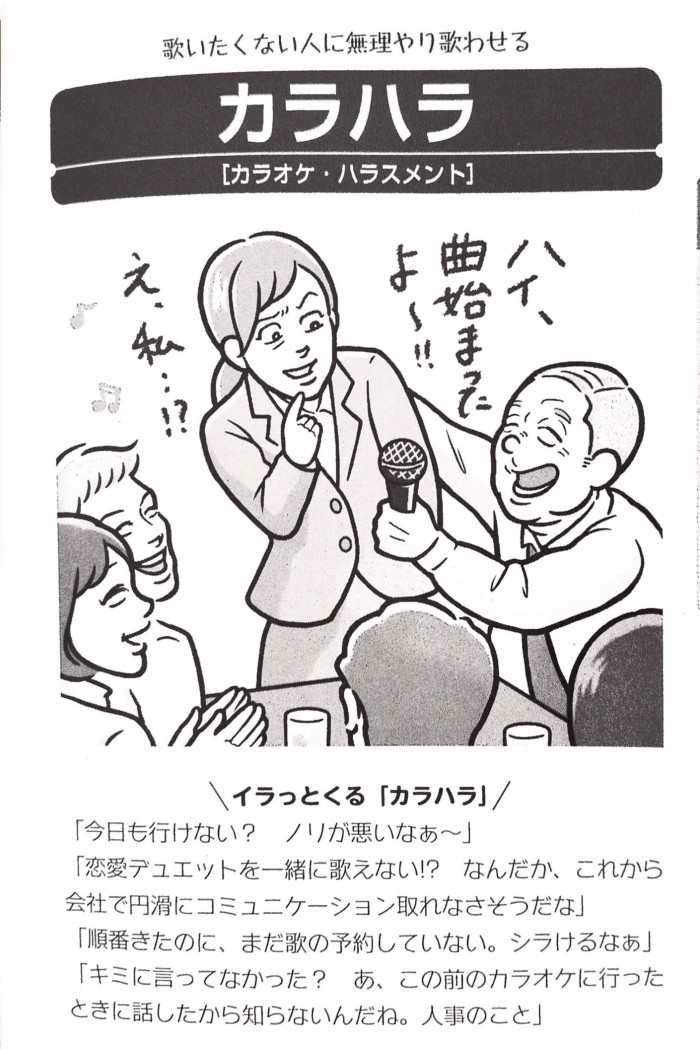
The listings of top-tier harassment types — sexual, racial, power, and the cajoling of people to overwork — need no introduction or much debate. These are, if properly addressed, sackable or even criminal offences whose prevalence does not say much more about Japan than they do anywhere else.
Up there, but tellingly new to Japan as a recognised scourge, is kasuhara customer harassment — the sort of vein-popping, self-righteous hectoring of shop, public transport, restaurant and other staff that used to be rare but which, anecdotally, has been sharply on the rise as inflation has returned and labour shortages diminish customer service.
One section, which catalogues dismal behaviour meted-out on younger women and men, usually by older colleagues, reveals much about how chronically low birth and marriage rates have evolved into modes of harassment.
Rabuhara is the persistent interrogation of how a colleague’s love life is going; shinhara cross examines singletons on why they are not married; konashihara is harassing a recently married woman to produce a child; beibihara is firing dirty looks at parents whose babies are crying in public; futahara is pressing the mother of a single child to have a second; cherihara is the harassment of young men to hurry up and lose their virginity.
Many of the other types identified in the book point to an important downward shift in tolerance levels — a gradually more confident refusal to grin and bear bad behaviour, which gains strength the more that behaviour is formally labelled as harassment.
Some will read the list and decide that the fact there is a word suihara (the deliberately uneven distribution of cake and sweets in an office context) or kimehara (remonstrating with someone for not being fully au fait with a popular TV show) simply proves that everyone is becoming absurdly sensitive. Others will feel that their all-too-real pain has finally been seen. Many will wonder how Japan has managed to present itself so successfully as a land of harmony and good manners with this boiling, festering undercurrent of nastiness reaching into so many lives.
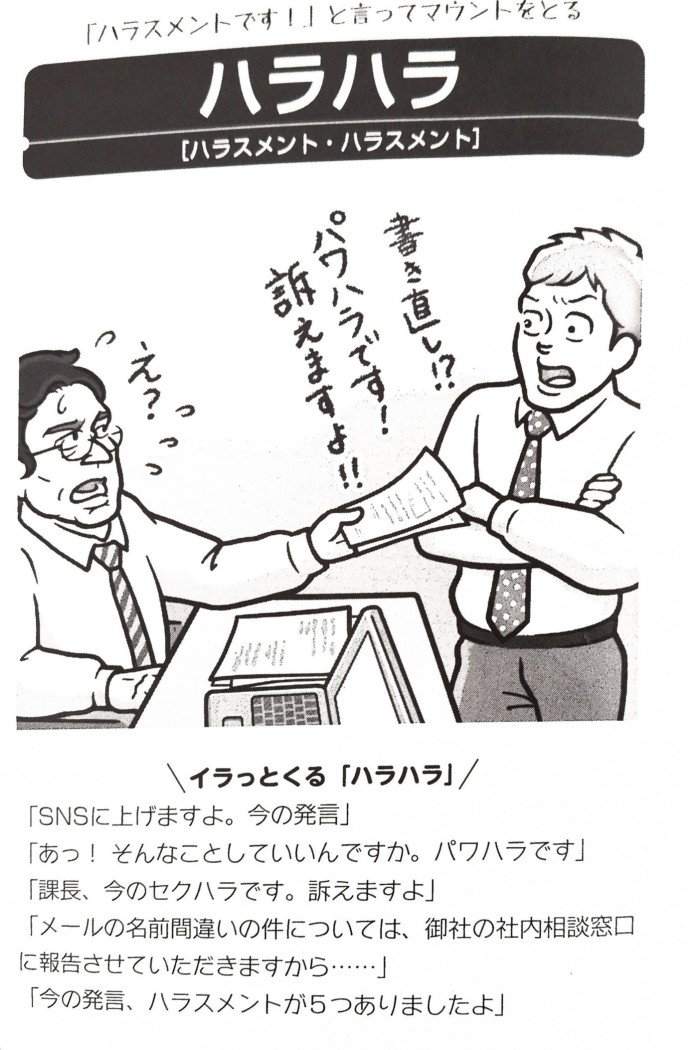
Gloriously, harahara, which makes its appearance towards the end of the book, is the phenomenon whereby a manager is harassed by their staff with excessive and endless claims of harassment.
But for all the encyclopedia’s thoroughness, timeliness and conceptual modernity, says a friend working in one of Japan’s biggest government ministries, it is incomplete. Arguably, he says, it is missing the most modern and pernicious harassment of the lot: nostalgia-harassment, or the repetitive, weakly evidenced insistence by the older echelons of a workforce or institution that everything was better in the past.
Obviously the insistence itself is all too familiar. Entire political movements have been built around just that assertion. But my friend’s observation, based on what he hears around the civil service and from across the private sector, is that nostalgia has been weaponised to the point where its use should properly be seen as a form of harassment. It is especially potent in a country with one of the world’s highest labour participation rates by the over 65s — the generation for whom nostalgia has never been better.
Nostalgia harassment takes two forms. One cites the past where Japan was straightforwardly in much better nick than it is now. When expense accounts were fatter, the sense of financial and social reward was greater and the global heft of the country itself was that much more tangible. The other recourse to nostalgia cites a time when, rather than whining about long hours and demanding to leave work at 5pm, workers were more robust, toiled harder, complained less and definitely didn’t fuss about whether they were being harassed.
It is an important omission from an otherwise sharply revealing book. Nostalgia harassment is a danger everywhere, and to be resisted wherever possible.
Find out about our latest stories first — follow FT Weekend on Instagram, Bluesky and X, and sign up to receive the FT Weekend newsletter every Saturday morning