Roula Khalaf, Editor of the FT, selects her favourite stories in this weekly newsletter.
Prime Minister Narendra Modi has hailed a new airport developed by Gautam Adani on the fringes of Mumbai, in the latest sign of the Indian tycoon’s domestic rehabilitation after fraud allegations.
Set to the east of the heaving financial capital in Navi Mumbai, or New Mumbai, the airport cost more than $2bn to build and is 74 per cent owned by the Adani Group. It is due to begin commercial operations in December.
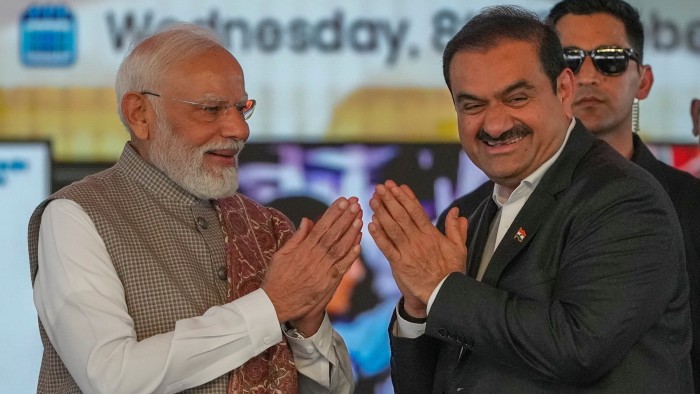
Speaking at the official inauguration of the airport, designed to eventually serve 90mn passengers a year, Modi said the project was an example of “Viksit Bharat [developed India],” referring to India’s aspiration to attain developed-nation status by 2047.
“It will boost trade with other countries and enhance access to the global market,” he said as Adani sat nearby.
<div data-o-component="o-expander" class="o-expander o-expander__info-box" data-o-expander-shrink-to="hidden" data-trackable="clip-info-box" data-o-expander-collapsed-toggle-text="Show video info” data-o-expander-expanded-toggle-text=”Hide video info“>
Shaped like a lotus, India’s national flower and the emblem of Modi’s Bharatiya Janata party, the project was first envisioned in 1997 and is expected to grow into a four-terminal hub.
Adani Group, which also operates extensive port and power networks across India, took charge of the facility’s development four years ago after launching an aggressive expansion into airports in 2019.
The inauguration comes weeks after India’s markets regulator cleared the group of a number of fraud allegations stemming from a 2023 report published by the now-defunct short seller Hindenburg Research. The conglomerate hailed the rulings as a “resounding victory”.
Hindenburg’s report became a focal point of attack by India’s opposition parties, which criticised Modi over his long relationship with the infrastructure magnate. The two Gujaratis were seen to have risen in parallel, with Adani’s corporate empire expanding alongside Modi’s ascent as leader of their home state and then the nation.
<div data-o-component="o-expander" class="o-expander o-expander__info-box" data-o-expander-shrink-to="hidden" data-trackable="clip-info-box" data-o-expander-collapsed-toggle-text="Show video info” data-o-expander-expanded-toggle-text=”Hide video info“>
Modi was seen to have briefly distanced himself from India’s second-wealthiest man but has since last year attended investment summits at the same time as Adani and inaugurated one of his new ports.
The tycoon still faces US Department of Justice and Securities and Exchange Commission charges brought late last year related to an alleged solar energy bribery scheme in India. The billionaire and his group have consistently denied any wrongdoing or receiving favouritism from New Delhi.
The new airport is meant to ease chronic congestion at Mumbai’s existing Chhatrapati Shivaji Maharaj International Airport — also operated by Adani Group — which sits in the heart of the city and is nestled alongside crowded slums. The older airport has struggled with delays and limited expansion room as Mumbai’s population has grown to more than 20mn.
The visit by Modi marks a high-profile week for India’s financial hub with the prime minister on Thursday due to address a three-day fintech summit — expected to draw more than 100,000 people — with British counterpart Sir Keir Starmer.
Illustrative of Mumbai’s infrastructural challenges and inability to cater to major VIP tours and conferences, police have warned residents the event will lead to major traffic snarl-ups. Commuters griped on social media about heavier than usual jams.
India’s government has attempted to address Mumbai’s infrastructure challenges, recently opening a coastal road that has cut journey times, though a surge in construction has resulted in heightened air pollution.
Modi also presided over the launch of a southern extension of an underground “Aqua Line” metro line connecting Mumbai’s main financial districts and densely populated northern suburbs.
The operational portion has already faced complaints after some stations flooded during heavy rain, while the wider metro network has registered low ridership and faced criticism for poor planning and limited connectivity.