A trade deal signed by UK Prime Minister Sir Keir Starmer and his Indian counterpart Narendra Modi in July signals the removal of tariffs on gemstones and jewellery imported into the UK from India. The category, which includes natural or cultured pearls, precious or semi-precious stones, precious metals and imitation jewellery, currently attracts duties of up to 4 per cent.
Kirit Bhansali, chair of the Gem and Jewellery Export Promotion Council (GJEPC), a trade body sponsored by India’s ministry of commerce and industry, says the agreement will be a “game changer” for both countries. He predicts the value of India’s gem and jewellery exports to the UK will grow, “without fail”, from $941mn to at least $2.5bn over the next three years. However, there are “mixed feelings” about the deal in the UK industry, according to Ben Massey, chief executive at the National Association of Jewellers (NAJ). So what opportunities are there for jewellers on the back of the agreement?
The signing came just over a month before the US introduced tariffs of 50 per cent on goods from India, including a 25 per cent penalty for trade with Russia. These taxes have left India’s gem and jewellery industry “in trauma”, says Bhansali. The US is India’s top market for gems and jewellery, holding a 30 per cent share of total exports in the financial year 2023-24. Exporters took precautions by sending sufficient stock for September, October and November before the increased tariffs kicked in but “are worried [for] after November”, says Bhansali. There is a need to “explore new markets” — and sights are set on the UK. He says members of his team will travel regularly from India.
The UK represented a 1.86 per cent share of India’s gem and jewellery exports in 2023-24, according to a GJEPC report, with the top commodities being gold jewellery, polished diamonds and silver jewellery.
“Now, in today’s India, with [the] latest equipment, we are competing with China and Italy,” says Bhansali. “Our craftsmen are making world-class jewellery. There is [a] good market in [the] UK for world-class jewellery.” He suggests the removal of duties will mean potential buyers among the 1.9mn people of Indian ethnicity living in England and Wales will no longer fly to India to shop for jewellery, but will purchase in the UK.
Last month, Indian actor Kareena Kapoor Khan launched Malabar Gold & Diamonds’ new showroom in Birmingham, one of the large Indian jeweller’s four UK stores. Kalyan Jewellers will open in Leicester this year, the first of three planned UK stores; Birmingham and Green Street, east London, will follow. Bhansali says more Indian retailers are interested in exploring the UK market following the trade agreement, which requires UK parliamentary scrutiny before it can come into effect.
But high jewellery designer Bina Goenka, who is relaunching her eponymous brand’s Mumbai store this month, says more clarity on the benefits for Indian jewellers is needed. She does not think the deal caters for “niche independent jewellers” like herself; her business is predominantly bespoke pieces.
There are benefits for UK jewellers who manufacture in India. Akansha Sethi — who is relaunching her London-based brand this month with a demi-fine collection, Guldasta, inspired by her passion for flower arranging — makes her pieces in Jaipur and pays import tariffs of 2-4 per cent. “For a small business, it’s a big difference,” she says of the removal of duties, adding that it will make it easier for her to bring in samples.
Sethi, who has received many email approaches from Indian gemstone dealers and manufacturers following the signing of the deal, will pass on any savings to customers because the jewellery market is already competitive and she thinks the trade agreement will “create an influx of Indian brands in[to] the UK”.
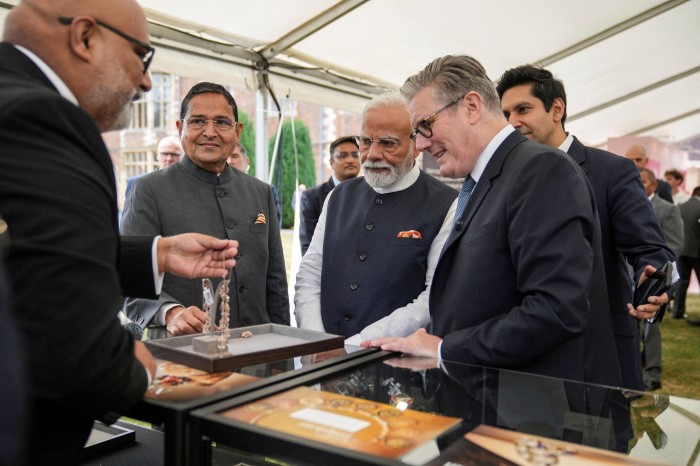
PureJewels, founded by Indian goldsmith Bhanji Gokaldas Raniga in Nairobi before he emigrated to the UK in 1975, crafts some designs in its workshop in London’s Green Street but uses Indian factories for volume production. The family business’s customers are predominantly of the UK’s south Asian diaspora and the brand specialises in 22-carat gold, which chief executive Jayant Raniga says is embedded in that culture, with jewellery historically used as a portable store of wealth.
It is a growing segment: hallmarking figures show the number of 22-carat gold items marked by the UK’s four assay offices between January and July rose 9.7 per cent on the same period last year to 314,242. If the growth continues, it could overtake 18-carat as the country’s second most hallmarked gold standard, behind nine-carat. Raniga thinks the high purity and investment value are driving interest.
He says the competitive market for 22-carat gold jewellery, sold by the weight, operates on tight margins. “If jewellery is sold by the weight, then the customer is a lot savvier [about gold prices and the cost of manufacturing] and a lot more in tune with how things are priced,” he says. Any financial benefit from the removal of tariffs will, therefore, probably be passed straight on to the customer.
Raniga says the trade deal brings opportunities for knowledge-sharing, a “two-way dialogue” and collaboration between British designers and Indian manufacturers or retailers on pieces for the Indian market. (India will continue to apply most-favoured-nation tariffs on imported finished jewellery from the UK.) Raniga says India’s high-end consumers “truly understand” British luxury, and he suggests the agreement presents the chance to have memoranda of understanding between the NAJ and GJEPC that could help collaborations to succeed.
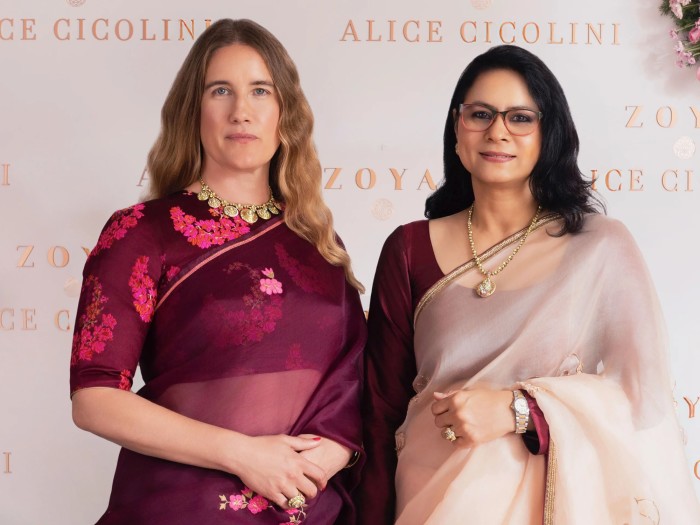
British jewellery designer Alice Cicolini, who has worked with Indian craftspeople for many years, collaborated with Indian luxury jewellery brand Zoya on a limited-edition capsule released in July. The collection, comprising 19 pieces made from 18-carat gold, enamel and uncut diamonds, was Zoya’s first international creative partnership. Designs included reimagined jhumkis (bell-shaped earrings).
“If western designers want to work in India and be taken seriously in the Indian jewellery market, they have to find a way to really deeply engage with and understand what that market looks like, because it is different,” says Cicolini. “It’s not like you can just import what you do and put it in an Indian jewellery store yet.”
The GJEPC organised a buyer-seller meet in London in July and will invite UK buyers to the India International Jewellery Show (IIJS Signature) in Mumbai in January. The NAJ’s Massey says the trade deal brings opportunities for UK retailers to source from India, meaning greater choice for consumers, but that there is also a need to be aware of the “really positive response” to UK-made products.
He adds that, particularly on the back of the recent recognition of Birmingham as a World Craft City for jewellery and allied trades, there has been a collective “doubling down” on celebrating British manufacturing.
Massey expects to see “more of a prioritisation of the [UK-made] value product” and thinks hallmarking can play a crucial role in providing transparency on provenance for consumers. “I think it’s important we call for ‘British made’ marks on pieces, whether that’s the return of import marks on product or an alternative,” he says.
The distinction through hallmarking between jewellery manufactured in the UK and imported pieces ended with a change in legislation in 1998. The NAJ’s created in the UK scheme allows members to feature a special mark on jewellery made in the UK.
The deal could open up another avenue with hallmarking. Birmingham Assay Office operated in Mumbai between 2016 and 2021, marking Indian manufactured goods prior to their import into the UK. Chief executive and assay master Doug Henry says an Indian sub-office is something the organisation might look at again in the future.
“I would never say never again as far as India is concerned,” he says. “The market’s too big. It’s finding the right opportunity.”