Stay informed with free updates
Simply sign up to the US-China relations myFT Digest — delivered directly to your inbox.
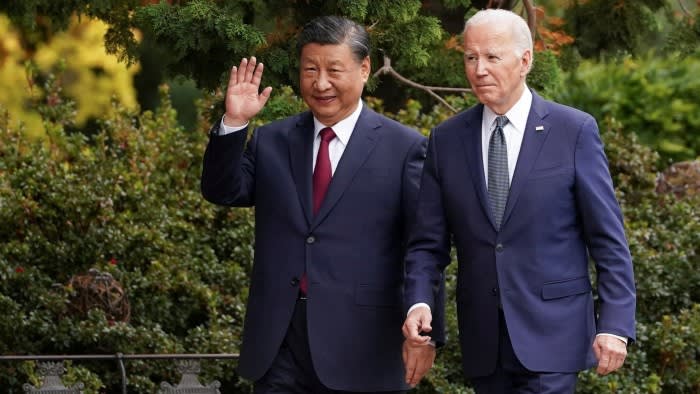
US President Joe Biden and Chinese President Xi Jinping held a phone call on Tuesday, the first engagement between the leaders since their November summit in San Francisco aimed at stabilising turbulent US-China relations.
The two leaders last spoke on the phone in July 2022. US national security adviser Jake Sullivan and secretary of state Antony Blinken have held separate meetings with Wang Yi, the top Chinese diplomat, in recent months to pave the way for the presidential-level call, which took place Tuesday morning Washington time, according to the White House.’
The White House said after the call that Biden had stressed the importance of peace and stability in the Taiwan Strait and the rule of law and freedom of navigation in the South China Sea. He also raised concern about Chinese support for Russia’s defence industrial base and its “impact on European and transatlantic security”.
Biden also voiced concern ahead of Treasury secretary Janet Yellen’s visit to China this week over what the US sees as Chinese unfair trade practices.
Ahead of the call, a senior US official said Biden was not expecting it to lead to any big announcements, and that it was partly to check on the progress that had been made on agreements reached in San Francisco in November. She said the two leaders were also following through on a commitment to “maintain regular open lines of communication to responsibly manage competition and prevent unintended conflict” between the two powers.
US-China relations last year deteriorated to their lowest level since the two countries established diplomatic ties in 1979. There have been signs of stabilisation since the San Francisco meeting, but US and Chinese officials say the fundamental differences between both sides remain unchanged — despite easing tensions.
Later this week, US and Chinese military officers will meet in Honolulu, resurrecting a once-regular channel of communication that China halted after then US House Speaker Nancy Pelosi angered Beijing by visiting Taiwan in 2022.
The US official said the White House expected that defence secretary Lloyd Austin would hold his first interaction with Dong Jun, the new Chinese defence minister, in the coming months. Foreign policy experts are watching to see if both defence ministers will attend the Shangri-La Dialogue defence forum in Singapore at the end of May.
The two leaders were expected to discuss the situation around the Second Thomas Shoal — a submerged reef in the Spratly Islands — in the South China Sea, where the US has accused China of engaging in aggressive behaviour against vessels from the Philippines. The US official said the Biden administration was “increasingly concerned” that Chinese activity, including firing water cannons at the vessels, “could lead us closer to unintended consequences”.
The US official said the two sides were also working on areas of co-operation, and that they hoped to launch “in the coming weeks” a bilateral dialogue on artificial intelligence as agreed at the summit in San Francisco. The US has welcomed some initial moves by China to crack down on the export of chemicals that can be used to illegally manufacture fentanyl, a synthetic opioid that has sparked a deadly drug epidemic in the US.
While the US is keen to keep relations from becoming more turbulent — particularly in an election year — China has been seeking to paint a picture of improving relations with Washington.
Chinese state media services claim the two leaders agreed on what China calls the “San Francisco consensus” — which Xinhua, the state news agency, has defined as “properly resolving issues on the basis of mutual respect, managing differences and mutually beneficial co-operation”. US officials insist that their overall approach towards China has not changed.
Beijing has also emphasised “people-to-people” relations — a favoured method by the Communist party, involving opening different tracks of communication alongside official government-to-government contacts.
Last week, Xi met a group of 18 US business leaders and told them that US-China tensions stemmed from “incorrect perceptions” in Washington about Beijing’s intentions, according to Xinhua.
Alongside these gestures, Beijing has maintained its hardline rhetoric against the US, warning that its actions are causing tensions in the South China Sea and claiming that the US is a hegemon.
Last week, the Ministry of State Security, China’s spy agency, reiterated its view that foreign consultancies often act on behalf of overseas intelligence services. Raids by the MSS on foreign consultancies have sent a chill through international investors in China.