“Eliminating all designated Chinese [technology and services] from every US network would be prohibitively expensive, if not impossible,” Corrigan testified.

02:42
Canada bans Huawei and ZTE 5G equipment, orders removal by 2024
Canada bans Huawei and ZTE 5G equipment, orders removal by 2024
Washington has already rid the country of telecoms infrastructure made by China’s Huawei Technologies and ZTE, alleging that those systems might contain spyware to transfer personal US data to Beijing.
Should the programme expand to cover Chinese hardware providers beyond Huawei and ZTE, that funding gap will only grow, Corrigan said.
“As such, it is crucial that policymakers target procurement bans and ‘rip and replace’ funding at the sectors, networks and use cases where breaches present the greatest risks to national security,” he said.
US instructs carriers on programme to remove Huawei and ZTE equipment
US instructs carriers on programme to remove Huawei and ZTE equipment
Nazak Nikakhtar, a former Commerce Department official during the Donald Trump administration, contended that the US was “stalling rather than dotting the i’s crossing the t’s” when it came to an outright ban on Chinese hardware and software.
She cited the case of TikTok, the Chinese short-video platform, and its owner ByteDance. “Everybody’s really keen on yelling about TikTok. But we don’t even use the litigation-proof legal authority that we have to put ByteDance on the entity list, which will then atrophy the app over time,” Nikakhtar argued.
She said that the only way to mitigate the economic costs would be to designate entire sectors that could not use Chinese components, and “phase it in over time so the economy adjusts”.
“The legal authorities exist, that capability exists, but across the board from industry to government, the will does not exist,” she said.

Another witness, Ivan Tsarynny, chief executive of Feroot Security, a data protection intelligence software company, said that TikTok collects a huge amount of US-based user data with tracking pixel – code websites use to track digital ad campaigns.
Tsarynny noted that TikTok is governed by China’s cybersecurity law, which requires all Chinese companies to share data with China’s authorities, which are under Communist Party control. Thus he said, “data collected by TikTok, and other companies from China, can be shared with the actors in China”.
During his congressional testimony last March, TikTok’s chief executive Shou Zi Chew said that the US data gathered on the platform “has always been stored in Virginia and Singapore”.
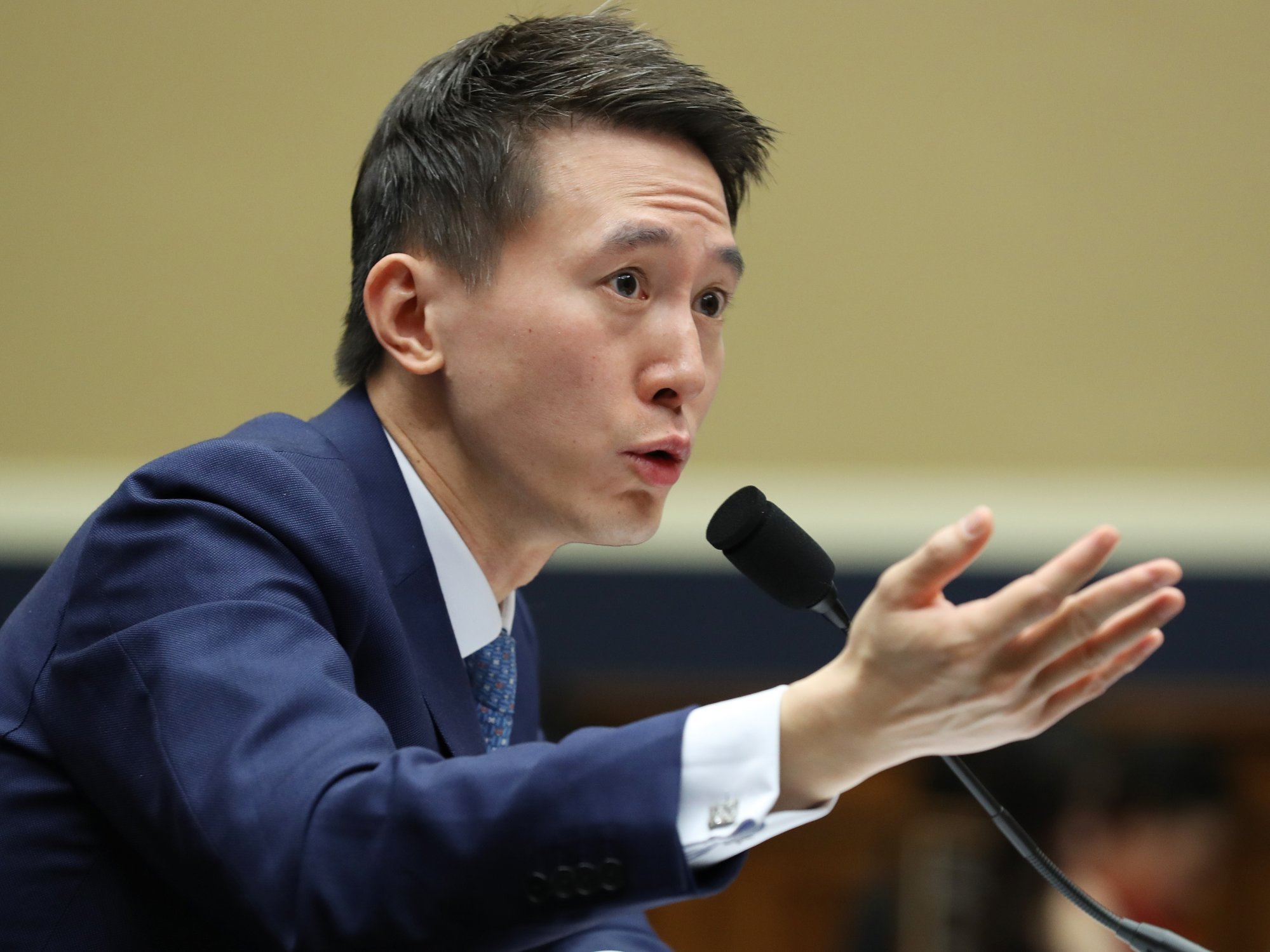
But weeks later, an investigation by Forbes magazine found that the company had stored the financial information of its US creators on servers in China.
“[It] seems to me like perjury – sounds like perjury, it smells like perjury,” USCC commissioner Jacob Helberg said during the hearing on Thursday.
Neither TikTok nor the Chinese embassy in Washington immediately responded to requests for comment.