Unlock the Editor’s Digest for free
Roula Khalaf, Editor of the FT, selects her favourite stories in this weekly newsletter.
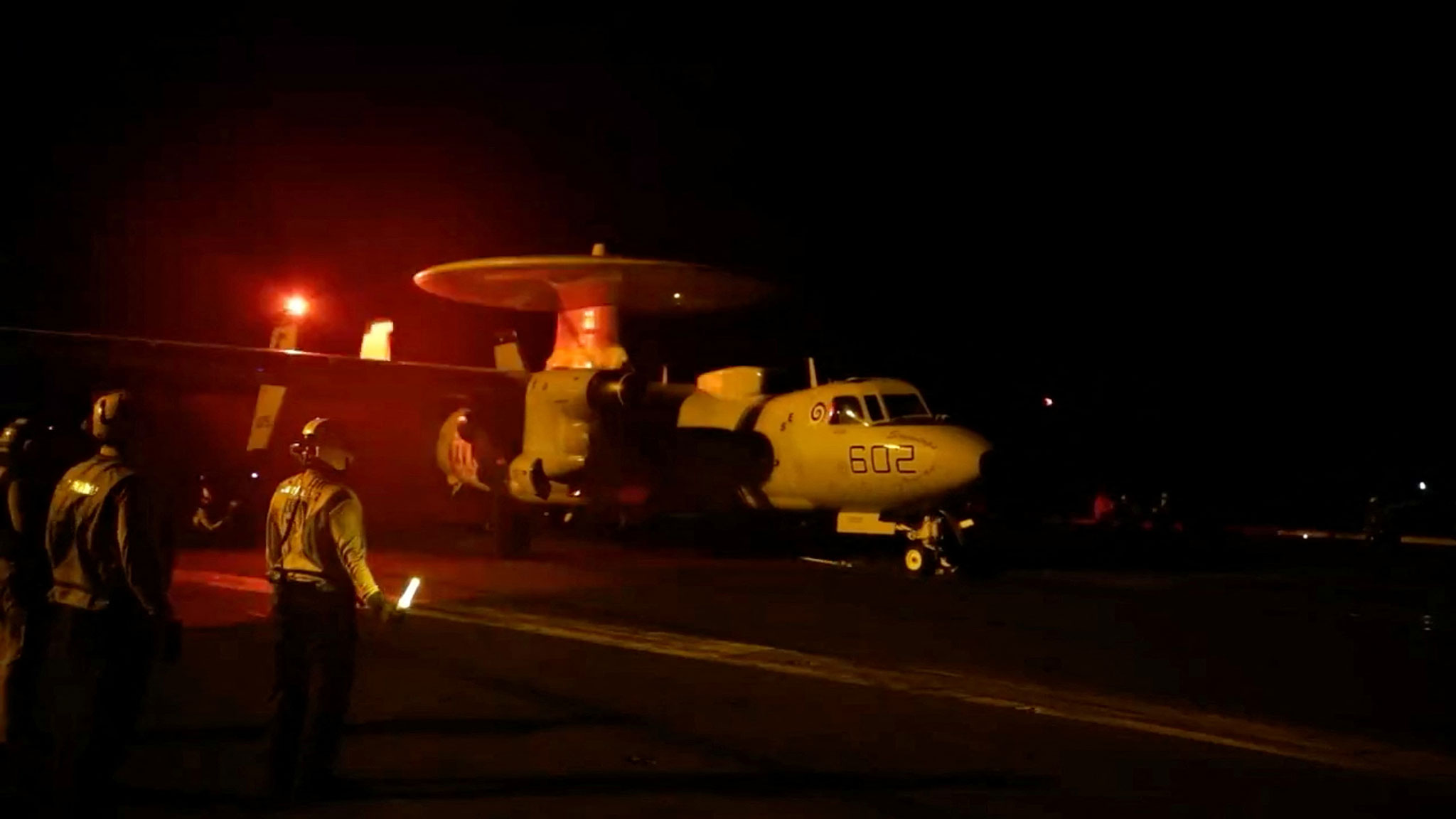
The US and the UK have carried out military strikes against Iran-backed Houthi rebels in Yemen, raising fears of a broader escalation of the conflict in the region.
US President Joe Biden said the strikes were in response to “unprecedented” attacks by the Yemen-based militants on shipping in the Red Sea, adding that they sent “a clear message that the US and our partners will not tolerate” disruption to commercial trade.
UK Prime Minister Rishi Sunak said the Iran-backed Houthi had ignored “repeated warnings” and had “continued to carry out attacks in the Red Sea, including against UK and US warships just this week”.
A US administration official said the strikes, which took place at 2.30am local time, had targeted Houthi missile, radar and drone capabilities. Australia, Bahrain, Canada and the Netherlands supported the operation.
The coalition struck more than 60 targets in 16 locations in Yemen with more than 100 precision-guided munitions, including Tomahawk cruise missiles launched from submarines, said General Alex Grynkewich, a senior Air Force commander overseeing forces in the Middle East, in a statement.
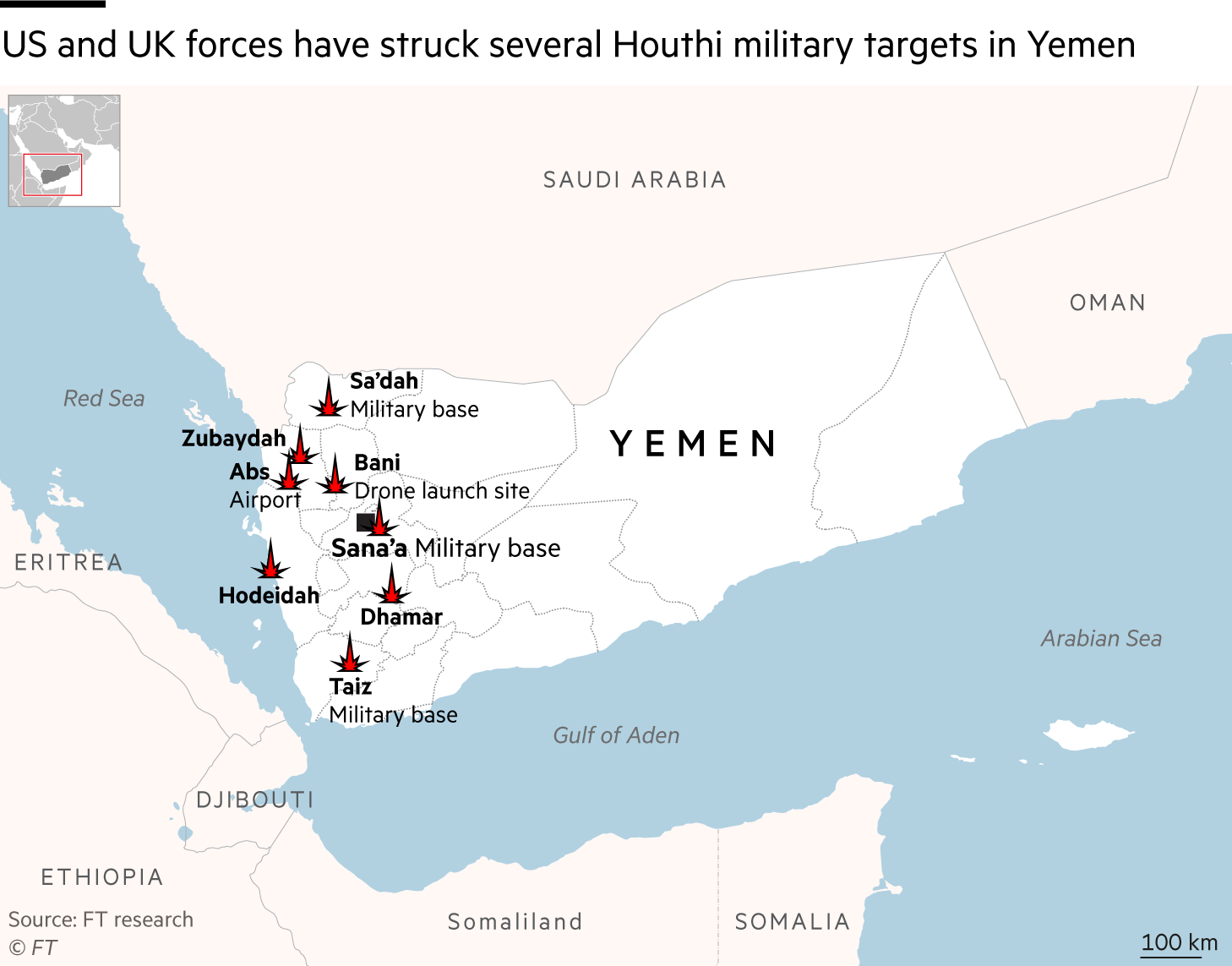
Four British Typhoon jets used guided bombs to hit two Houthi sites, the UK defence ministry said. One site, at Bani in north-western Yemen, was used to launch reconnaissance and attack drones, the other was the Abbs airfield that the MoD said had “been used to launch both cruise missiles and drones over the Red Sea”.
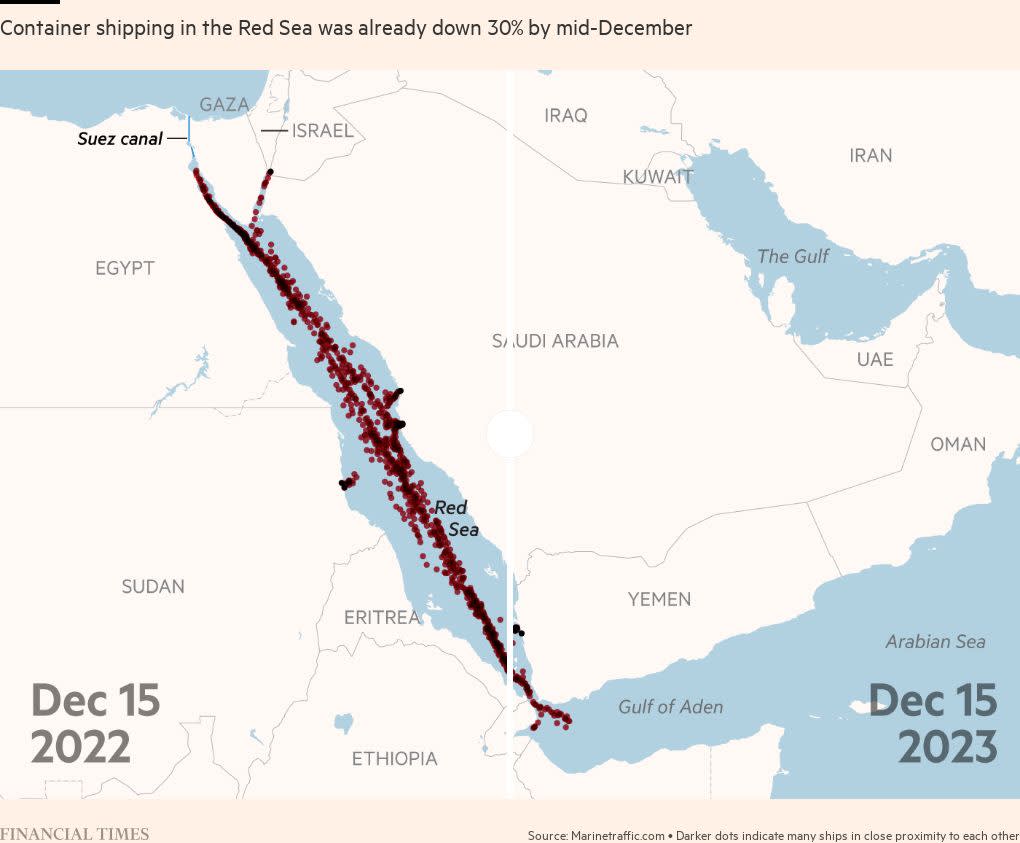
The Houthis, who control northern Yemen, have become one of the most active factions in Tehran’s so-called Axis of Resistance since the war between Israel and Hamas erupted on October 7. The group has carried over more than two dozen attacks in the critical maritime trade route and drawn the US Navy into combat.
The Islamist group said on Friday that the US and UK bombing raids had killed five of their fighters and wounded six others. The attacks triggered huge pro-Palestinian rallies in Yemen’s capital city Sana’a, according to footage shown by Houthi channel Al Masirah TV, with protesters carrying Yemeni and Palestinian flags.
The Yemeni rebels have insisted that they are targeting Israeli-owned vessels in support of the Palestinians in Gaza and vowed not to back down despite the western air strikes.
“This cruel aggression will not dissuade Yemen from its position of support” for the people of Palestine, the Houthis said in a statement on Friday, adding that they would continue to “prevent” Israeli ships or vessels bound for Israel from sailing freely in the Red Sea.
The International Association of Independent Tanker Owners, which represents almost 70 per cent of all internationally traded oil, gas and chemical tankers, on Friday advised members to “stay well away” from the Bab al-Mandab strait and for vessels travelling south via the Suez Canal to pause north of Yemen.
While the vast majority of container ships have been avoiding the Red Sea, the drop in the number of oil tankers transiting the route had been far smaller before Friday. “The threat period for shipping is expected to last for several days,” Intertanko said.
Oil prices extended gains on the news, rising more than 4 per cent on the day to above $80 a barrel, the highest price this month.
Although Biden has tried to prevent the Israel-Hamas war from turning into a regional conflict, the continuing attacks by Houthi militia have forced the White House to recalculate.
A senior US official said: “The Houthis claim their attacks on military and civilian vessels are somehow tied to the ongoing conflict in Gaza. That is completely baseless and illegitimate.”
The Biden administration held Iran “responsible for the role they have played with the Houthis and with the other groups in the region that have conducted attacks”, the official said.
Washington has also sent hundreds more troops to the Middle East and struck Iran-backed militias in Iraq and Syria in retaliation for attacks on US bases.
Iran condemned the strikes as “a blatant violation of Yemen’s sovereignty and territorial integrity and a breach of international laws and regulations”. A foreign ministry spokesman said the US and UK were seeking to “divert global attention from the crimes” of Israel and “expanding their supportive umbrella” for the Jewish state.
The strikes came a day after Iranian forces seized an oil tanker off the Oman coast, and Houthi forces fired a missile into international shipping lanes in the Gulf of Aden. US Central Command said this was the 27th attack by the Houthis on international shipping in the past two months.
Clarksons, a shipping brokerage, calculated that container traffic in the Red Sea has dropped about 91 per cent but oil tanker journeys have only declined by about a quarter. Nearly 15 per cent of global sea trade passes through the Red Sea.
Saudi Arabia, which led an Arab coalition that intervened in Yemen’s civil war in 2015 to fight the Houthis, called for “restraint” and to avoid an escalation. A fragile truce has been in place since 2022 and the kingdom has been holding peace talks with the rebels in an effort to exit the war.
During the war in Yemen, the Houthis fired hundreds of rockets and drones into Saudi Arabia, targeting airports, oil facilities and other infrastructure. The rebels also launched missile and drone attacks against the United Arab Emirates, the main partner in the Saudi-led coalition, two years ago.
Yemeni analysts have warned that strikes against the Houthis are unlikely to deter the rebels, an Islamist movement that endured through years of war against the Saudi-led coalition.
In a video posted on X, Houthi leader Abdul-Malik Badr al-Din al-Houthi said: “The response to any American attack will not only be at the level of the operation that was recently carried out with more than 24 drones and several missiles, but it will be greater than that.”
Additional reporting by Andrew England and Najmeh Bozorgmehr in Dubai