Chinese researchers say they have created natural, low-carbon building materials from grains including sand and brick rubble – and they were inspired by the underwater structures built by sandcastle worms.
The marine creatures, which are about 5cm (2 inches) long and found along the Californian coast, make their honeycomb-like colonies by cementing grains of sand together.
Based on this idea, scientists from the Chinese Academy of Sciences’ Technical Institute of Physics and Chemistry in Beijing say they have developed an alternative to conventional building materials.
These Greater Bay Area start-ups are making decarbonisation pay off
These Greater Bay Area start-ups are making decarbonisation pay off
Writing in the peer-reviewed journal Matter on September 20, they said there was an urgent need for low-carbon options due to the “massive energy consumption and carbon emissions” of traditional materials.
Materials used in construction – such as concrete, glass, steel, bricks and aluminium – accounted for an estimated 9 per cent of overall global energy-related carbon dioxide emissions in 2021, according to the UN-hosted Global Alliance for Buildings and Construction.
These emissions are produced when the materials are processed – for example burning fossil fuels to high temperatures during the process of creating cement.
While natural alternatives to cement are more eco-friendly they also tend to have “weak mechanical properties”, according to the researchers.
They looked to sandcastle worms to get around this problem. The worms secrete an adhesive that binds together sand and shell pieces to make their sandcastle colonies.
Although the specific binding mechanism for this process is unclear, the researchers found that the glue the worms secrete has both positively and negatively charged proteins which create a “strong charge attraction”.
The team sought to do the same thing, using oppositely charged bio-polymers to bind different grains and create their building materials – a process that does not require high temperatures or pressure.
01:35
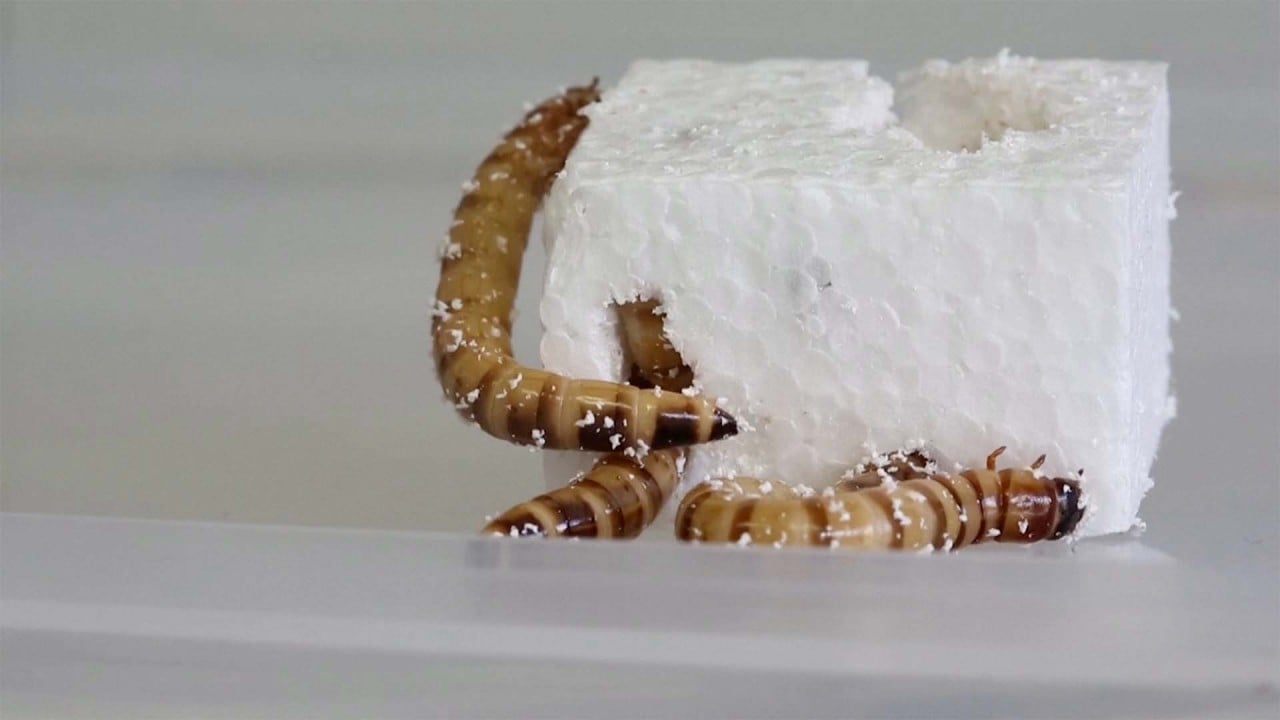
Plastic-eating superworms with ‘recycling plant’ in their guts might get a job gobbling up waste
Plastic-eating superworms with ‘recycling plant’ in their guts might get a job gobbling up waste
Materials used in construction must meet a standard for maintaining their structure under compression. According to the paper, the materials the team developed have a high resistance to breaking at a compressive strength above the construction threshold.
They can also maintain mechanical performance under weathering from the sun, can be waterproofed with paint, and show feasibility for large-scale fabrication, the researchers said.
Sand is in short supply globally because of the high demand for the specific types required to make construction materials.
But the Chinese team said its materials were versatile – they can be made from negatively charged grains such as desert and sea sand, coal cinder, brick rubble, mineral residue and concrete slag.
China can ‘demonstrate ethical decarbonisation’ in construction sector: report
China can ‘demonstrate ethical decarbonisation’ in construction sector: report
The materials also have a “unique recyclability” as they can be remoulded by crushing and hydrating the blocks. Over five processes, the materials kept a similar strength and elasticity to the original, according to the paper.
It said the production time was also significantly shorter than for traditional concrete – it takes just two days rather than the 28 needed for concrete.
According to the Global Alliance for Buildings and Construction, building materials, especially in developing economies, are set to “dominate resource consumption” in the decades ahead, with raw material use expected to double by 2060.
Given this growing demand, the team said its natural alternative provided “a promising route in accelerating the next-generation construction industry with limited energy consumption and carbon emissions”.