Receive free US foreign policy updates
We’ll send you a myFT Daily Digest email rounding up the latest US foreign policy news every morning.
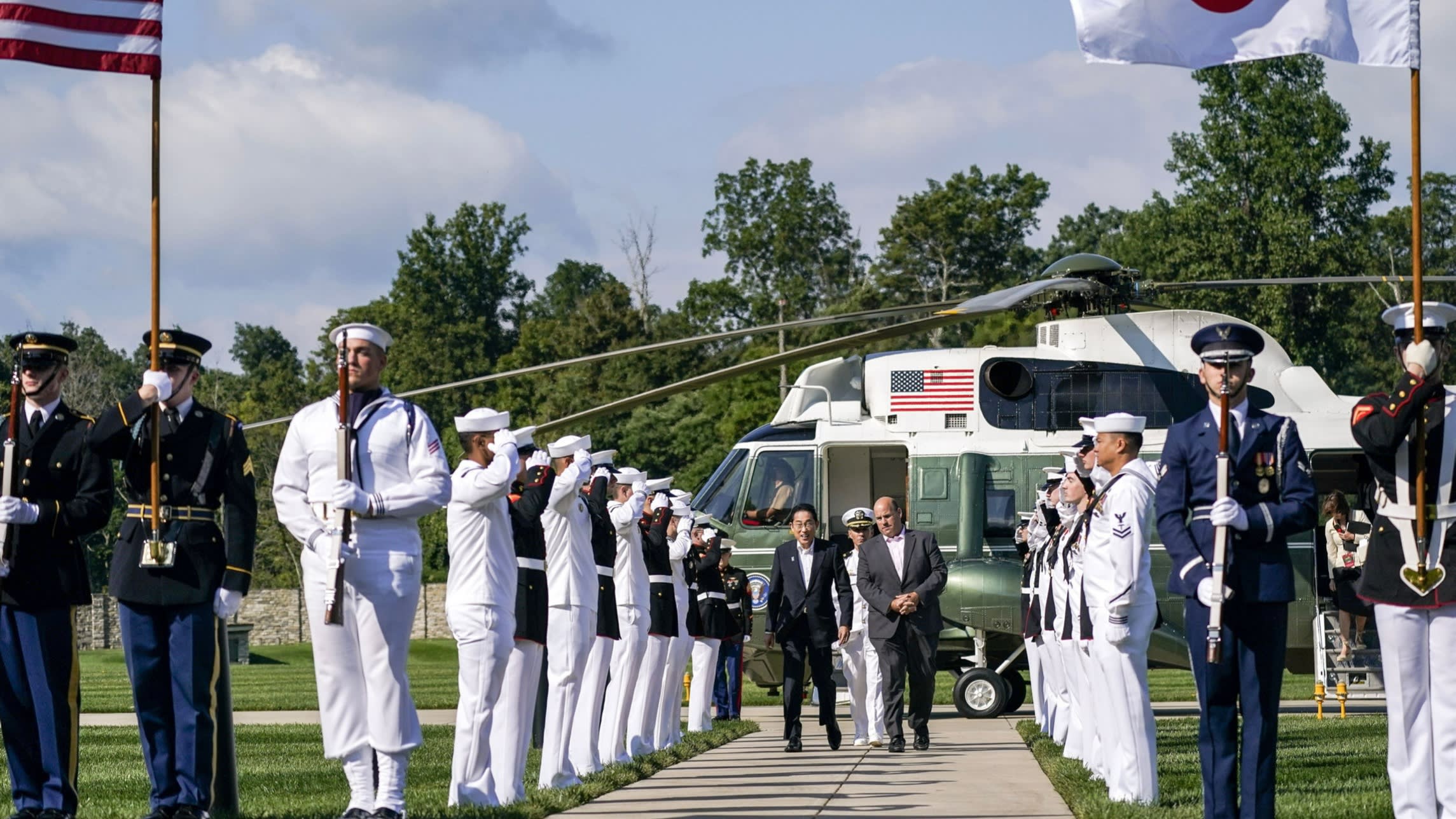
The leaders of Japan and South Korea arrived at Camp David on Friday morning ahead of a summit with President Joe Biden that American officials said would open “a new era” in security ties between the three countries.
Speaking at the presidential retreat, Jake Sullivan, the White House national security adviser, said a new trilateral agreement, due to be signed later on Friday, would have “staying power” — a shift in a region where the two American allies have long had strained relations.
The US has bilateral defence treaties with Tokyo and Seoul, but has for decades struggled to convince the two allies to work more closely on regional security arrangements. US officials believe Friday’s summit — the first time any foreign leader has visited Camp David since 2015 — will mark a turning point in their relations.
The Biden administration has worked for more than a year to persuade Japan and South Korea to move beyond bitter historic tensions over Japan’s wartime behaviour and co-operate more closely in areas including military exercises, cyber security and intelligence sharing.
The decision to attend the summit and sign up to an agreement that binds the historical rivals poses political challenges at home for both South Korean president Yoon Suk Yeol and Japanese prime minister Fumio Kishida. Analysts credit both leaders for taking what is regarded as a bold step that many of their predecessors were unwilling to broach.
The two leaders agreed to the summit amid growing regional concern about China’s rapid military modernisation. Sullivan insisted the new arrangement was not aimed at any one rival but was designed to enhance security in the Indo-Pacific region more broadly.
Still, other US officials have made clear that the move is aimed at boosting deterrence against China and North Korea. Rahm Emanuel, the US ambassador to Japan, this week said the measures would “change the strategic landscape” in the region.
“China’s entire strategy is based on the premise that America and its number one and number two ally in the region can’t get together and get on the same page. That’s fundamentally going to be different,” Emanuel said.
Patricia Kim, an Asia expert at the Brookings Institution, said the “striking progress” on bilateral and trilateral co-operation would not have been possible without the rising threat posed by Beijing and Pyongyang.
Kim said that “a heightened sense of insecurity” around China and North Korea was coupled with “renewed fears” of a disintegrating international security environment triggered by Russia’s invasion of Ukraine. She also credited “incredible political will in all three capitals — particularly in Seoul.”